Lecture 23: Paramagnon fractionalization in the Hubbard model
Overview
Subir Sachdev first shows how antiferromagnetic paramagnon exchange near momentum (π, π) favors a d-wave superconducting gap, then explains why that Fermi-liquid picture cannot account for the cuprate pseudogap. He develops the FL* picture of small, spinful electron-like pockets coexisting with spinons, connects its predicted pocket area to the Yamaji effect, and introduces an ancilla model that fractionalizes the paramagnon into two spins to build a tractable Kondo-lattice theory.
Key takeaways
- Paramagnon exchange peaked near (π, π) favors d-wave pairing because the BCS gap must reverse sign between Fermi-surface regions connected by that momentum.
- The FL* proposal combines a small, spinful Fermi surface with spinon excitations; for four pockets, it predicts area p/8 per pocket rather than the holon-metal value p/4.
- At hole doping p = 0.1, FL* predicts pockets occupying about 1.25% of the Brillouin zone, consistent with the 1.3% estimate associated with Yamaji-effect measurements.
- A holon-only Fermi surface is difficult to observe in photoemission because ARPES removes electron-like composites, not isolated spinless holons.
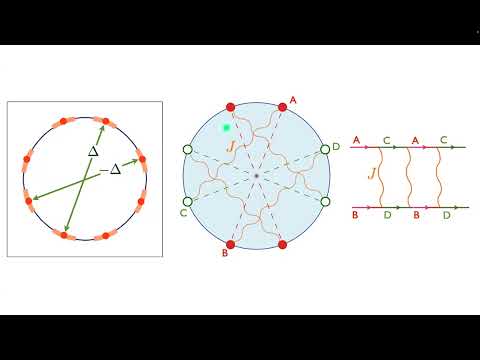
- Truncating the paramagnon's three harmonic oscillators to their singlet and triplet states allows their low-energy spectrum and matrix elements to be represented by two spin-1/2 ancillas.
- The resulting two-layer Kondo-lattice model uses JK/JS as a tuning parameter to study d-wave superconductivity, FL*, and the conventional Fermi liquid in a common framework.
Chapters
- The Hubbard-Stratonovich transformation recasts Hubbard interactions as electrons exchanging a spin-carrying paramagnon.
- The static interaction depends on the Lindhard susceptibility of particle-hole pairs near the Fermi surface; finite-frequency effects add damping.
- The interaction becomes strongest near the antiferromagnetic wave vector (π, π), while its denominator approaching zero signals a spin-density-wave instability.
- In the BCS gap equation, scattering by momentum near (π, π) connects Fermi-surface regions where the gap must have opposite signs.
- For a simple cuprate-like Fermi surface, the resulting gap has the d-wave form cos(kx) minus cos(ky).
- The preferred pairing symmetry depends on Fermi-surface geometry and on where the paramagnon interaction is largest.
- Paramagnon theory produces d-wave superconductivity from a large Fermi surface, much like analyses of the t-J model.
- In the cuprate pseudogap, experiments instead find Fermi arcs and broad spectral functions, not the large coherent Fermi surface assumed by the theory.
- The strange-metal region near optimal doping, where Tc is highest, remains unexplained by either the conventional Fermi-liquid or pseudogap-limit descriptions.
- In a Kondo lattice, conduction electrons couple to localized spins with exchange JK, while the localized spins also interact through Heisenberg exchange.
- The conventional heavy Fermi liquid incorporates the localized spins into a large Fermi surface that counts both conduction electrons and spins.
- At weaker JK, a spin liquid can coexist with a small Fermi surface counting only the conduction-electron density; this fractionalized metal is called FL*.
- Sachdev contrasts antiferromagnetic order, which can produce reconstructed pockets, with the pseudogap, where comparable order is not observed.
- The proposed alternative starts from a square-lattice resonating-valence-bond spin liquid, whose defining excitations include spin-1/2 spinons.
- A spin-liquid description is appealing because it can combine a reduced Fermi surface with incoherent spin excitations.
- Removing an electron from a spin-liquid background can create a holon carrying charge but no spin, while spinons carry spin-1/2 but no charge.
- A proposed holon metal would form a Fermi surface with total carrier density p, potentially split into four pockets of area p/4.
- The proposal has a spectroscopy problem: photoemission ejects electron-like composites, not isolated spinless holons, so the electron spectral signal may be broad and gapped.
- Hopping with amplitude t can bind a holon to a spinon, gaining energy and forming a composite with the same spin and charge quantum numbers as an electron.
- At hole density p, these spinful composites can form a small Fermi surface while unbound spinons remain as excitations of the spin liquid.
- For four pockets, the FL* pocket area is p/8 per pocket, half the holon-metal estimate because the composites carry spin.
- Sachdev compares pocket-area predictions: spin-density-wave pockets and holon-metal pockets scale as p/4, while FL* pockets scale as p/8.
- The Yamaji effect in angle-dependent magnetoresistance occurs at a special field orientation where orbit areas on a warped three-dimensional Fermi surface become independent of kz.
- For doping p = 0.1, the FL* estimate is 1.25% of the Brillouin zone per pocket, close to the reported 1.3% pocket size.
- Sachdev motivates a new route to FL*: keep the physical electrons and generate fractionalized spin excitations by fractionalizing the paramagnon instead.
- The approach starts from the Hubbard model rather than building electron fractionalization into the t-J model from the outset.
- Its goal is a quantitative theory that can retain spin-liquid physics without having to calculate a finite-density Fermi surface of bound holon-spinon states.
- The Hubbard-Stratonovich representation couples electrons to a three-component paramagnon field, an exact rewriting before further approximations.
- Integrating out high-energy electrons generates regular corrections, including a paramagnon quadratic term, while low-energy electrons retain their damping effects.
- The construction treats the paramagnon as a collective spin-one mode and sets up its conversion into quantized spin degrees of freedom.
- The three paramagnon components are modeled as harmonic oscillators, and the low-energy Hilbert space is truncated to the oscillator ground state and three first-excited states.
- These four retained states form one singlet and one triplet, matching the spectrum of two spin-1/2 degrees of freedom.
- Matching matrix elements expresses the paramagnon field through the difference of two spins, thereby fractionalizing the paramagnon.
- The mapped spins are ancilla degrees of freedom, with a local splitting between the two spin layers and Kondo-like couplings to the conduction electrons.
- Sachdev identifies two spin layers, labeled F and G, and a coupling JK between the F spins and physical electrons.
- A ferromagnetic coupling to the other spin layer is omitted in the simplified model because it does not produce the Kondo screening associated with antiferromagnetic exchange.
- The two ancilla-spin layers can also have Heisenberg exchanges, denoted JF and JG, which can help organize mean-field treatments.
- The construction recasts paramagnon physics as a two-layer Kondo model rather than fractionalizing every physical electron.
- Its central benefit is a new tuning parameter, the ratio JK/JS, that can organize distinct low-energy phases.
- Sachdev proposes varying the ratio JK/JS to access three target phases: d-wave superconductivity, the FL* pseudogap, and a conventional Fermi liquid.
- The ancilla construction aims to make these phases accessible within one comparatively simple effective model.
- The lecture closes by setting up the next discussion of the model's phase diagram.
Transcript excerpt
0:13 Okay. All right. So, we're talking about the paramagnon theory of the of the Hubard model which sums interaction to all orders by the Hubbard strat transformation. uh and then what we find is this induced interaction uh left over between the electrons. Uh so here's one electron here and there's one electron here and they exchange a paramagnon. So this is much like particle electrons exchanging a phonon but there's some other bzon which carries spin. So one consequence of that uh is the fact that uh this vertex uh which we write so this v alpha beta gamma delta of q is something that sits over here
1:01 uh sorry it sits over sorry it sits over the whole propagator uh and it's given by by by this expression here. So there's one sigma alpha beta acting on this side and sigma gamma delta x over there is the electrons and and this thing has this factor j of q. Now if this was a harmonic oscillator or a phonon you would just get a phonon propagator 1 / omega^ 2 minus c ^ 2 q ^ 2 for the acoustic phonons. uh but here you get this expression and what this expression involves u is the uh uh susceptibility the lindard function of the particle whole pairs of
1:49 the parent firmy surface. So we have now approximated at zero energy uh but uh if you wanted to study the problem problem better you would also put in a finite energy and that's where all the damping terms are. So just ignoring the damping terms and just thinking of this as a equal time static interaction. Okay. All right. So it's just a potential energy here uh which is given by this this interaction which is first of all
This is the start of the transcript. Save this video free for the whole transcript, searchable and time-coded.
In this course
Related notes
Summary, takeaways, and chapters were generated by AI from the video's transcript and may contain errors. The video belongs to its creator, Subir Sachdev.