Lecture 4+5: Dilute Bose gas and Bose Hubbard model
Overview
Subir Sachdev connects the dilute Bose gas to the Bose-Hubbard model by tracing how interactions produce condensate depletion, phase-density collective modes, and superfluid order, then showing how a lattice and strong on-site repulsion create Mott-insulating lobes. He develops the strong-coupling and mean-field pictures and distinguishes the dilute Bose gas critical behavior along lobe edges from the relativistic O(2) critical point at their tips.
Key takeaways
- Helium-4 can have a condensate fraction of only about 10% while its zero-temperature superfluid density equals the total density, so condensate density and superfluid density measure different properties.
- In the dilute Bose gas, density and phase are canonically conjugate; integrating out the gapped density fluctuation produces a gapless, linearly dispersing long-wavelength phase mode.
- Strong on-site repulsion in the Bose-Hubbard model stabilizes integer-filled Mott states with gapped particle rearrangements and zero compressibility over finite ranges of chemical potential.
- Mott-lobe edges are governed by dilute particle or hole excitations, while lobe tips have particle-hole symmetry and relativistic O(2) critical behavior.
- The single-site mean-field method turns hopping into a self-consistent order-parameter source, distinguishing Mott states with zero order parameter from superfluids with nonzero order parameter.
Chapters
- In the interacting Bose gas, Bogoliubov theory adds a finite-momentum population to the zero-momentum condensate.
- The finite-momentum particles arise through pair fluctuations: particles scatter into or out of the zero-momentum condensate in opposite-momentum pairs.
- At fixed chemical potential, the condensate population is not the total particle number; the total includes both condensate and non-condensate particles.
- A delta-function peak at zero momentum corresponds, by Fourier transform, to off-diagonal long-range order.
- The order parameter expectation value of a particle annihilation operator is most convenient in a description that does not strictly fix total particle number.
- With a strictly fixed particle number, long-distance coherence is expressed through correlations between distant particle operators.
- Neutron scattering measurements find that only about 10% of helium-4 atoms occupy the zero-momentum condensate peak.
- Despite its small condensate fraction, helium-4 can have superfluid density equal to its total density at zero temperature in a Galilean-invariant continuum.
- At finite temperature, excited Bogoliubov modes contribute to the normal-fluid component in the two-fluid description.
- For positive chemical potential, the complex Bose field has a Mexican-hat potential with a nonzero minimum.
- Choosing a phase selects one point on the circle of minima; fluctuations along the circle cost no energy when spatially uniform.
- Long-wavelength phase fluctuations are particularly consequential in low dimensions: finite-temperature order is absent in two dimensions, while the one-dimensional gas has no superfluid order at finite temperature.
- Sachdev expands the complex field about its condensate amplitude using a density fluctuation and a phase, rather than Cartesian real and imaginary components.
- The radial fluctuation represents local density changes, while the angular variable represents phase fluctuations.
- The phase is a Goldstone mode because the action depends on its gradients, not on a uniform shift.
- The Bose-gas action contains a first-order time-derivative term coupling density fluctuation to phase evolution.
- Density and phase are canonically conjugate, analogous to momentum and position for an oscillator.
- The density is not locally fixed: particles can redistribute between locations even when total particle number is conserved.
- At quadratic order, the density fluctuation has a finite energy cost, while the phase costs energy through spatial gradients.
- Integrating out the Gaussian density field gives an effective phase-only action.
- The resulting mode reproduces the Bogoliubov spectrum, becoming a gapless, linearly dispersing phonon at long wavelengths.
- Each momentum mode of the phase field behaves as a harmonic oscillator, corresponding to the collective Bogoliubov excitation.
- The coefficient of the phase-gradient energy is the superfluid stiffness, analogous to a solid's resistance to shear.
- The canonical relation between phase and density explains why both describe the same collective oscillator.
- The Bose-Hubbard model places bosons on discrete lattice sites, with nearest-neighbor hopping W and on-site repulsion U.
- Its interaction term, U nᵢ(nᵢ − 1)/2, counts pairs: three bosons on one site cost 3U, while four cost 6U.
- The discussion focuses on large U relative to the hopping bandwidth, where a strong-coupling starting point is available.
- At zero hopping, each site's energy depends only on its integer occupation n and the chemical potential μ.
- Minimizing over nonnegative integers gives successive ground states with fixed occupation, including the vacuum and one-, two-, and higher-particle states.
- As μ varies, the preferred occupation changes in discrete steps rather than continuously.
- Within an integer-filling region, moving a boson creates an empty site and a doubly occupied site, costing interaction energy.
- For finite ranges of hopping, the Mott state retains a gap to particle rearrangements and an integer average density per site.
- Because changing μ within a Mott region does not change the density, the state is incompressible.
- At the boundary between neighboring integer fillings, the particle-addition or particle-removal gap closes.
- The Bose-Hubbard phase diagram has Mott-insulator lobes at integer density, surrounded by a superfluid with phase coherence.
- The lattice permits a superfluid density of zero in the Mott phase, unlike the zero-temperature Galilean-invariant continuum gas.
- The mean-field strategy replaces the full many-body problem with a solvable Hamiltonian controlled by an order parameter, then minimizes the original energy.
- Hartree-Fock decoupling replaces a product of operators with terms involving their expectation values and subtracts the duplicated average contribution.
- Self-consistency requires the assumed order parameter to equal its expectation value in the resulting mean-field ground state.
- The lattice problem reduces to a single-site Hamiltonian with on-site U and μ terms plus a mean-field source proportional to hopping and the coordination number.
- Although this source does not conserve the site's particle number, its ground state can be computed by diagonalizing a truncated occupation-number basis.
- A zero order parameter describes the Mott state; a nonzero value describes the superfluid, and the mean-field phase boundary follows from the quadratic coefficient changing sign.
- At a Mott-lobe edge, adding particles or holes produces a dilute Bose gas on top of the integer-filled background.
- At a lobe tip, particle-hole symmetry brings particle and hole modes together, yielding a relativistic complex-field theory with O(2) symmetry.
- In two spatial dimensions, the lobe-tip transition has the universality of the 2+1-dimensional XY model; edge transitions have different critical behavior.
Transcript excerpt
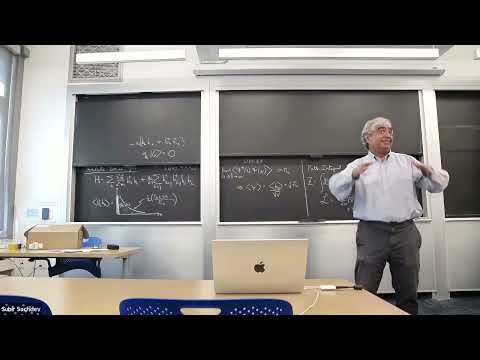
0:04 All right. So we are continuing and hopefully finishing the discussion of the Bose gas fairly soon. Um just to summarize we are considering a system in in free space a bunch of Bzons. So the canonical example would be helium 4 which has a dispersion and this is the mass of a single helium 4 atom. uh there's repulsive interactions between the atoms and we just approximate it by an S-wave uh uh contact interaction you not um okay so then we solve this uh using uh the just an expansion in powers of you not so at at you not equal to zero all the particles go into the zero momentum state so there's a delta
0:52 function in the in the number distribution exactly at zero moment Uh but then we put in the effect of the interactions uh perturbatively and the bogoff theory we found there were there was also in addition to the delta function there was a continuum contribution of finite k which is given by this function which actually diverges we one as one / k at small. So the total number of particles the number of particle is well you see integral in dimensions of dk and the volume here. Um so
1:44 that involves both the contribution the condensate and the contribution of the non-condensate. Okay. So anyway, so so it's not as if as in the old Bose Einstein theory, all the particles go to zero momentum. Some of the particles are finite momentum u and but they are you know they're constantly scattering off the uh uh of the condensate. Some are going in and some come coming up out. uh since the condensate has zero momentum the only way the finite momentum particles can go in and come out is in pairs. So there's
This is the start of the transcript. Save this video free for the whole transcript, searchable and time-coded.
In this course
Related notes
Summary, takeaways, and chapters were generated by AI from the video's transcript and may contain errors. The video belongs to its creator, Subir Sachdev.