Lecture 7: Insulating magnets
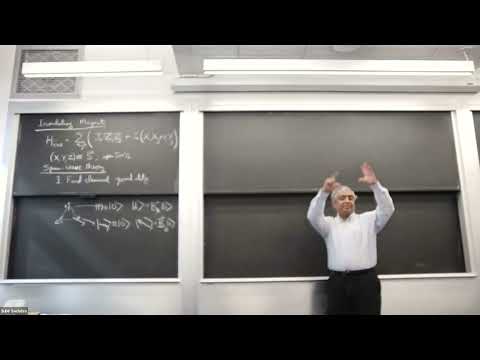 Watch on YouTube →
Overview
Subir Sachdev connects spin-1/2 magnets to interacting hard-core bosons, then contrasts exactly tractable ferromagnetic spin waves with approximate spin-wave theory for square-lattice antiferromagnets. He uses valence-bond solids and Anderson’s resonating-valence-bond proposal to motivate quantum spin liquids, whose defining feature is fractionalized excitations that cannot be created by local operators.
Key takeaways
- In the easy-axis ferromagnet, a single reversed spin forms an exact one-magnon sector because U(1) symmetry conserves spin-flip number; its gap closes as the exchange becomes isotropic.
- An isotropic Heisenberg ferromagnet has a quadratic Goldstone dispersion because total spin is both conserved and the order parameter, unlike the linear mode of a superfluid.
- Square-lattice antiferromagnetic spin-wave theory requires a Bogoliubov transformation because transverse exchange creates and annihilates pairs of bosons; its spin-1/2 approximation is useful but not controlled by a small parameter.
- A valence-bond solid can preserve spin-rotation symmetry but still be nontrivial because selecting singlet bonds breaks lattice translation symmetry.
- For a square lattice with spin-1/2 per site and the relevant symmetries, the Lieb–Schultz–Mattis–Oshikawa–Hastings constraint rules out a trivial symmetric ground state.
- Quantum spin liquids are distinguished by fractionalized excitations that cannot be produced singly by local operators, rather than merely by a complicated superposition of singlet coverings.
Chapters
0:00
From the Bose–Hubbard Model to Spin-1/2 Magnets
- A spin-1/2 degree of freedom can be represented as a hard-core boson, linking magnetic phases to Bose–Hubbard physics.
- Sachdev frames the lecture around conventional spin-wave theory and less conventional quantum spin liquids, also called fractionalized phases.
3:00
The XXZ Model, Superexchange, and Spin–Orbit Coupling
- The nearest-neighbor XXZ model couples the x and y spin components equally and allows a distinct coupling along z.
- Positive exchange in many insulating magnets follows from superexchange: virtual electron hopping favors antiparallel spins.
- Spin–orbit coupling can make the exchange anisotropic; Sachdev contrasts light elements such as copper with heavier magnetic atoms.
7:00
Classical Spin Order as the Starting Point for Spin-Wave Theory
- Spin-wave theory begins by finding a classical ordered state and treating quantum bosons as local spin flips around it.
- On a triangular lattice, the classical state can have three differently oriented sublattices; each sublattice gets its own local boson convention.
- The square lattice provides a simpler setting for developing the method without the triangular lattice’s multi-sublattice algebra.
11:00
The Exact Ising-Like Ferromagnetic Ground State
- For negative exchange with stronger easy-axis coupling, the ferromagnetic ground state has every spin aligned along z.
- The fully polarized state is an exact eigenstate: the longitudinal exchange is minimized and the transverse spin-flip terms annihilate it.
- When the exchange becomes spin-rotation invariant, the ground-state manifold contains states of total spin N/2 and has N + 1 orientations.
15:00
Hard-Core-Boson Mapping for a Ferromagnetic Spin Flip
- Sachdev represents the aligned spin as the boson vacuum and a reversed spin as one boson, with spin-raising and spin-lowering operators mapped to boson annihilation and creation.
- The mapping turns a single reversed spin into a mobile particle whose hopping comes from the transverse exchange.
- U(1) symmetry conserves boson number, so a one-spin-flip state remains in the one-particle sector.
21:00
The Exact One-Magnon Dispersion and Anisotropy Gap
- Because the one-boson sector does not mix with states containing more spin flips, its dispersion is exact for the ferromagnet.
- On the square lattice, the easy-axis excitation gap is 2(|Jz| − |Jx|) for the anisotropy regime discussed.
- Sachdev distinguishes this exact one-magnon result from higher-order corrections that arise in more general interacting spin-wave problems.
26:00
Why a Heisenberg Ferromagnet Has a Quadratic Goldstone Mode
- At isotropic exchange, the ferromagnetic gap closes and the low-momentum magnon energy varies as k² rather than linearly.
- The total spin is both conserved by the Heisenberg Hamiltonian and serves as the ferromagnetic order parameter.
- This differs from a superfluid’s linear Goldstone mode, where the broken U(1) order parameter is distinct from the conserved charge.
35:00
Square-Lattice Néel Order and Its Quantum Fluctuations
- For positive exchange with easy-axis anisotropy, the square-lattice classical ground state is Néel order: opposite spins on the A and B sublattices.
- Unlike the ferromagnet, the up-down product state is not an exact ground state because transverse exchange can create spin-flip fluctuations.
- Sachdev notes that the exact two-dimensional spin-1/2 antiferromagnetic ground state is not known analytically.
39:00
Linear Spin-Wave Approximation for the Antiferromagnet
- The two-sublattice boson mapping produces quadratic terms as well as higher-order interactions, including four-boson terms.
- Dropping the higher-order terms is not controlled for spin-1/2, though large-S reasoning and experience support the approximation in many settings.
- The doubled magnetic unit cell reduces the Brillouin zone and requires tracking A- and B-sublattice bosons.
44:00
Bogoliubov Modes and the Antiferromagnetic Spectrum
- A Bogoliubov transformation diagonalizes the quadratic antiferromagnetic boson Hamiltonian, including terms that create or annihilate boson pairs.
- The ordered state supports two degenerate spin-wave polarizations associated with fluctuations in the x and y directions.
- Easy-axis anisotropy gives the modes a gap; at isotropic exchange the gap closes and the long-wavelength dispersion becomes linear.
49:00
Staggered Order, Conserved Spin, and Relativistic Dynamics
- In the antiferromagnet, the conserved total spin differs from the broken-symmetry order parameter, which is the staggered spin sum over the A and B sublattices.
- That distinction accompanies two linearly dispersing Goldstone modes for the isotropic antiferromagnet.
- The low-energy spectrum’s approximate square-root form motivates a relativistic field-theory description; Sachdev connects this framework to Haldane’s work.
54:00
Quantum Reduction of the Néel Moment
- Spin fluctuations reduce the square-lattice spin-1/2 Néel moment from its classical value of 1/2 to roughly 0.6 × 1/2.
- The triangular-lattice moment is substantially smaller, though Sachdev reports that numerical studies still find it nonzero.
- The square lattice is easier to study with conventional numerical methods because it avoids the sign problem encountered on the triangular lattice.
59:00
Valence-Bond Solids and the Constraint on Trivial States
- A two-spin singlet has exchange energy −3J/4, lower than the −J/4 energy of an antiparallel product state on that bond.
- A valence-bond solid pairs selected spins into singlets, preserving spin-rotation symmetry while breaking lattice translation symmetry.
- Sachdev discusses the Lieb–Schultz–Mattis–Oshikawa–Hastings constraint: for a square lattice with spin-1/2 per site and the relevant symmetries, a trivial symmetric ground state is forbidden.
1:05:00
Anderson’s Resonating-Valence-Bond State
- Anderson proposed superposing many singlet-bond coverings rather than choosing one fixed valence-bond pattern.
- The resulting resonating-valence-bond state is a coherent quantum superposition; its dimer-covering states are nonorthogonal and exponentially numerous in system size.
- A single measurement of one bond configuration cannot establish coherence, making entanglement-sensitive probes or suitable measurements of the ground state important.
1:12:00
Fractionalization as the Signature of a Quantum Spin Liquid
- Unlike spin waves or ordinary spin flips, the characteristic excitations of a quantum spin liquid cannot be created individually by local operators.
- These excitations occupy distinct superselection sectors; in two dimensions, such sectors can include anyons.
- Sachdev identifies fractionalization as the key to understanding spin-liquid phases and points to excited-state properties as a practical route to their characterization.
Summary, takeaways, and chapters were generated by AI from the video's transcript and may contain errors. The video belongs to its creator, Subir Sachdev.