Lecture 22: Paramagnon theory of Hubbard model
Overview
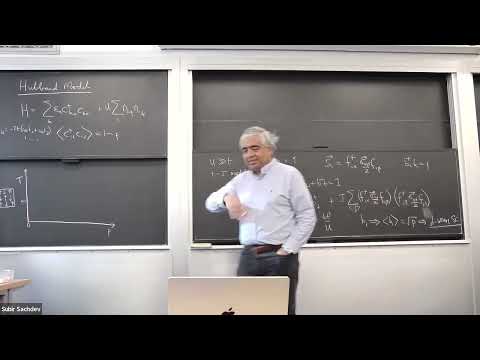
Subir Sachdev develops the paramagnon approach to the square-lattice Hubbard model, contrasting it with the slave-boson treatment of the t-J model and its difficulty explaining the pseudogap. He decouples the Hubbard interaction in the spin channel, derives a fluctuation kernel from the free-electron spin susceptibility, and explains how magnetic instabilities, Landau-damped paramagnons, and spin-mediated pairing emerge; the lecture sets up, but does not complete, the derivation of d-wave superconductivity.
Key takeaways
- At half filling and U much larger than t, the square-lattice Hubbard model reduces to a Heisenberg antiferromagnet with J = 4t²/U and Néel order.
- Replacing the slave-boson holon with a condensate proportional to the square root of doping helps produce d-wave superconductivity, but the resulting Fermi-liquid picture does not explain the pseudogap metal.
- The spin-channel Hubbard-Stratonovich transformation turns the interacting-electron problem into free fermions coupled to a three-component spin field, whose effective quadratic action is controlled by the Lindhard spin susceptibility.
- A magnetic instability occurs when the quadratic spin-field kernel first vanishes at the wavevector where the static susceptibility is largest; on the square lattice, the relevant antiferromagnetic vector is often (π, π).
- A metallic paramagnon has a low-energy inverse propagator of the form r + k² + γ|ωn| because it can decay into Fermi-surface particle-hole pairs, even at zero temperature.
- Paramagnon exchange creates a spin-dependent electron interaction that can favor d-wave pairing, but the lecture postpones the detailed pairing derivation and does not claim to resolve the pseudogap.
Chapters
- Sachdev connects Kondo-lattice ideas to the Hubbard model, including how spin-liquid entanglement can produce a fractionalized Fermi liquid.
- A conventional heavy Fermi liquid incorporates local moments into the Fermi surface, while a fractionalized Fermi liquid can violate the usual Luttinger count.
- He previews three remaining lectures, moving from basic Hubbard-model theory toward recent research on the pseudogap.
- The square-lattice dispersion begins with nearest-neighbor hopping, εk = -2t(cos kx + cos ky), with possible second- and third-neighbor terms.
- At one electron per site and U much larger than t, the Hubbard model maps to a Heisenberg antiferromagnet with exchange J = 4t²/U.
- The square-lattice ground state has long-range Néel order, consistent with observations at half filling.
- Projecting out double occupancy at large U gives the t-J model, with hopping between holes and exchange interactions between spins.
- The slave-boson representation uses fermionic spinons and bosonic holons, constrained to allow only spin-up, spin-down, or empty states per site.
- A common approximation replaces the holon field by its condensate, with amplitude proportional to the square root of the hole density, and yields a d-wave superconducting state.
- The phase diagram includes antiferromagnetism at low doping, a superconducting dome, and a conventional Fermi liquid at sufficiently high doping.
- The superconducting transition temperature can approach 100 K, while the exchange scale J is about 130 meV, or roughly 1,300 K.
- The condensed-holon treatment predicts a Fermi liquid above the superconducting transition, but the optimal-doping region instead exhibits unusual metallic and magnetic properties.
- The pseudogap is metallic in its electrical resistance but does not show the ordinary Fermi surface or spin susceptibility expected of a Fermi liquid.
- Sachdev argues that the many t-J theories built around holon condensation and its fluctuations have not convincingly explained the pseudogap.
- He proposes returning to the original Hubbard model and developing its spin-fluctuation, or paramagnon, description.
- BCS theory attributes electron pairing to phonons, but superfluid helium-3 has no crystal lattice or phonons to provide that mechanism.
- Paramagnons, which are spin fluctuations in a metal, can play the role of pairing mediators in helium-3 and in the Hubbard model.
- Sachdev frames the paramagnon approach as a perturbative treatment in the interaction that resums selected Feynman diagrams.
- A paramagnon is a spin-one fluctuation without magnetic long-range order; unlike a spin wave, it retains full spin-rotation symmetry.
- Its lifetime is limited because it can decay into low-energy particle-hole pairs near a Fermi surface.
- Ferromagnetic paramagnons occur near zero momentum, while antiferromagnetic paramagnons occur near wavevectors such as (π, π); Sachdev also notes analogous valley or pseudospin fluctuations in graphene-based materials.
- Sachdev rewrites the on-site Hubbard interaction using the square of the electron spin operator, up to a chemical-potential term.
- The identity follows by comparing the four on-site states: spin-up, spin-down, empty, and doubly occupied.
- This spin-channel choice makes magnetic order and its fluctuations explicit, but does not include every possible mean-field channel.
- A Hubbard-Stratonovich transformation introduces a three-component field φ that couples to the electron spin density.
- The saddle point of φ reproduces Hartree-Fock theory, while integrating over φ allows systematic treatment of fluctuations around that saddle point.
- Unlike unrestricted Hartree-Fock, choosing only the spin channel sacrifices a general variational principle but permits analysis when the average φ is zero.
- Treating φ as an external source for free electrons and integrating out the fermions gives an effective action for the spin field.
- The linear term vanishes in a spin-singlet Fermi gas; the leading contribution is quadratic and contains the free-electron spin susceptibility.
- In momentum and imaginary-frequency space, the quadratic kernel combines the Hubbard-Stratonovich weight with the Lindhard response, whose structure depends on the Fermi surface.
- The most susceptible wavevector is where the static spin response is largest, provided the quadratic fluctuation kernel remains positive.
- Increasing U can drive that kernel to zero at the preferred wavevector, signaling an instability of the paramagnetic state.
- A quartic term in φ stabilizes the theory beyond the instability and permits a nonzero spin-density-wave order parameter.
- The ordered phase has a nonzero spin field at a selected wavevector, producing a spin-density wave.
- A generic susceptibility maximum can yield an incommensurate ordering vector, as observed in metals such as chromium.
- For the square-lattice Hubbard model, Sachdev focuses on the commensurate antiferromagnetic case at wavevector (π, π), with the transition corresponding to a Stoner instability.
- In the antiferromagnet, choosing an orientation for the order parameter leaves two transverse spin-wave directions and a longitudinal amplitude mode.
- In the paramagnetic phase, all three components of φ fluctuate equivalently, defining the paramagnon rather than a symmetry-breaking spin wave.
- The paramagnon propagator is the inverse of the quadratic kernel governing those spin-field fluctuations.
- Near the magnetic wavevector Q, the inverse propagator has the low-energy form r + k² + γ|ωn|, where r vanishes at the ordering transition.
- The |ωn| term continues to a damping contribution proportional to -iγω in real frequency, unlike the leading undamped phonon or spin-wave form.
- Damping arises because a spin fluctuation can transfer momentum Q between Fermi-surface points and decay into a particle-hole pair, even at zero temperature.
- Exchanging a paramagnon between two electrons produces an interaction set by the spin-fluctuation propagator and spin matrices, distinguishing it from ordinary phonon exchange.
- Near a magnetic instability, retaining the resummed susceptibility in the interaction denominator makes the effective coupling strong, although this is not a simple finite-order expansion in U.
- On the square lattice, antiferromagnetic paramagnon exchange leads to d-wave pairing in the BCS framework; Sachdev cites David J. Scalapino's early paramagnon work and leaves the detailed derivation for the next lecture.
Transcript excerpt
0:15 All right. So um yeah as we're just discussing the presentation so the presentations are u on the you know on the on canvas and I've listed all the rooms and also on they're on Tuesday Wednesday Thursday two weeks from now and I have uh on the Wednesday I have started uh 15 minutes earlier starting at 9:45 rather than 10 because of the room not being available after 11:45. So they'll have two on Wednesday. Yeah. Several Tuesday and Thursday. >> Do you have to attend other students? >> Uh that's optional. Yes. But the idea is that you do attend and learn learn something different. [laughter]
1:03 Don't have to, but uh I recommend it. Okay. Um so we've talked about condo lattice. I I can see it wasn't the most popular topic. It's not very popular these days. Uh but it's a problem of fundamental importance which used to be really the center of physics for a long time. Uh there was the condo impurity problem and then the heavy firm materials which were described by uh the condo lattis. Um and my reason for talking about it uh despite it being a bit oldfashioned now u is that there's a lot of new ideas that came up on how spins interact induction like electrons
1:54 uh and uh the kind of phases you can get uh and in particular uh the most common phase is the spins effectively become part of the firmy surface that's what how you get the heavy firmy liquid And that's the lattice analog of the impurity condo effect where this impur spin is screened by the conduction electrons. But at the very end of last lecture I also talked about uh this fractionalized firmy liquid phase where because of the appearance of a spin liquid
This is the start of the transcript. Save this video free for the whole transcript, searchable and time-coded.
In this course
Related notes
Summary, takeaways, and chapters were generated by AI from the video's transcript and may contain errors. The video belongs to its creator, Subir Sachdev.