Lecture 1: Quantum Ising Model
Overview
Subir Sachdev introduces the transverse-field quantum Ising model, H = -JΣ⟨ij⟩σᶻᵢσᶻⱼ - gΣᵢσˣᵢ, and builds its excitation spectrum from the large-g paramagnet and small-g ferromagnet. He explains how spin flips become dispersing quasiparticles, how multiparticle continua and bound states arise, why one dimension instead has fractionalized domain walls, and why the gap closes universally at the quantum critical point.
Key takeaways
- In the large-transverse-field phase, a local spin flip becomes a momentum-resolved quasiparticle with leading dispersion 2g - 2JΣα cos(kαa), rather than remaining an N-fold-degenerate excitation.
- The global spin-flip symmetry conserves particle-number parity in the paramagnet, so a one-particle excitation cannot decay into two particles even when their energy bands overlap.
- At small transverse field, finite systems form cat-state combinations of the two ferromagnetic ground states, but their splitting scales as Jgᴺ and vanishes exponentially with system size.
- In dimensions above one, defect motion in the ordered phase first appears at second order in g; cancellation between virtual paths prevents unphysical long-range hopping.
- In one dimension, a local spin flip fractionalizes into two domain walls that behave as emergent fermions, while an isolated domain wall cannot be created by a local operator.
- At a continuous ferromagnet-to-paramagnet transition, the gap follows Δ ∝ |g - gc|^(zν); z = 1 here, and ν is universal within a given spatial dimension and symmetry class.
Chapters
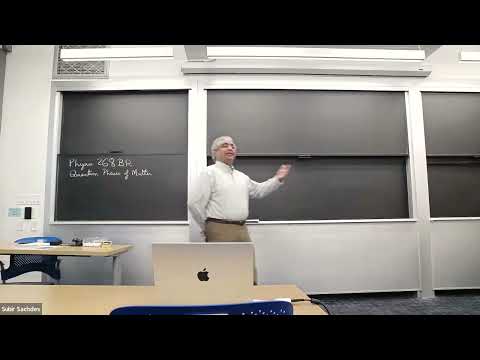
- Subir Sachdev describes Physics 268 as a graduate course on quantum phases of matter, quantum simulation, and atomic physics.
- Students should expect a presentation near the end of the semester, based on a recent paper and explained for classmates rather than as an original research project.
- Sachdev permits AI for clarifying questions and allows collaboration, but asks students to write their own homework solutions rather than submit AI-written work.
- Lectures will be recorded and posted on Canvas; suggested preparation includes graduate quantum mechanics and statistical mechanics, while quantum field theory is useful but not required.
- The classical Ising model describes ferromagnetic spins and has no finite-temperature phase transition in one dimension, but does in two and higher dimensions.
- Sachdev turns to the quantum version to study ground states and quantum phase transitions rather than only temperature-driven behavior.
- The transverse-field Ising model is relevant to experiments with Rydberg atoms and to related systems built from superconducting qubits.
- Each lattice site holds a qubit with Pauli operators σˣ, σʸ, and σᶻ, and the nearest-neighbor Ising interaction favors aligned z-spins.
- A transverse field gΣᵢσˣᵢ does not commute with the Ising interaction, making the model quantum rather than classical.
- The lecture focuses on the ground state and excitation spectrum as the dimensionless ratio of transverse field g to coupling J changes.
- For g much greater than J, the σˣ term dominates and the ground state is a unique product state with every spin aligned along the field.
- The large-g ground state has no long-range correlations or special boundary behavior, making it a simple paramagnet.
- Flipping one spin costs approximately 2g, while p independent flips cost approximately 2pg before interactions lift their degeneracy.
- At J = 0, the one-spin-flip sector has N degenerate states, one for each site of an N-site lattice.
- The Ising perturbation σᶻᵢσᶻⱼ moves a flipped spin between neighboring sites when acting within that degenerate sector.
- Perturbation theory must retain matrix elements inside the degenerate subspace; processes that leave it contribute only at higher order.
- On a translation-invariant lattice, Fourier transforming the site-labeled spin flips gives momentum eigenstates.
- To leading order in J, the one-particle dispersion is approximately 2g - 2JΣα cos(kαa), with the sum over spatial directions.
- The degenerate set of local spin flips therefore becomes a dispersing quasiparticle band, with its minimum at zero momentum for the ferromagnetic coupling.
- Higher-order corrections change the quasiparticle dispersion and wavefunction, including the overlap of a local spin flip with the dressed excitation.
- In the large-g regime, an isolated one-particle state at each momentum is stable because no energetically allowed continuum can absorb it.
- Sachdev describes this overlap as the quasiparticle residue, which becomes smaller than its simple spin-flip-limit value once the excitation is dressed.
- Two widely separated spin-flip quasiparticles have energies that add, forming a two-particle continuum rather than a single sharp energy at fixed total momentum.
- At a given total momentum K, the continuum contains energies E(k₁) + E(k₂) for all pairs satisfying k₁ + k₂ = K.
- Interactions can pull a discrete bound-state branch below the continuum or, in a gapped spectrum, create an antibound state above it.
- Bound states are additional arrangements of the same finite-system states, not particles that must remain far apart.
- The transverse-field Ising model conserves global spin-flip parity, represented by the product of σˣᵢ over all sites.
- In the large-g phase, this symmetry prevents a one-particle excitation from decaying into two particles, even if the two-particle continuum overlaps its energy.
- Decay into a three-particle continuum can become possible when energies overlap and the relevant symmetry permits it.
- Sachdev emphasizes that stable particles, continua, bound states, and decay channels parallel phenomena in particle physics.
- At g = 0, the ground states are the two fully polarized configurations, all spins up or all spins down along z.
- The global spin-flip operator commutes with the Hamiltonian and exchanges these two ordered states.
- For finite N, the transverse field mixes them into symmetric and antisymmetric cat states, with an energy splitting of order Jgᴺ.
- As N grows, that splitting becomes exponentially small, so realistic perturbations select one ordered state and produce spontaneous symmetry breaking.
- In the small-g ferromagnet, flipping one spin creates a localized defect and breaks each of its neighboring ferromagnetic bonds.
- On a square lattice, the defect costs 8J at g = 0; on a cubic lattice, it costs 12J.
- In dimensions above one, perturbations allow the defect to move and generate a quasiparticle band, but its dispersion first appears at second order in g.
- At first order in g, flipping a spin either returns the state to the ground sector or takes it into a two-defect sector, so it does not split the one-defect degeneracy.
- Sachdev introduces an effective Hamiltonian that removes higher-energy sectors using a unitary, or canonical, transformation.
- The resulting operator acts only within the one-particle subspace, reducing the problem to an N-by-N matrix that can be diagonalized by momentum.
- Naive second-order paths appear to move a defect arbitrarily far in one step, which would conflict with the locality of the Ising Hamiltonian.
- For non-neighboring final sites, paths through higher- and lower-energy intermediate states have opposite energy denominators and cancel.
- When the target site is a nearest neighbor, the intermediate energy changes because the defects share bonds, so the cancellation is incomplete.
- The effective second-order Hamiltonian therefore produces local nearest-neighbor hopping and a cosine-like dispersion proportional to g²J.
- In one dimension, a reversed spin region has two domain walls, and moving a wall can leave the energy unchanged rather than confining the defect into a stable bubble.
- A local spin flip creates two domain-wall quasiparticles, while creating a single wall requires flipping an entire half-chain and is therefore nonlocal.
- The exact one-dimensional solution describes the domain walls as fermions; exchanging two walls gives an S-matrix of -1.
- This fractionalization makes the one-dimensional spectrum fundamentally different from the higher-dimensional spin-flip quasiparticle picture.
- The paramagnetic and ferromagnetic limits have distinct ground states, so the system must undergo at least one phase transition between them in the thermodynamic limit.
- The lowest quasiparticle gap Δ decreases toward the critical coupling gc and vanishes continuously at a second-order transition.
- Near criticality, the gap scales as Δ ∝ |g - gc|^(zν); for the transverse-field Ising transition, Sachdev identifies z = 1 and ν as the correlation-length exponent.
- The exponent ν is universal for the symmetry-breaking transition and depends on spatial dimension, motivating the field-theory treatment in the next lecture.
Transcript excerpt
0:07 Okay, welcome everyone. This is the first class of physics 268 VR and raise a matter. Um, it's a graduate physics course. I I presume and most of you are physics graduate students although maybe some some from QSE there are a few. Okay. uh and uh it's a course I've taught many times but it changes over the years uh try to make it as current as I can to current topics in uh in matter and atomic physics research. Okay. So action. Okay. So uh let's start again. So this
0:59 is physics 268 PR quantum phases of matter uh a course graduate level course on current topics in quantum net matter theory and also these days uh in quantum simulation and atomic physics. Um so there's a rough outline that being passed around of topics I want to cover. Um there's still some flexibility. I'm not fully set uh on the topics I'm going to go cover depending on what uh all of you are interested in. Um the first few parts are fairly standard. I definitely will do you know up to up to chapter 7 fairly fairly standard topics that uh everyone should learn I suppose. So I
1:48 will go through all of that. Uh much of that is in my book with the same title. uh but uh the presentation will be uh probably a bit different uh uh anyway. Okay. Um and then I want to go on to various topics mostly in quantum condensed matter uh related to superc conductivity condo effect and uh I guess there's a lot of work on twisted polar graphine I may not touch on it directly but uh at least indirectly you can talk about very uh related things uh let's see so we're going to meet uh
This is the start of the transcript. Save this video free for the whole transcript, searchable and time-coded.
In this course
Related notes
Summary, takeaways, and chapters were generated by AI from the video's transcript and may contain errors. The video belongs to its creator, Subir Sachdev.