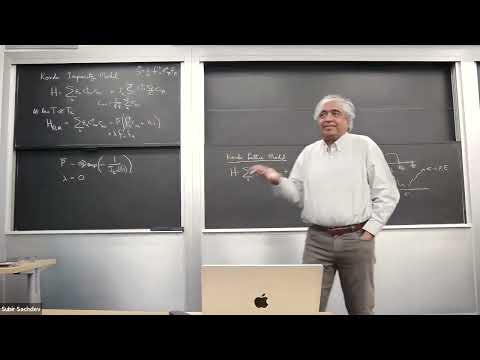
Lecture 20: Kondo-Heisenberg Lattice Model
Overview
Subir Sachdev develops a mean-field account of the Kondo lattice, explaining how Kondo hybridization incorporates localized spins into a large Fermi surface and produces heavy quasiparticles with exponentially small spectral weight. He then adds Heisenberg exchange to form the Kondo-Heisenberg model, where a dispersing spinon band can suppress hybridization and allow a fractionalized Fermi liquid, or FL*, with a small conduction-electron Fermi surface coexisting with a spin liquid.
Key takeaways
- In the basic Kondo-lattice mean field, a logarithmic divergence drives nonzero Kondo hybridization for arbitrarily weak J_K, producing a large Fermi surface that counts conduction electrons plus one spin per site.
- Weak Kondo hybridization creates a nearly flat heavy band and a large effective mass, while the conduction-electron quasiparticle residue becomes very small, reducing photoemission peak intensity.
- A finite spinon hopping amplitude Q from Heisenberg exchange gives the f band its own dispersion and removes the divergence that otherwise makes Kondo hybridization unavoidable.
- When J_K is sufficiently weak relative to J_H, the mean-field solution can have Q nonzero and P zero, leaving a small conduction-electron Fermi surface alongside a spin liquid.
- The FL* state differs from a conventional heavy Fermi liquid because its Fermi volume counts only conduction electrons; the localized spins remain in fractionalized spinon degrees of freedom.
Chapters
- At temperatures below the Kondo temperature, the impurity spin is screened and its Curie susceptibility saturates.
- A fermionic spinon mean-field description reduces the low-energy impurity to a resonant level hybridized with conduction electrons.
- The narrow resonance has an exponentially small energy scale, while the screened ground state is a singlet.
- In materials such as CeCu6, localized cerium moments couple to a conduction band supplied by other atoms.
- Many heavy-fermion compounds form low-temperature Fermi liquids with very large effective masses.
- Their Fermi volume counts both conduction electrons and one localized spin per site, consistent with Kondo hybridization absorbing the spins into the Fermi sea.
- Angle-resolved photoemission measures electron energy and momentum by analyzing electrons ejected by photons.
- The occupied-state boundary across momentum identifies the Fermi surface, whose enclosed volume estimates the electron count.
- Sachdev notes that mean-field theory captures the basic band picture, while numerical methods such as dynamical mean-field theory provide more detailed calculations.
- The lattice model represents each localized spin with fermionic spinons and decouples the Kondo exchange using a hybridization amplitude.
- The resulting mean-field Hamiltonian mixes a conduction band with a spinon level on every lattice site.
- A constraint enforced by the Lagrange multiplier lambda keeps the spinon occupation at one per site.
- Hybridization appears to violate separate conduction-electron number conservation because it converts a conduction electron into a spinon.
- The spinon representation introduces a U(1) gauge redundancy, and a nonzero hybridization field acts like a Higgs field for that gauge structure.
- The conserved quantity in the mean-field bands is the combined conduction-electron and spinon number, which fixes the large Fermi volume at 1 + n_c.
- With zero hybridization, the conduction band crosses the Fermi level while the spinon band is flat at that level.
- Nonzero hybridization produces two repelling bands, with the constraint setting their filling and lambda shifting the spinon level.
- For conduction density n_c below one, the occupied lower hybridized band encloses a volume counting both n_c and the localized spins.
- When the hybridization is small, the spinon-derived part of the occupied band remains nearly flat near the Fermi level.
- The small band slope corresponds to a large effective mass, giving the lattice version of the narrow Kondo resonance.
- The large Fermi surface can emerge even though the original localized-spin degrees of freedom cannot move between sites.
- The self-consistency equations determine the hybridization amplitude and the constraint field lambda.
- At zero temperature, the hybridization equation contains a logarithmic divergence as the amplitude approaches zero.
- That divergence permits a nonzero hybridization solution for arbitrarily weak Kondo exchange in the basic Kondo-lattice mean field, with a scale exponentially small in inverse exchange coupling.
- Photoemission probes the conduction-electron Green function rather than directly ejecting the tightly bound localized f electron.
- The conduction-electron quasiparticle residue scales with the square of the small hybridization amplitude.
- The Fermi surface remains large, but its heavy quasiparticles have a tiny physical-electron overlap and therefore weak spectral intensity.
- The basic Kondo-lattice mean field always screens the spins and converts spinons into heavy electron-like quasiparticles.
- Localized spins can instead form a spin liquid rather than magnetic order, opening the possibility that spinons survive alongside conduction-electron quasiparticles.
- Sachdev identifies CeCoIn5 and the cuprates as motivating contexts for investigating states beyond the conventional heavy Fermi liquid.
- The Kondo-Heisenberg model supplements conduction electrons and Kondo exchange with a direct spin-spin Heisenberg coupling J_H.
- Even without an explicit J_H term, second-order perturbation in J_K generates an RKKY interaction through a conduction-electron particle-hole loop.
- Adding J_H by hand makes spin-liquid mean-field analysis manageable, although its value combines direct exchange and conduction-mediated contributions.
- Kondo exchange J_K favors incorporating localized spins into the conduction-electron Fermi sea.
- Heisenberg exchange J_H can favor a spin liquid, represented in mean field by spinons with their own band dispersion.
- The outcome depends on the exchange ratio: sufficiently strong J_K favors the heavy Fermi liquid, while sufficiently weak J_K can leave the spinons deconfined from the conduction electrons.
- A spin-liquid mean field introduces a spinon hopping amplitude Q, adding dispersion to the formerly flat f band.
- On a square lattice, the lecture uses a nearest-neighbor form proportional to -2Q(cos k_x + cos k_y), alongside the conduction dispersion.
- The Kondo-Heisenberg saddle point must satisfy equations for hybridization, the constraint field, and Q.
- With Q nonzero, the f band is dispersive, so the hybridization susceptibility is finite rather than logarithmically divergent.
- For sufficiently small J_K, no nonzero-hybridization solution exists beyond the trivial P = 0 solution.
- The resulting phase boundary separates a heavy Fermi liquid with P and Q nonzero from a state with Q nonzero and P zero.
- At P = 0, conduction electrons form their own Fermi surface while the localized spins form a separate spin liquid.
- The conduction-electron Fermi volume remains at its small value set by n_c, rather than counting one additional electron per spin.
- Sachdev calls this coexistence of a Fermi liquid and a spin liquid FL*, and points toward the single-band Hubbard model as a more delicate setting for the same idea.
Transcript excerpt
0:14 All right. So I want to continue our discussion of the Kondo lattice model today. And then there's three more lectures in the course and I'll probably I will go back to the Hubbard model and really tell you more about it with the aim of coming closer to you know the the main unsolved problem today of high temperature superconductivity on the in the cuprate compounds. Okay. So so let me just quickly review what we learned about the quantum Kondo impurity model. So you know we learned about the first part of the course we talked a
1:01 lot about spin systems and spins can do one thing they can do is they can break spin rotation symmetry and order. Or we found they could form spin liquids with various complicated anion excitations. And in the Kondo impurity model we find something else. We take a spin just a single spin and you couple it to the conduction electrons. And we found a state at low temperatures in which the Curie susceptibility of the spin was saturated. And it ended up looking like I mean this was the main result for a lot of discussions. So then at low T you can smaller than
1:49 the Kondo temperature you could approximate this by a theory of a resonant level model where effectively spin became a resonant free fermion resonant level. So in this case, the Hamiltonian of the resonant level model was epsilon k p dagger k sigma c sigma and remember I wrote minus p bar and you know so and f dagger alpha c zero alpha Uh just for fun we can also add term in
2:37 the energy of the resonant level with f dagger alpha f alpha. So the way this happened was you wrote our spin as one half
This is the start of the transcript. Save this video free for the whole transcript, searchable and time-coded.
In this course
Related notes
Summary, takeaways, and chapters were generated by AI from the video's transcript and may contain errors. The video belongs to its creator, Subir Sachdev.