Lecture 20: Kondo Lattice Model
Overview
Subir Sachdev derives the Kondo impurity’s low-energy physics using an Abrikosov-fermion representation and a mean-field hybridization that maps the problem to a resonant level. The self-consistency equation produces an exponentially narrow Kondo resonance, while applying the same method to the Kondo lattice yields hybridized bands, a large Fermi surface that counts local moments, and heavy quasiparticles whose mass grows as the Kondo scale falls.
Key takeaways
- Abrikosov fermions turn the Kondo impurity’s spin-1/2 moment into constrained spinons, and mean-field decoupling in the hybridization channel maps the impurity onto a self-consistent resonant-level problem.
- The impurity constraint pins the Kondo resonance to the Fermi energy, while its width becomes exponentially small at weak exchange, Γ ∼ D exp[-1/(J_Kρ(0))] up to convention-dependent factors.
- A nonzero hybridization saddle point is not evidence of a physical finite-temperature phase transition for a single impurity, because the associated U(1) gauge symmetry is a redundancy rather than a physical symmetry.
- In a translationally invariant Kondo lattice, momentum-conserving hybridization produces two bands and a large Fermi surface that counts the conduction electrons plus one local moment per unit cell.
- The nearly flat, spinon-like portion of the hybridized band produces heavy quasiparticles; the effective mass scales roughly as the inverse Kondo temperature and can be about 1,000 times the bare electron mass.
Chapters
- The Kondo impurity couples a spin-1/2 moment at one spatial point to conduction electrons through the exchange J_K.
- Sachdev introduces a simple approximate route to the established impurity solution, connecting Kondo physics to spin-liquid mean-field methods.
- The lecture briefly notes that students can use AI to help derive the canonical transformation in the assigned renormalization-group exercise.
- The impurity spin is represented using fermionic spinons rather than bosonic spinons.
- Kondo screening effectively incorporates a conduction electron into the local moment, making the fermionic representation natural for describing the resulting resonance.
- The same fermionic spinon construction also appears in spin-liquid theories, though there the spinons occupy bands or form Dirac spectra.
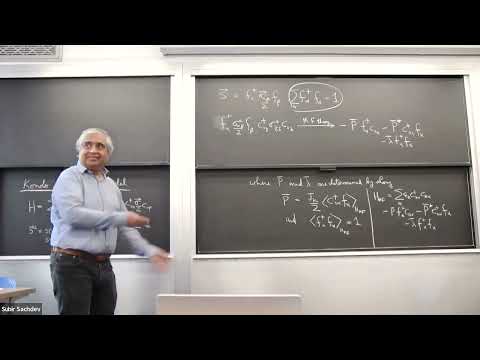
- Represent the spin-1/2 operator with Abrikosov fermions f_α, subject to the single-occupancy constraint ∑_α f†_αf_α = 1.
- Decouple the Kondo exchange in the f†c hybridization channel, introducing a mean-field amplitude and a Lagrange multiplier λ.
- The resulting saddle point is determined by self-consistency equations for the hybridization and the constraint.
- The mean-field impurity Hamiltonian has the same structure as a resonant-level model, with the spinon level set by λ and its coupling to conduction electrons set by the hybridization.
- The spinon Green function is a Lorentzian resonance with width Γ, proportional to the conduction-electron density of states and the squared hybridization.
- Unlike a generic resonant-level model, the Kondo parameters are not fixed externally: the exchange J_K determines them through self-consistency.
- The Abrikosov representation has a local U(1) gauge redundancy because a phase rotation of the spinons leaves the physical spin unchanged.
- The hybridization field carries gauge charge, so a nonzero mean-field value acts like a Higgs condensate in the saddle-point description.
- The apparent gauge-symmetry breaking is not a physical symmetry-breaking transition, which helps explain why the mean-field onset temperature for hybridization is an artifact.
- The spinon Green function supplies the spectral function needed to impose the single-occupancy constraint at finite temperature.
- Requiring one spinon on average pins the impurity resonance to the Fermi energy in the Kondo regime.
- This pinning is an emergent particle-hole symmetry of the constrained Kondo description, even when a generic resonant-level model would have a level away from the Fermi energy.
- The remaining saddle-point equation uses the off-diagonal spinon-conduction-electron Green function to determine the hybridization.
- Summing over conduction-electron momentum introduces the density of states, while the Lorentzian spinon spectrum carries the hybridization dependence.
- The resulting equation resembles a BCS gap equation, but it describes a gapless Kondo resonance rather than superconductivity.
- The self-consistency equation always permits a zero-hybridization solution, while a nonzero solution appears below a mean-field onset temperature.
- That finite-temperature onset cannot represent a true impurity phase transition: there is only one impurity and no physical symmetry is broken.
- At low temperatures, treating the conduction density of states as constant simplifies the equation and isolates the Kondo scale.
- At zero temperature, the integral over the resonance spectrum produces a logarithm involving the bandwidth and resonance width Γ.
- Solving the low-energy equation yields a resonance width exponentially small in the inverse dimensionless coupling, with the form Γ ∼ D exp[-1/(J_Kρ(0))] up to convention-dependent factors.
- The Kondo temperature is of order Γ; below it the impurity moment is screened, while above it the moment behaves increasingly like a free local spin.
- In one dimension, additional logarithmic corrections can modify details, while the basic Kondo scale also applies in higher dimensions with a regular density of states.
- The Kondo lattice places a local moment on every lattice site and couples each moment to the conduction electrons.
- Heavy-fermion materials, especially compounds containing f electrons, can have effective masses up to roughly 1,000 times the bare electron mass.
- Sachdev links the large mass to the narrow Kondo resonance becoming mobile across the lattice, with its small bandwidth setting a low energy scale.
- The model combines a dispersing conduction band with a spin-1/2 local moment at every site and an on-site Kondo exchange J_K.
- Direct superexchange between local moments is omitted initially to isolate the Kondo lattice mechanism.
- Heavy-fermion compounds often have Kondo temperatures near 1 kelvin or below, and some also become superconducting.
- Introduce a site-labeled fermionic spinon at each local moment and enforce one spinon per site on average with a Lagrange multiplier.
- Assume a uniform hybridization between spinons and conduction electrons so the saddle point preserves translation symmetry.
- Unlike the impurity problem, the lattice conserves crystal momentum, giving the spinons momentum-resolved states and permitting a Fermi-surface analysis.
- For each momentum, the mean-field problem reduces to diagonalizing a 2 × 2 matrix mixing the conduction dispersion ε_k with the nearly flat spinon level.
- Nonzero hybridization creates two bands, conventionally labeled E_k+ and E_k−, with avoided crossings where the original bands meet.
- The hybridization is determined self-consistently, distinguishing the Kondo lattice bands from an ordinary fixed-parameter two-band model.
- When the lower hybridized band is the only occupied band, its Fermi volume counts both the conduction-electron density n_c and one local moment per unit cell.
- The resulting large Fermi surface differs from the small conduction-only Fermi surface by one electron per unit cell, in the appropriate volume units.
- Away from the avoided crossing, the hybridized band is nearly flat and mostly spinon-like, so its small slope corresponds to a large quasiparticle mass.
- The mass scale grows roughly as the inverse Kondo temperature, providing a mean-field explanation for effective masses that can reach about 1,000 bare electron masses.
Transcript excerpt
0:23 All right. So, uh the discussion on the corno impurity model like to finish it today and then talk about the cornis model. So spending a a great deal of time on this because of it's really extremely important and introduces a lot of new ideas uh that have wide application uh not only in the study of materials but the study of meoscopic systems of all types. So it's you know played a big role in the development of of our understanding of correlated electron uh systems. So it's really the simplest problem you can imagine but you put all the correlation on one side your free electrons will be described by your
1:13 liquid and they're coupled to a single spin s and we're going to take our discussion today s² s + one s uh so it's a spinner half and it's coupled to the uh the conduction electrons at just one point in space time with some energy scale what we call the condo exchange. So what we've done so far is to uh well look at various limits of small JK and large JK uh and also talk a little bit about the renomination group analysis uh which any I have now set up a homework where you're going to do that RG by yourself well but really you I've
2:03 asked you to just do it with AI. So it's uh you know in some sense it's the same canonical transformation that we've seen already uh when we went from the hubard model to the Eisenberg antifromagnet uh it's a very similar type of transformation but you know you could just enter it into AI and I've written a form where you can just enter the Hamiltonian into AI and it'll find the canonical transformation for you. All right so
This is the start of the transcript. Save this video free for the whole transcript, searchable and time-coded.
In this course
Related notes
Summary, takeaways, and chapters were generated by AI from the video's transcript and may contain errors. The video belongs to its creator, Subir Sachdev.