Lecture 3: Correlation functions and quantum criticality
Overview
Subir Sachdev develops the connection between the transverse-field Ising model and a continuum phi-four field theory, then uses the quantum-to-classical mapping to relate quantum response functions to classical correlations. The Kubo formula and analytic continuation reveal sharp particle peaks away from criticality, but at the relativistic quantum critical point anomalous scaling produces a branch-cut continuum with no well-defined quasiparticles.
Key takeaways
- The quantum transverse-field Ising model in d spatial dimensions maps through imaginary time to a classical Ising model in d plus one dimensions, with periodic boundary conditions along the imaginary-time direction.
- The Kubo formula turns linear response to a weak external perturbation into a retarded commutator correlation function, linking laboratory measurements to equilibrium quantum correlations.
- A classical Euclidean two-point function can yield the real-frequency quantum susceptibility by analytic continuation, enabled by causality and analyticity in the upper half-plane.
- In the Gaussian paramagnet, the susceptibility has poles at E(k) = sqrt(k squared plus R), while its imaginary part identifies particle energies and multiparticle absorption continua.
- At criticality, the anomalous exponent eta changes the response into a branch-cut spectrum with no isolated pole, indicating the absence of well-defined quasiparticles.
- The operator used to probe a system selects which symmetry sector appears in the measured spectrum: an Ising-odd longitudinal field sees odd-particle excitations, while even operators can reveal even-particle states.
Chapters
- The transverse-field Ising model has a ferromagnetic phase with spins ordered along plus or minus z and a paramagnetic phase polarized along x.
- Elementary excitations are wrong-way spins in the paramagnet and bubbles of the opposite ordered phase in the ferromagnet.
- Near the phase transition, Sachdev replaces lattice sums with a continuum field phi, representing the displacement of coupled nonlinear oscillators.
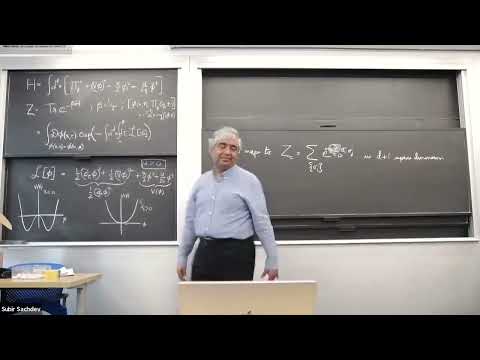
- The quantum partition function becomes a path integral over field configurations, using the same construction as the Feynman path integral for a particle.
- Imaginary time is periodic over the interval from zero to beta in a thermal trace.
- The continuum action combines spatial and imaginary-time derivatives into a relativistically invariant form, yielding emergent relativistic behavior near the critical point.
- Taking imaginary time as an additional spatial coordinate maps a quantum system in d dimensions to a classical system in d plus one dimensions.
- The 2D transverse-field Ising critical point shares universal behavior with the 3D classical Ising model.
- The quantum temperature controls the imaginary-time extent, while the classical model has its own Boltzmann temperature; at finite quantum temperature, the classical counterpart is a periodic slab.
- Critical exponents match between the transverse-field Ising model and its corresponding classical Ising universality class, despite the approximate microscopic mapping.
- The 2D quantum Ising transition shares critical exponents with the 3D Ising universality class, which also describes a liquid-gas critical point such as carbon dioxide.
- A liquid-gas critical endpoint lacks an exact Z2 symmetry and requires tuning both pressure and temperature to reach criticality.
- Sachdev introduces a weak, time-dependent external field h(x,t) coupled linearly to an operator such as phi.
- The induced change in the expectation value is a spacetime convolution of h with the linear susceptibility, plus corrections of order h squared.
- For the Ising model, a field coupled to the order parameter corresponds to applying a longitudinal magnetic field.
- A time-independent Hamiltonian in thermal equilibrium makes the response depend on time differences rather than absolute times.
- Spatial translation invariance reduces the susceptibility to a function of the separation x minus x-prime.
- Causality requires the response to vanish before the perturbation is applied, restricting the retarded susceptibility to nonnegative time differences.
- First-order time-dependent perturbation theory gives the Kubo formula for the linear susceptibility.
- The retarded response is proportional to a thermal expectation value of the commutator of Heisenberg-picture operators, multiplied by a step function enforcing causality.
- The formula connects measurable quantities such as magnetization response to equilibrium correlation functions of the unperturbed system.
- The classical counterpart has a two-point correlation function formed by averaging the product of fields at two spatial points over the classical partition function.
- Translation invariance lets the correlation depend only on the separation between points, making its Fourier transform a function of momentum.
- Sachdev uses the classical correlation function as a calculational route to the more complicated quantum response function.
- The classical Euclidean correlation function is evaluated at imaginary frequency, while the physical quantum susceptibility is defined at real frequency.
- Causality makes the retarded response analytic in the upper half of the complex-frequency plane.
- Analytic continuation from imaginary to real frequency yields the quantum response; going in the reverse direction is difficult because continuation is numerically unstable.
- For positive mass parameter R in the paramagnetic phase, Sachdev first neglects the interaction coupling u and treats the field theory as Gaussian.
- Fourier transformation diagonalizes the quadratic action, leaving independent Gaussian modes with coefficients proportional to momentum squared plus R.
- The Gaussian two-point function is the inverse of that coefficient, producing a propagator proportional to 1 divided by p squared plus R.
- Continuing the Gaussian propagator to real frequency gives a denominator involving k squared plus R minus the squared frequency, with the retarded prescription.
- Its poles occur at positive and negative frequencies equal in magnitude to the dispersion E(k) = sqrt(k squared plus R).
- The positive-frequency pole identifies the paramagnetic particle excitation found from the spectrum.
- The imaginary part of the retarded susceptibility contains delta-function peaks at stable particle energies and continua when multiparticle states are available.
- The imaginary part also measures absorption: a neutron-scattering experiment can transfer momentum k and excite the system only at energies allowed by its spectrum.
- At nonzero temperature, collisions with thermally excited particles broaden a sharp spectral peak into a feature with finite width.
- A longitudinal magnetic field couples to an operator odd under the Ising Z2 symmetry and probes odd-particle excitations.
- An even operator, such as one associated with the transverse direction or phi squared, can reveal even-particle excitations that the longitudinal probe misses.
- The Kubo framework applies to general local operators, although analytic continuation becomes harder for higher-order correlation functions and their loop integrals.
- On the ferromagnetic side, the elementary excitation has a mass proportional to twice the parameter r in the treatment discussed earlier.
- The critical-point calculation cannot simply set the interaction u to zero, because interactions become essential at criticality.
- Critical correlations exhibit nontrivial momentum dependence, requiring an additional universal exponent beyond the exponent governing the energy gap.
- At a relativistic critical point, the response scales with an anomalous exponent eta, giving a frequency-momentum dependence proportional to [k squared minus (omega plus i0) squared] raised to the power minus one plus eta over two.
- For nonzero eta, the imaginary part has a branch cut rather than an isolated pole, so the critical spectrum is continuous instead of a sharp particle peak.
- Sachdev's central conclusion is that critical excitations decay strongly into a many-body continuum, preventing a particle-like basis from describing the critical point; the lecture closes with section and homework reminders.
Transcript excerpt
0:13 Okay. Um, so let me summarize where we were and happy to answer questions on that. So we started looking at the icing model in a trackus field in uh in any space dimension and we found that had two phases. Uh one the ferroagnetic phase where the spins all lined up in the z direction. Um and the other was the paramagnetic phase where they were all lined up in the x direction. Uh the difference being of course is the ferroagnetic phases could be either plus z or minus z. uh and in both phases there were particle-l like exitations. Uh in one case the paramagnet is just a spin burning in the wrong x direction. Um and in the ferroagnetic phase these were little bubbles of the wrong phase.
1:03 So if all spins were up there would be a bubble with all spins down. Okay. Okay, so that's the basic picture of these particles and you could build up the whole spectrum uh just by taking multiparticle uh exitations and that gives you essentially all the states of this uh system. So now we are trying to understand the phase transition between them and that's of course for the IS model it's a very hard thing to do. No one has actually solved the model completely except in one dimension. uh so if you want to understand what's going on in higher dimensions we are going to have to take a leap of faith uh and what has been very systematically studied by a variety of methods in all dimensions and really at this point there's hardly any uncertainty about the results although
1:53 uh nothing is exactly exact or proven uh but they're very precise results are very available through all kinds of methods some of which we'll discuss of this
This is the start of the transcript. Save this video free for the whole transcript, searchable and time-coded.
In this course
Related notes
Summary, takeaways, and chapters were generated by AI from the video's transcript and may contain errors. The video belongs to its creator, Subir Sachdev.