Lecture 2: phi^4 field theory
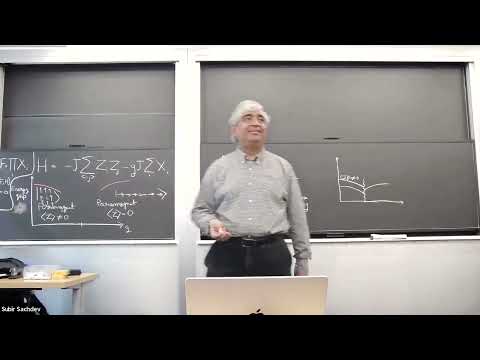 Watch on YouTube →
Overview
Subir Sachdev develops a low-energy route from the quantum Ising model to scalar phi^4 field theory, using a double-well oscillator to motivate the mapping and analyzing its symmetric and symmetry-broken phases. The field theory explains how both excitation gaps close at the critical point, predicts emergent relativistic behavior at mean-field level, and motivates renormalization-group universality and critical exponents.
Key takeaways
- The quantum Ising order parameter is the Z magnetization: it changes sign under the global spin-flip symmetry, whereas the transverse X expectation value does not serve as an order parameter.
- A deep double-well oscillator reduces to a qubit: its tunneling splitting produces the effective Pauli X term, while its displacement operator projects to Pauli Z.
- The scalar phi^4 theory reproduces the two Ising phases: positive mass has one symmetric minimum, and negative mass has two symmetry-related minima.
- Mean-field theory predicts that the excitation gap closes on both sides of the transition and that the critical dispersion is linear in momentum, yielding dynamic exponent z = 1.
- Renormalization-group universality makes the critical exponents independent of microscopic details when models share the same symmetry, dimensionality, and continuous-transition structure.
- Quantum Ising criticality in two spatial dimensions shares the three-dimensional classical Ising universality class and its correlation-length exponent near 0.63, also found at liquid-gas critical endpoints.
Chapters
- Sachdev points students to Canvas folders containing lecture materials, notes, and problem sets.
- The first assignment applies quantum-mechanical perturbation theory to a many-body system, where intermediate expressions can depend on system size even though local observables should not.
- At large transverse field, the quantum Ising model has a unique ground state and particle-like spin-flip excitations labeled by momentum.
- At small transverse field, the infinite system has two ground states, with all spins pointing up or all pointing down.
- The excitation gap is the lowest particle energy above the ground state; the lowest excitation in the ferromagnetic case occurs near zero momentum.
- The global spin-flip operator, the product of Pauli X operators over all sites, commutes with the Ising Hamiltonian.
- The magnetization expectation value of Z distinguishes the ordered phase from the phase with unbroken spin-flip symmetry.
- Sachdev identifies a critical coupling where the order parameter vanishes and the excitation gaps on both sides close.
- A finite Ising system has a unique cat-state ground state, while the splitting between the two macroscopic configurations vanishes exponentially with system size in the gapped ordered phase.
- Small perturbations cannot close a finite gap while ordinary perturbation theory remains valid; the critical point requires methods beyond either weak- or strong-coupling expansions.
- A first-order transition could instead produce a discontinuous magnetization jump while retaining finite excitation gaps.
- The one-dimensional quantum Ising chain has an exact solution, but that method does not provide a general solution in two or three spatial dimensions.
- Sachdev introduces a mapping to a scalar field theory as a way to study the critical region in dimensions where exact solutions are unavailable.
- The goal is to capture low-energy, long-wavelength behavior near criticality rather than calculate all properties far from the transition.
- The starting oscillator has Hamiltonian kinetic energy plus an even potential, chosen as a quadratic term and a positive quartic term.
- For a negative quadratic coefficient, the potential has two degenerate minima at positive and negative field displacement.
- When the wells are deep, the two lowest localized states form an effective two-level system, separated from higher oscillator levels.
- Tunneling between the two wells produces symmetric and antisymmetric low-energy states, with a splitting denoted by delta.
- Within the two-state subspace, the oscillator Hamiltonian is proportional to minus delta times the Pauli X operator.
- Because the potential is even, the field displacement operator has opposite-sign matrix elements between the two localized states and maps to a constant times Pauli Z.
- Sachdev places one nonlinear oscillator at each lattice site and couples neighboring field displacements with a term proportional to minus J times phi_i phi_j.
- The coupling preserves the global symmetry that reverses every field displacement together.
- Projecting each oscillator to its two lowest states recovers the quantum Ising model, with the field-coupling strength rescaled by the squared matrix-element constant.
- The mapping is intended for low-energy critical behavior; the oscillator model includes higher states that are absent from the Ising description.
- Sachdev Fourier-transforms the lattice field and expands the nearest-neighbor dispersion at small momentum, retaining its leading quadratic dependence on k.
- The long-wavelength limit replaces lattice sums with spatial integrals and introduces a continuum field phi(x) and its conjugate momentum.
- The resulting Hamiltonian contains a kinetic term, a spatial-gradient term, a quadratic mass parameter r, and a quartic interaction u phi^4/24.
- The continuum theory inherits an ultraviolet momentum cutoff of order the inverse lattice spacing, even when its integrals are written without explicit limits.
- Renormalization-group analysis describes how cutoff-dependent parameters change toward low energies and identifies properties that do not depend on microscopic details.
- Sachdev distinguishes the field-theory mass parameter from the original oscillator potential parameter because intersite coupling shifts the effective mass.
- For positive r, the phi^4 potential has a single minimum at phi = 0, so the ground state preserves the Z2 symmetry.
- At quadratic order, each momentum mode is a harmonic oscillator with frequency omega_k = sqrt(r + c^2 k^2), where c is the field velocity.
- Mean-field theory gives a gap of sqrt(r), matching the unique-ground-state, gapped phase of the transverse-field Ising model.
- For negative r, the potential has two minima at phi_0 = plus or minus sqrt(-6r/u), representing the two symmetry-broken ground states.
- Writing phi = phi_0 + fluctuation removes the linear term because phi_0 minimizes the potential.
- The quadratic fluctuation is a massive collective mode with mean-field gap proportional to sqrt(2|r|), analogous to a Higgs mode in a simple scalar theory.
- The mean-field gaps scale as sqrt(r) on the symmetric side and sqrt(2|r|) on the ordered side, so both vanish at r = 0.
- At the critical point, the long-wavelength dispersion is linear in momentum, omega_k = c|k|, despite the original lattice model having no microscopic relativistic symmetry.
- Sachdev identifies this as emergent relativistic invariance; in low-dimensional cases the critical theory can have the larger symmetry of a conformal field theory.
- Mean-field results give way to nontrivial critical exponents when fluctuations and higher-order terms in u are included.
- The renormalization group explains why different microscopic models with the same Z2 symmetry and continuous transition flow to the same low-energy fixed point.
- Wilson and Fisher's epsilon expansion treats epsilon as 4 minus the spacetime dimension and provides a systematic route to critical behavior below four spacetime dimensions.
- The dynamic exponent z describes critical excitation energies through omega_k proportional to k^z; emergent relativistic invariance fixes z = 1 for this scalar theory.
- The correlation-length exponent nu governs the gap's approach to criticality; mean-field theory gives nu = 1/2, valid above the upper critical spacetime dimension of four, with logarithmic corrections at four.
- The one-dimensional quantum Ising chain maps to the two-dimensional classical Ising model and has nu = 1; the two-dimensional quantum model belongs to the three-dimensional classical Ising universality class, with nu near 0.63.
- The same three-dimensional Ising critical behavior describes the liquid-gas endpoint, including the critical point of carbon dioxide.
Transcript excerpt
0:16 Okay. Shall we get started? So, that watch is uh about two minutes pass. So, we're nearing the end of the class. I'm going to take that cook off. Um, all right. So, um, I hope you've all gotten at least a couple of emails from me about the homework and the AI policy and, uh, although needed material is on Canvas under the files, uh, headings. There's folders for my lectures and some notes and, uh, and the problem sets, right? So surge is not here. So hopefully he's going to be scheduling. Why is this thing changing? Oh, it's fine. Uh
1:05 he's going to be scheduling the uh the section where you can certainly discuss the problem set. It's mostly an exercise in uh motivation theory that you learned in quantum mechanics but now applied to a manybody system uh where there are some subtleties because for example when you do motivation theory to intermediate stages uh you get quantities that seem to diverge with the size of the system. So typically you want to take a finite system of a certain size and keep those terms around. But when you're done and you're computing physical quantities that can be measured the size of the system drops out and this you know has to happen uh because the Hamiltonian is local. So they can they're well definfined answers locally which don't depend on how big the system is and
1:54 that's what we mostly this course. Okay. So yeah, so please have a have a go at the problems. Sergey is not here yet, but hope I think he sent out a poll for sections. So hopefully there will be a section this week. Uh if there's a delay, well, we may have to postpone the due date for the first
This is the start of the transcript. Save this video free for the whole transcript, searchable and time-coded.
In this course
Related notes
Summary, takeaways, and chapters were generated by AI from the video's transcript and may contain errors. The video belongs to its creator, Subir Sachdev.