Lecture 20 - Free Energy, Pt. 4: The Equilibrium Constant
Overview
Nathan Seifert derives the gas-phase equilibrium relationship ΔG = ΔG° + RT ln Q, showing that the reaction quotient equals the equilibrium constant only when ΔG is zero. He applies the result to pressure-dependent PCl₅ dissociation, a laboratory NO₂ example, and competing product pathways, including the finding that an energy difference of about 5.7 kJ/mol at 298 K produces a 10:1 product ratio.
Key takeaways
- For a gas-phase reaction, ΔG = ΔG° + RT ln Q; only at equilibrium does ΔG become zero and Q equal K, giving ΔG° = -RT ln K.
- Gas equilibrium expressions must use dimensionless pressure ratios, such as each partial pressure divided by the 1-bar standard pressure.
- For PCl₅(g) ⇌ PCl₃(g) + Cl₂(g), increasing total pressure suppresses dissociation because the reaction produces more gas molecules.
- At 298.15 K, a Gibbs-energy difference of about 5.7 kJ/mol creates a 10:1 equilibrium product ratio, illustrating how small energetic changes can produce substantial selectivity.
- Reducing pressure can be a practical way to shift gas-phase equilibria: Seifert used an approximately 100 L vessel and a week of equilibration to favor NO₂ over associated nitrogen oxides.
- A single hydrogen bond or a few kJ/mol of conformational strain can strongly affect molecular recognition, helping explain why small structural changes can make a drug candidate much more or less effective.
Chapters
- Seifert frames the lecture around deriving the equilibrium constant for a general reaction with arbitrary stoichiometric coefficients.
- At fixed temperature and pressure, equilibrium is a minimum in Gibbs energy, so the reaction's net Gibbs-energy change is zero.
- Chemical potentials connect each component's amount change to the reaction's overall Gibbs-energy change.
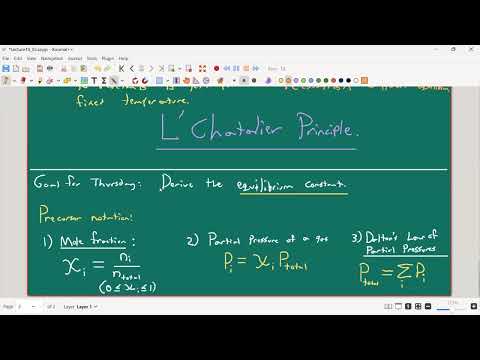
- Dalton's law says a mixture's total pressure is the sum of its component partial pressures.
- A gas's partial pressure is proportional to its mole fraction and, at fixed temperature, tracks concentration without requiring the gas volume.
- Equilibrium quotients for gases can therefore be written using partial pressures, with pressure ratios referenced to the 1-bar standard state.
- At constant temperature and chemical equilibrium, the pressure-dependent Gibbs-energy differential reduces to dG = V dP.
- Using the ideal-gas relation V = RT/P and integrating from standard pressure to pressure P gives G(P) = G° + RT ln(P/P°).
- Doubling a gas's pressure adds RT ln 2 to its Gibbs energy; lowering pressure shifts it by the corresponding logarithmic amount.
- The reaction Gibbs energy is the stoichiometric sum of product Gibbs energies minus the corresponding sum for reactants.
- Substituting G(P) = G° + RT ln(P/P°) gives ΔG = ΔG° + RT ln Q, where Q combines normalized partial pressures raised to stoichiometric powers.
- For solutions, the analogous quotient uses concentrations or, more rigorously, dimensionless activities.
- Q changes with the current composition during a reaction, while K is its value specifically at chemical equilibrium.
- Setting ΔG to zero at equilibrium yields ΔG° = -RT ln K.
- For a simple A ⇌ B system, the equilibrium abundance ratio follows an exponential dependence on the Gibbs-energy difference, analogous to Boltzmann statistics.
- Seifert analyzes PCl₅(g) ⇌ PCl₃(g) + Cl₂(g), a decomposition that changes the total number of gas molecules.
- He defines the gas equilibrium expression using partial pressures and includes the 1-bar standard pressure so the quotient is dimensionless.
- An ICE-style setup begins with 1 mole of PCl₅ and no products, then tracks reaction progress with an extent variable.
- For reaction extent n, the amounts are 1 − n moles of PCl₅ and n moles each of PCl₃ and Cl₂.
- The total gas amount is 1 + n moles, so each partial pressure follows from its mole fraction multiplied by total pressure.
- Substituting those mole fractions into K shows that the equilibrium composition depends on both the fixed equilibrium constant and total pressure.
- At fixed temperature, K is constant, so raising total pressure requires the dissociation extent to decrease for PCl₅ ⇌ PCl₃ + Cl₂.
- The reaction produces two gas molecules from one, so high pressure favors the side with fewer gas molecules, PCl₅.
- A value of K greater than one alone does not establish the composition under every condition; pressure also matters.
- The lecture explains pressure effects through the PV work needed to occupy a volume: forming two gas molecules instead of one increases the gas-side space-filling burden.
- High pressure makes that burden more consequential and favors the lower-mole PCl₅ side in the dissociation equilibrium.
- In dilute liquid reactions, solvent-dominated molar volumes often change little between reactants and products, making comparable pressure effects less prominent.
- Seifert recounts analyzing NO₂, a toxic brown gas that forms other nitrogen oxides, including N₂O₄.
- His thermodynamic analysis indicated that lowering pressure could favor the desired NO₂ composition over association products.
- He transferred a small amount from a roughly 250 mL, 40-bar lecture bottle into an empty helium cylinder of about 100 L, then let it equilibrate for a week before preparing a sample.
- A branching reaction A ⇌ B or A ⇌ C raises the practical question of how much the two pathways' Gibbs energies must differ to favor one product.
- The example targets a 10:1 ratio of product concentrations, a useful benchmark for synthesis, catalysis, and pharmaceutical chemistry.
- The equilibrium constants for A ⇌ B and A ⇌ C can be combined so the common reactant concentration cancels.
- Using the Boltzmann-like relation between product ratio and Gibbs-energy difference, Seifert sets the desired ratio to 10 at 298.15 K.
- The calculation gives an energy difference of RT ln 10, approximately 5.7 kJ/mol.
- That modest energy shift can strongly change product selectivity without requiring an entire chemical bond to be made or broken.
- A product that gains one solvent hydrogen bond can differ in Gibbs energy by roughly 12 to 20 kJ/mol, enough to substantially alter its abundance.
- Drug designers tune functional groups to adjust interactions such as hydrogen bonding and improve fit within a protein binding pocket.
- The lecture connects small interaction-energy changes to large differences in binding efficacy and reaction selectivity.
- Seifert describes a binding comparison in which molecules differed by about 6 kJ/mol, with a reported order-of-magnitude effect on binding.
- Lost hydrogen bonding and a few kJ/mol of molecular strain can make an otherwise similar candidate much less effective.
- Compared with a carbon-carbon single bond energy of about 450 kJ/mol, these small energy differences explain why fine molecular tuning matters in drug and materials design.
Transcript excerpt
0:00 Just like we're really good at fitting lines to things in this class, physics is just one more step where it's functions of multip of multiple powers. All right, it's gotten quiet. I guess I'll just start talking. Um, yeah, so we're field equilibrium. Uh, we kind of stopped in the middle and I want to pick back up. So, I'm going to need a few minutes to catch this up. Um, yeah. So this is going to be a kind of a theoryheavy c lecture a little bit the first half and then we'll kind of move to applications and then after that it's pretty much all applications for the rest of the module. Um, so we were talking about chemob equilibrium and and I and our goal that I wrote at the la at the end of last class was that our goal was to derive
0:48 equilibrium constant um and we're taking a long path to get there um from the ground up. And so let me talk a little bit about what that that ground level looks like first. But we're having a chemical reaction between two generic reactants and two generic products of some arbitrary stokometric ratio. Have some stoometric coefficients. Uh I can I can put whatever I want here but just keep it general. We're going to make some assumptions about this reaction. First we're going to fix temperature and pressure. where we're going to see um because we're working with gases, pressure is going to be in some sense the concentration of the system uh or
1:36 proportional to the total amount of molecules in the system. So changing pressure kind of just means that we're putting more molecules or less molecules in. So we're just going to kind of think what I mean by fixed pressure is we're
This is the start of the transcript. Save this video free for the whole transcript, searchable and time-coded.
In this course
Related notes
Summary, takeaways, and chapters were generated by AI from the video's transcript and may contain errors. The video belongs to its creator, Nathan Seifert.