Lecture 15 - Enthalpy, Pt. 3: Thermochemistry
 Watch on YouTube →
Overview
Nathan Seifert connects heating curves to heat capacity, enthalpy, and entropy, then explains how chemistry defines formation enthalpies relative to stable elemental standard states rather than an unhelpful universal zero at 0 K. He uses methane formation, thermochemical reaction networks, NIST Chemistry WebBook data, and Excel calculations to show how measured reaction enthalpies and temperature-dependent heat capacities support estimates of molecular stability and phase transitions.
Key takeaways
- At constant pressure, Cp = (∂H/∂T)p, so integrating Cp over temperature yields enthalpy change, while integrating Cp/T yields entropy change.
- Elemental standard forms such as graphite, H2 gas, and O2 gas are assigned formation enthalpy zero by convention; this chemically useful reference distinguishes compounds in a way that a universal 0 K zero cannot.
- Methane's standard formation reaction, graphite + 2 H2 → CH4(g), has ΔHf ≈ −74.5 kJ/mol, while atomizing its graphite and hydrogen reactants requires roughly 1,150 kJ/mol before bond formation releases energy.
- Thermochemical data systems infer formation enthalpies from networks of measured reactions; the water example cited uses 317 reactions representing 90% of the statistical weight.
- NIST polynomial data show water-vapor heat capacity changing from about 33 to 37 J mol−1 K−1 over several hundred kelvin, demonstrating that constant heat-capacity assumptions are approximations.
- Comparing temperature-dependent liquid and gas enthalpies gives vaporization enthalpy, while Gibbs free-energy differences determine phase boundaries where the transition free energy reaches zero.
Chapters
- For water boiling in an open pot, pressure stays constant while heat input raises the liquid temperature, holds it steady during vaporization, then heats the gas.
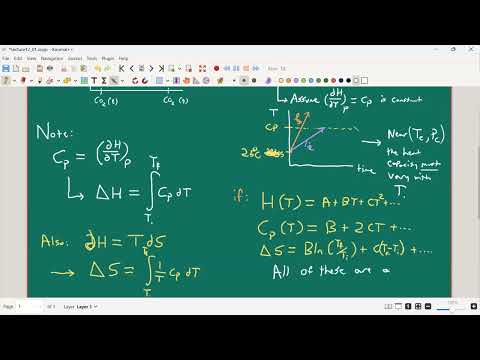
- Because the graph plots temperature against heat, its slope is proportional to the inverse of heat capacity; the more gradual liquid slope indicates a larger heat capacity than the gas.
- At the boiling plateau, added heat drives vaporization without raising temperature, which Seifert describes as an effectively infinite heat capacity during the phase change.
- Freezing, melting, and sublimation show analogous heating-curve plateaus.
- In a sealed carbon dioxide vessel, liquid and gas approach one another and become indistinguishable at the critical point.
- If gas and liquid heat capacities stayed constant, their heating curves would remain straight lines with different slopes and would never meet.
- Near the critical temperature and pressure, the gas becomes more liquid-like and the liquid more gas-like, so their heat capacities vary as the phases converge.
- Water's familiar heat capacity of 4.184 J per gram per kelvin applies near 25 °C, not universally near boiling or a critical point.
- At constant pressure, heat capacity is defined as the derivative of enthalpy with respect to temperature: Cp = (∂H/∂T)p.
- The enthalpy change from Ti to Tf is the integral of Cp dT over that temperature interval.
- Using dH = T dS, the entropy change is the integral of Cp/T dT from Ti to Tf.
- Knowing Cp as a function of temperature therefore makes it possible to calculate both enthalpy and entropy changes.
- Chemistry experiments generally measure changes in enthalpy, not absolute enthalpies, so calculations require a defined reference state.
- Seifert frames the goal as assigning chemical reference enthalpies that can be used to calculate material enthalpies, entropies, and eventually Gibbs free energies.
- The method builds molecular energy information from measurable reaction enthalpies rather than treating heat content as an absolute quantity.
- Seifert considers one mole of benzene at about 300 K and 1 bar, then tests the idea of defining its enthalpy as zero at 0 K.
- That reference fails chemically because every molecule would have the same assigned zero enthalpy at 0 K.
- Benzene and its high-energy structural isomer Dewar benzene would both appear to have zero enthalpy at that reference, despite their very different stability.
- A useful standard must preserve energy differences among molecules, not merely set the thermal energy of every substance to zero.
- Seifert proposes chemical primitives, stable and readily available reference forms assigned zero standard enthalpy by convention.
- At 298.15 K and 1 bar, oxygen's reference is O2 gas and hydrogen's is H2 gas, rather than isolated atoms.
- Reaction enthalpies can then connect those elemental references to compounds such as H2O, allowing unknown formation enthalpies to be inferred from measured reactions.
- The elemental reference choices are practical and terrestrial, selected for stable, common forms rather than hypothetical species.
- Carbon uses graphite rather than methane, which contains hydrogen, or diamond, which is not the stable common form at room conditions.
- Common reference examples include H2, O2, N2, F2, helium gas, and solid elemental metals.
- Seifert describes the ATcT thermochemical data list, where elemental standard forms such as graphite and crystalline silicon have formation enthalpy zero by definition.
- Atomizing or changing the phase of an element from its standard form can require energy, so isolated H atoms and gaseous carbon have positive formation enthalpies.
- The standard formation reaction is graphite plus 2 H2 gas forming CH4 gas; the tabulated methane formation enthalpy is −74.5 kJ/mol.
- Seifert estimates atomizing two H2 molecules costs 2 × 217 kJ/mol, or 434 kJ/mol, and vaporizing graphite to gaseous carbon costs about 716 kJ/mol.
- Those atomization steps total about 1,150 kJ/mol before carbon and hydrogen atoms recombine into methane.
- Forming methane releases enough energy to leave its enthalpy below the graphite-plus-hydrogen reference, illustrating why its formation enthalpy is negative.
- A negative formation enthalpy for methane indicates it is lower in enthalpy than graphite plus 2 H2 at the reference conditions, though that fact alone does not establish reaction rate or completion.
- Seifert contrasts methane's strong C-H bonding with ethylene, whose C-C double bond and overall bonding make its formation less favorable by comparison.
- Formation enthalpies help track energy stored in reactants and products, including why breaking and rearranging hydrocarbons can favor stable products such as methane.
- The practical target is usually the enthalpy difference between reactants and products, rather than the isolated value for a single molecule.
- Directly cracking H2 and O2 and recombining the atoms to form water is experimentally difficult, so formation enthalpies are inferred indirectly.
- The Active Thermochemical Tables approach combines measured reactions that share species, treating each reaction enthalpy as products' formation enthalpies minus reactants' formation enthalpies.
- For water, Seifert cites 317 reactions accounting for 90% of the statistical weight in the reported formation enthalpy estimate.
- A weighted statistical fit across interconnected reactions produces mutually consistent formation enthalpies for species such as H2O and CH4.
- Formation enthalpies provide reference values, but predicting a reaction at another temperature also requires temperature-dependent thermochemical properties.
- The NIST Chemistry WebBook lists gas and condensed-phase data for water, including formation enthalpy, standard entropy, and heat-capacity information.
- NIST presents temperature-dependent properties through polynomial expressions, so their coefficients can be used to evaluate enthalpy or heat capacity at selected temperatures.
- Because heat capacity links enthalpy and entropy to temperature, one property function can support calculations of all three.
- Seifert copies NIST polynomial coefficients into Excel and creates a temperature column beginning at water's freezing point, 273 K.
- The formulas use temperature scaled by 1,000 and polynomial terms, including inverse-temperature terms, to calculate heat capacity.
- Excel can extend equally spaced temperatures by selecting two values and dragging the fill handle.
- The resulting spreadsheet supplies heat-capacity values across a range of temperatures for later enthalpy and entropy calculations.
- The calculated gas-phase water heat capacity rises from roughly 33 to 37 J mol−1 K−1 over several hundred kelvin.
- That temperature dependence contrasts with the constant heat capacity assumed for an ideal gas in a simplified calculation.
- The variation is modest over the displayed range but demonstrates why constant-Cp approximations can miss behavior at changing temperatures.
- Seifert evaluates the NIST enthalpy polynomial for water vapor and notes that its enthalpy increases with temperature.
- Since heat capacity is the derivative of enthalpy, the rising heat capacity gives the enthalpy curve a slight upward bend.
- Comparing liquid and gas enthalpies at the same temperature gives the enthalpy of vaporization; analogous comparisons apply to fusion.
- The next step is Gibbs free energy: phase boundaries occur where the free-energy change for a transition is zero.
- In the closing question period, Seifert says isotopes usually have little effect on chemical bond enthalpies because electronic structure dominates molecular bonding.
- He identifies isotope-dependent heat-capacity effects as subtle and notes that a more complete treatment requires the Born-Oppenheimer approximation.
- The discussion also returns to the caveat that molecular energy at 0 K is not exactly zero in a full physical treatment.
Transcript excerpt
0:00 Let's keep on grinding through enthalpy today. Um I'm going to step away from phase transitions for a short bit. We'll come back to them. Um I want to talk today about enthalpy in particular. Um so let me just set the stage a little bit from last class, catch us up a bit, make a few comments about um our observations, and then I want to do something slightly different today. So we wanted to look at the thermmochemistry or the thermodynamics of of of a phase transition. So the example I gave you was was boiling in a pot on the stove, right? We have an open container got some water in it and inside of that container is some liquid, some water gas and that gas is in constant exchange with the atmosphere. Okay? So the pressure is constant on the
0:47 system. The only thing that's changing in some sense the the densities of the material are allowed to change um and uh which is the volume right um of the material and the temperature is allowed to change which we induce by implying a heating coil and I showed you that what we're going to look at is is thinking about the temperature of the material as a function of time as we heat or or as a function of the applied heat from the coil. And what we saw with boiling, we walk through that the liquid heats slowly. It starts to boil and then that boiling fluid, it's temperature stays constant as it boils. And it's not until you boil all the liquid off and you only have gas that the system starts to heat again.
1:35 And of course, the gas heats much more rapidly than the liquid, right? And we talked about how these slopes
This is the start of the transcript. Save this video free for the whole transcript, searchable and time-coded.
Related notes
Summary, takeaways, and chapters were generated by AI from the video's transcript and may contain errors. The video belongs to its creator, Nathan Seifert.