Lecture 19 - Free Energy, Pt. 3: Chemical Equilibrium
Overview
Nathan Seifert frames chemical equilibrium as the long-time state where a reaction has no net thermodynamic drive, distinguishing it from thermal equilibrium and from kinetics, which describes how quickly equilibrium is approached. For a generic gas-phase reaction A + B ⇌ C + D with arbitrary stoichiometric coefficients, he connects equilibrium to Gibbs energy and chemical potentials at fixed temperature and pressure, then introduces Le Chatelier’s principle, mole fractions, partial pressures, and Dalton’s law as preparation for deriving the equilibrium constant.
Key takeaways
- Thermal equilibrium and chemical equilibrium are independent conditions: a reaction can have a uniform fixed temperature while its reactant and product amounts continue to change.
- Equilibrium describes the final composition, while kinetics describes the time-dependent path and rate by which a system approaches that composition.
- At fixed temperature and pressure, Gibbs-energy changes from reaction progress are governed by component chemical potentials and stoichiometric mole changes.
- Adding a component perturbs an equilibrium mixture, prompting a reaction response that tends to counter the perturbation; the equilibrium constant remains tied to temperature.
- For ideal gas mixtures, a component’s partial pressure is its mole fraction multiplied by total pressure, and Dalton’s law gives total pressure as the sum of partial pressures.
- The lecture sets up applications of equilibrium to ammonia synthesis through the Haber process and to molecular binding between drugs, enzymes, and receptors.
Chapters
- Nathan Seifert positions chemical equilibrium as a multi-lecture topic and approaches it through thermodynamics rather than only general-chemistry rules.
- He contrasts product-making reactions often emphasized in organic chemistry with cases where reactants and products coexist in equilibrium.
- The central goal is to explain how temperature, pressure, and starting amounts affect equilibrium composition.
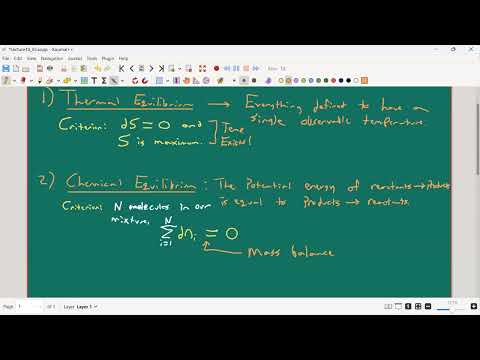
- Thermal equilibrium means the system has one temperature; Seifert relates it to maximum entropy under the relevant constraints.
- A reaction held in a fixed-temperature bath can be thermally equilibrated while its reactant and product amounts are still changing.
- Chemical equilibrium occurs when the opposing thermodynamic drives for reactants-to-products and products-to-reactants balance.
- For A ⇌ B starting with one mole of A and no B, A decreases and B increases until both concentrations level off.
- At long times, the concentration derivatives with respect to time approach zero, marking the equilibrium state.
- Kinetics studies the earlier time-dependent slopes and the rate of approach; equilibrium analysis concerns the final composition, not the reaction speed.
- Seifert frames the next analysis around which system properties determine the final concentrations of every reacting component.
- The intended output is the equilibrium relationship between products and reactants given system conditions and initial amounts.
- The lecture shifts from observing concentration curves to deriving a general thermodynamic toolkit.
- The model reaction has two reactants, A and B, forming C and D, with arbitrary stoichiometric coefficients denoted by μ in the lecture.
- The discussion begins with gases to avoid complications from non-ideal solutions, ionic mixtures, and activity coefficients.
- The assumptions are fixed temperature and pressure, a balanced reaction, ideal-gas behavior, and enough time for equilibrium to be reached.
- At constant temperature and pressure, the −S dT and V dP terms in the Gibbs-energy differential vanish.
- The remaining contribution is a sum of component chemical potentials multiplied by changes in mole amounts.
- The equilibrium condition requires no net Gibbs-energy change for a reaction shift consistent with its stoichiometry.
- Seifert defines chemical potential through the change in Gibbs energy with respect to a component’s mole amount at fixed temperature and pressure.
- Its units are joules per mole, because a chemical potential multiplied by a change in moles contributes energy in joules.
- The component-based chemical potentials determine the thermodynamic push or pull associated with changing the mixture.
- The lecture relates Gibbs energy to enthalpy and entropy through G = H − TS, using formation enthalpies and standard entropies as thermochemical inputs.
- Seifert connects this calculation to the preceding problem set, where students used heat capacities and numerical integration to obtain temperature-dependent thermodynamic quantities.
- He emphasizes that the chemical-potential values, rather than the absolute sign of a formation Gibbs energy, matter for comparing reaction states.
- A schematic energy comparison places A and B above C and D, illustrating a product-favored reaction with a negative reaction Gibbs energy.
- Adding extra A perturbs the equilibrium mixture and changes the system’s Gibbs energy by a contribution associated with A’s chemical potential.
- The system responds through reaction shifts that oppose the perturbation and move the mixture toward equilibrium again.
- Seifert describes equilibrium restoration after adding reactant and stresses that the equilibrium constant is fixed at a given temperature.
- He distinguishes isothermal conditions from an insulated sample that cools or warms during a phase transition.
- Using a naphthalene-biphenyl melting experiment as an example, he explains that a temperature-controlled bath can absorb or supply heat to keep temperature constant.
- The next derivation will connect the equilibrium constant to products and reactants raised to their stoichiometric powers.
- Mole fraction is defined as a component’s moles divided by total moles, ranging from zero to one.
- Partial pressure is defined as total pressure multiplied by mole fraction, setting up calculations for gas-phase equilibria.
- Dalton’s law states that total gas pressure is the sum of the component partial pressures; Seifert dates John Dalton’s observation to 1801 and publication to 1802.
- A historical aside credits Antoine Lavoisier with foundational modern chemistry work, including naming oxygen and advancing conservation of mass.
- Planned applications include the Haber process and ammonia fertilizer production, plus equilibrium in drug, enzyme, and receptor binding.
Transcript excerpt
0:00 I think everyone's why I'm here first place was simply man I just like on the mechanics Um So if you're doing that Um and I'm on one of my not my favorite topic but getting close to my favorite topic uh which is chemical Second of the last topics that we'll cover Um and I'm in fact I will introduce one of technically the last topic is because it's part of equilibrium Um so I want to talk about chemical equilibrium for the next week or two until basically right before Thanksgiving Um maybe three or four lectures Um we're going to look at it in a a a more kind of big picture way then maybe not even big picture a more technical way to do it in in general chemistry I want to understand how is chemical equilibrium how does it
0:47 play a role in the same way that entropy and volume changes work and heats how they all interconnect So I want to stick to this perspective of thermodynamics that we're learning in this class and I want to look from and from a a chemical equilibrium that perspective Um and and we're going to end up coming to conclusions that you're you've seen me We're going to write down equations for equilibrium that you've seen in Gen Chem Not in some sense the conclusions aren't new the way that we look at equilibrium is different than we do I'll try to highlight that over the next two lectures in particular about what have you missed since some Gen Chem about equilibrium What are some of the things that we can use in order to from a P Chem perspective that maybe is
1:35 missing that equilibrium is one of those weird concepts that you learn you and
This is the start of the transcript. Save this video free for the whole transcript, searchable and time-coded.
In this course
Related notes
Summary, takeaways, and chapters were generated by AI from the video's transcript and may contain errors. The video belongs to its creator, Nathan Seifert.