Lecture 14 - Enthalpy, Pt. 2
 Watch on YouTube →
Overview
Nathan Seifert uses boiling and the CO2 critical point to connect phase transitions with calorimetry, heat capacity, and enthalpy. He derives heat capacity from the slope of a temperature-versus-heat curve, calculates a CO2 vaporization enthalpy of about 19.4 kJ/mol from tabulated formation enthalpies, and shows how integrating heat capacity explains temperature-dependent enthalpy differences.
Key takeaways
- At constant pressure, heat capacity is Cp = (∂H/∂T)p; a material that warms slowly under steady heating has a larger heat capacity.
- During boiling at constant pressure, supplied heat can vaporize material while temperature remains nearly constant, so the effective heat capacity of the two-phase mixture becomes very large.
- CO2's critical point is not ordinary boiling: the liquid-gas density difference and visible boundary vanish, leaving a single supercritical phase.
- Using formation enthalpies of −412.868 kJ/mol for liquid CO2 and −393.477 kJ/mol for gaseous CO2 gives a vaporization enthalpy of about +19.4 kJ/mol.
- When Cp depends on temperature, enthalpy changes must be calculated by integrating Cp(T) over the temperature interval.
- A positive vaporization enthalpy does not by itself determine whether boiling is spontaneous; Gibbs free energy is needed to explain why vaporization proceeds at the boiling point.
Chapters
- Nathan Seifert distinguishes ordinary liquid-to-gas boiling from crossing CO2's critical point, where the liquid-gas boundary disappears.
- Below the critical point, liquid and gas coexist; beyond it, there is one supercritical fluid and no liquid-to-gas boiling process.
- The lecture uses phase transitions to introduce enthalpy and prepare for Gibbs free energy in the following class.
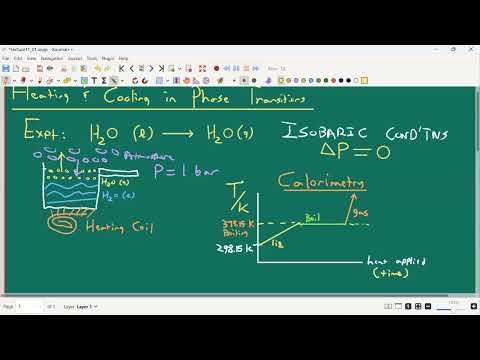
- An open pot of water represents isobaric heating at roughly 1 bar, with heat supplied by a stove coil.
- On a temperature-versus-applied-heat plot, liquid water warms toward its 373 K boiling point, then stays near that temperature while boiling.
- After the liquid has boiled away, the remaining vapor heats much faster because the liquid no longer absorbs heat.
- Boiling and freezing proceed locally over time, such as bubbles forming in a pot or an ice cube freezing inward from its edges.
- A constant-volume demonstration begins near 29 to 30 °C with liquid CO2 and a gas layer in a pressurized container.
- Adding CO2 while raising temperature balances condensation from pressure against expansion from heating.
- Near the critical point, the visible phase boundary becomes cloudy and disappears; above it, the container holds one uniform-density phase.
- Cooling restores the boundary, and the observed cloudiness is associated with physical changes near the critical point.
- The boiling curve has a temperature plateau while added heat converts liquid into gas over time.
- Seifert contrasts that plateau with the critical-point crossing, where the two phases become indistinguishable rather than one phase boiling into the other.
- The lecture frames these as two distinct transition behaviors and uses their calorimetry curves to compare material properties.
- At constant pressure, the inverse slope of temperature versus supplied heat corresponds to the change in enthalpy per change in temperature.
- Heat capacity is defined as Cp = (∂H/∂T)p, the heat required to raise a sample's temperature by one kelvin at constant pressure.
- A flatter temperature rise under steady heating indicates a larger heat capacity; the lecture uses liquid and gas heating curves to illustrate this relationship.
- Seifert cites water's familiar specific-heat value of 4.184 J per gram per kelvin, though the transcript labels it as a molar value.
- During equilibrium boiling at constant pressure, added heat can drive vaporization without raising temperature, giving the two-phase mixture a very large effective heat capacity.
- Water-based engine coolant absorbs heat during boiling and transfers it through a condenser or radiator for recirculation.
- Seifert contrasts liquid-cooled engines with air-cooled Porsche 911s, which switched to liquid cooling in the early 1990s as engine heat loads increased.
- The lecture argues that heat absorption changes sharply once coolant has boiled away, increasing the risk of engine overheating.
- If Cp changes with temperature, a temperature-versus-enthalpy plot is curved rather than a straight line.
- For a curved heating relation, Seifert differentiates temperature with respect to enthalpy and takes the reciprocal to obtain heat capacity at a given state.
- The lecture shows how a quadratic temperature-versus-enthalpy model can yield a heat capacity that varies with temperature.
- A single tabulated heat-capacity value therefore applies at a stated temperature, rather than necessarily describing a material over its full temperature range.
- Seifert links heat capacity to how much heat and entropy a material can accommodate for each kelvin of temperature change.
- As temperature rises, additional molecular motions and accessible states can change a material's heat capacity.
- The temperature dependence of heat capacity will matter when calculating enthalpy changes and later discussing free energy.
- The example uses standard conditions of 298.15 K and 1 bar to discuss CO2 vaporization enthalpy.
- Reaction enthalpy is calculated as product enthalpy minus reactant enthalpy, using tabulated enthalpies of formation.
- Seifert introduces the ATcT thermochemical tables, a Department of Energy-backed source for precise formation enthalpies.
- Formation enthalpies are relative values: elemental reference states are assigned zero, and other materials are measured against those references.
- The cited liquid CO2 formation enthalpy is −412.868 kJ/mol, while the gas value is −393.477 kJ/mol.
- Subtracting the liquid value from the gas value gives a vaporization enthalpy of approximately +19.4 kJ/mol.
- That positive difference means energy must be supplied to vaporize CO2 at the specified reference conditions.
- Enthalpy alone does not determine whether boiling occurs spontaneously; the lecture reserves that question for the Gibbs free-energy discussion.
- An enthalpy diagram places liquid CO2 below gaseous CO2 at the reference temperature, with a gap of about 19.4 kJ/mol.
- The lecture interprets the gap as energy needed to move from the lower-enthalpy liquid state to the gas state.
- For water, the molecular interactions to overcome include hydrogen bonding; for CO2, vaporization likewise requires overcoming intermolecular attractions.
- From Cp = (∂H/∂T)p, Seifert writes dH = Cp(T)dT and integrates between a reference temperature and a target temperature.
- The resulting enthalpy change is the integral of heat capacity over temperature, not simply Cp multiplied by temperature when Cp varies.
- A constant heat capacity permits a simple linear calculation, while a temperature-dependent Cp requires its functional form and integration.
- The example uses a gas heat capacity near 20.8 J mol−1 K−1 and a liquid value around 50 J mol−1 K−1.
- Because liquid CO2 has the larger heat capacity in this example, its enthalpy rises faster than the gas enthalpy as both are heated.
- The enthalpy gap between liquid and gas consequently narrows at higher temperature, making the calculated vaporization enthalpy smaller.
- The numerical calculation is presented as an approximation, with a more rigorous treatment promised for the next class.
- At the boiling temperature, water begins to vaporize without continued temperature increase, yet vaporization still requires a positive enthalpy input.
- Seifert ends by posing the unresolved question: how can boiling proceed spontaneously if the enthalpy change remains positive?
- The next lecture is set to calculate the vaporization enthalpy at 373 K and use Gibbs free energy to explain the apparent contradiction.
Transcript excerpt
0:03 All right, everybody. Hi. Um let's keep on grinding through phase transitions. I promised you a video today Nile Red. Fortunately, I don't have a Nile Red video for you, but I do have a video. Um I want to motivate our conversation. So, actually going to kind of drift stay around phase transitions, but I want to work with phase transitions in context of building skills. And this week's really going to be about intro. Um and you'll see next week is really going to be about Gibbs free energy. That's what we'll introduce next. Um but I like to do it in the context of phase transitions because our processes that are in some sense what talk about what the difference between a physical and a chemical transformation is. I know your gen chem instructor always tell you that a phase transition
0:50 is a physical transformation of the material. And I I want to imply that there's some subtlety to that that that that terminology. And that really what is the difference between a physical transformation and chemical transformation? It's not so clear. Especially in phase transition. One of the things that I I hinted at last class, and if you don't remember, that's okay. We're going to talk about it plenty today. You'll see it time and time again. That there there in some sense it seems like there's two different types of phase transition. All right? And that and I'll show you one today. Though there you can boil something and freeze or liquefy something. I think you all know what that looks like. And we'll go back and and think about the the boiling and the little and
1:37 condensing from a a physical point of view in a second. But one of the things I showed you was
This is the start of the transcript. Save this video free for the whole transcript, searchable and time-coded.
Related notes
Summary, takeaways, and chapters were generated by AI from the video's transcript and may contain errors. The video belongs to its creator, Nathan Seifert.