Lecture 12 - The van der Waals fluid
 Watch on YouTube →
Overview
Nathan Seifert connects the Lennard-Jones interaction potential to the van der Waals equation of state, using molecular size and attraction corrections to explain why real gases can depart from ideal-gas behavior and form liquid phases. A constant-temperature CO₂ example illustrates the emergence of condensation near its critical temperature, while the equation’s critical point is characterized by vanishing first and second pressure derivatives with respect to volume.
Key takeaways
- The van der Waals equation adds a finite-size correction b and an attractive correction a/V̄² to the ideal-gas law: P = RT/(V̄ − b) − a/V̄².
- At low pressure, molecules are too far apart for their interactions to matter; at high temperature, thermal energy overwhelms those interactions. Both limits move gas behavior toward Z = 1.
- The cubic volume dependence in the van der Waals equation permits multiple real solutions, providing a simple model-level explanation for distinct gas and liquid states.
- A pressure plateau during CO₂ compression near its critical temperature indicates that added material is condensing rather than raising the gas pressure.
- The critical point satisfies both (∂P/∂V̄)T = 0 and (∂²P/∂V̄²)T = 0; the van der Waals model predicts V̄c = 3b, Tc = 8a/(27Rb), and Pc = a/(27b²).
Chapters
0:00
Lennard-Jones Interactions and the Pressure-Dependent Mean Free Path
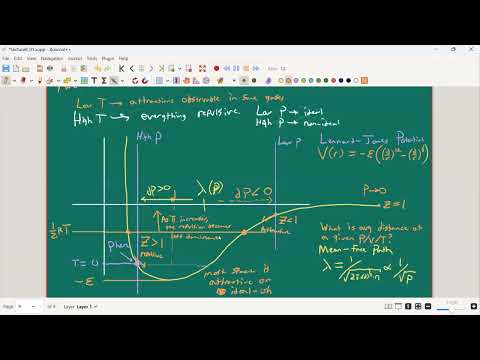
- The Lennard-Jones potential describes pairwise interactions, with its well depth and equilibrium distance depending on the interacting molecules.
- Pressure changes the average distance molecules travel before collisions—the mean free path—which decreases as pressure rises.
- At high pressure, molecules sample the repulsive side of the potential; at low pressure, they are farther apart and approach ideal-gas behavior.
5:00
Why Attractive Forces Make the Compressibility Factor Less Than One
- When molecules sample the attractive part of the potential, their interactions lower the measured pressure relative to an ideal gas, giving Z < 1.
- At very low pressure, intermolecular forces become negligible and Z approaches 1.
- At sufficiently high pressure, short-range repulsions dominate and the expected compressibility factor rises above 1.
10:00
Temperature Adds Kinetic Energy to the Interaction Potential
- For an ideal monatomic gas, translational kinetic energy averages 3/2 RT per mole, or 1/2 RT per independent direction.
- At fixed pressure, increasing temperature raises the thermal energy relative to the intermolecular potential.
- As temperature becomes very high, interactions matter less and Z approaches the ideal-gas value of 1.
15:00
Replacing Lennard-Jones Integrals with the van der Waals Model
- Integrating the Lennard-Jones potential to obtain an equation of state requires complicated contributions from inverse powers such as r⁻⁶ and r⁻¹².
- Seifert introduces the van der Waals model as a simpler approximation that retains two physical effects: molecular size and attraction.
- The model modifies the ideal-gas equation using molecule-dependent parameters rather than evaluating the full interaction potential.
20:00
Finite Molecular Size and the van der Waals b Parameter
- Unlike ideal-gas particles, which are treated as having zero volume, van der Waals particles occupy finite space.
- Seifert relates the particle size to the Lennard-Jones distance parameter D and describes b as the finite-size correction to molar volume.
- The excluded-volume correction is molecule-specific because different substances have different molecular sizes.
25:00
Modeling Attraction with a Hard-Core Potential
- The van der Waals picture replaces a soft Lennard-Jones repulsive wall with an impenetrable hard core.
- In the simplified potential, the energy becomes infinite inside the hard-core distance and is attractive outside it.
- This step-like potential is a deliberately simple way to represent finite size and intermolecular attraction.
30:00
The van der Waals Equation: Volume Exclusion and Attraction
- The molar van der Waals equation is P = RT/(V̄ − b) − a/V̄², where V̄ is molar volume.
- The b term corrects for finite molecular size, while the a/V̄² term lowers pressure because attractions pull molecules together.
- The attraction correction scales with the square of density because it represents interactions between pairs of molecules.
35:00
Why the van der Waals Equation Can Have Multiple Volume Solutions
- Rearranging the van der Waals equation at fixed pressure and temperature produces a cubic equation in volume.
- Unlike the ideal-gas equation, which gives a single volume for fixed pressure and temperature, a cubic can admit multiple real solutions.
- Multiple mathematical solutions suggest that the model may describe distinct physical states under the same conditions.
40:00
A Constant-Temperature CO₂ Experiment in Pressure–Volume Space
- The proposed experiment holds a sealed CO₂ sample in a temperature-controlled bath and adds gas while measuring pressure.
- The plotted independent variable is molar volume, the inverse of molar density; the illustrated pressure range is about 40–100 bar.
- At high temperatures, including roughly 40–100 °C in the example, the measured curves look approximately like ideal-gas isotherms.
45:00
CO₂ Isotherms Develop a Flat Region Near 31–32 °C
- As the CO₂ sample cools toward approximately 32 °C, its pressure–volume curve develops a hump and a changing-curvature region.
- Near 31 °C, the curve reaches a point where dP/dV at constant temperature is zero.
- Seifert corrects an initial description: zero slope indicates an extreme response to compression, not an incompressible gas.
50:00
A Pressure Plateau Signals Gas–Liquid Condensation
- Along a flat pressure region, additional CO₂ can enter the container without a corresponding rise in gas pressure.
- The interpretation is that added molecules enter a condensed phase rather than increasing the gas density.
- During phase coexistence, the gas pressure remains approximately fixed while the relative amounts of gas and liquid change.
55:00
The Critical Point Marks the End of the Gas–Liquid Coexistence Region
- Below the critical temperature, the CO₂ isotherms show a condensation region; above it, the illustrated curves have no liquid–gas coexistence plateau.
- The critical point is the limiting condition where the coexistence region first appears or disappears.
- The lecture uses experimental CO₂ behavior to connect the van der Waals model’s multiple solutions with the existence of distinct phases.
1:00:00
Criticality as an Inflection Point on a Pressure–Volume Isotherm
- At the critical point, the pressure–volume curve is neither at a maximum nor a minimum; it is an inflection point.
- The defining conditions are (∂P/∂V̄)T = 0 and (∂²P/∂V̄²)T = 0.
- Applying both conditions to the van der Waals equation gives two equations that determine the critical temperature and molar volume.
1:05:00
Critical Constants Depend on the van der Waals Parameters
- For the molar van der Waals equation, the critical constants are V̄c = 3b, Tc = 8a/(27Rb), and Pc = a/(27b²).
- The predicted critical temperature reflects the balance between attraction parameter a and size parameter b.
- Each substance has its own critical conditions, but the model predicts critical behavior as a general consequence of intermolecular interactions.
1:10:00
From Coexisting Phases to Enthalpy and Free Energy
- The van der Waals equation is a qualitative model: it captures the possibility of condensation but does not fit real experimental curves perfectly.
- In the coexistence region, the liquid is more stable for added molecules, so the gas can remain nearly unchanged as liquid accumulates.
- Seifert previews the next step: analyze phase changes at fixed pressure using enthalpy, then combine enthalpy and entropy to develop free energy.
Summary, takeaways, and chapters were generated by AI from the video's transcript and may contain errors. The video belongs to its creator, Nathan Seifert.