Lecture 16 - Free Energy, Pt. 1: Spontaneity
 Watch on YouTube →
Overview
Nathan Seifert connects enthalpy and entropy through Gibbs free energy, ΔG = ΔH − TΔS, to explain when processes such as water boiling are thermodynamically spontaneous. He contrasts water vaporization with methane combustion to show that ΔG predicts the favored direction and equilibrium, but not the reaction rate: combustion requires overcoming an activation barrier, a question addressed by chemical kinetics.
Key takeaways
- At constant pressure, ΔG = ΔH − TΔS combines the heat cost of a process with its temperature-weighted entropy change; ΔG < 0 favors the forward direction and ΔG = 0 marks equilibrium.
- Water vaporization illustrates why enthalpy alone is insufficient: at 298.15 K, ΔH ≈ 43 kJ/mol and TΔS ≈ 35.2 kJ/mol give ΔG ≈ +7.8 kJ/mol, while higher temperature makes the entropy contribution large enough to favor vaporization.
- At water’s boiling point, vapor and liquid coexist at equilibrium, so the accurate phase-transition condition is ΔG = 0; Seifert’s estimate of about −4 kJ/mol at 373 K comes from assuming the entropy change stays constant with temperature.
- Methane combustion can have strongly negative ΔG and still proceed slowly because its mechanism requires energy-intensive bond rearrangements before forming CO₂ and H₂O.
- Thermodynamic spontaneity predicts the favored equilibrium direction, not the time required to get there; activation energy and chemical kinetics are needed to explain reaction rates.
Chapters
- Seifert introduces Gibbs free energy as a way to bring together enthalpy and entropy.
- The new homework involves calculating enthalpy and entropy and using Excel for numerical integration of data points.
- He cites gas chromatography, NMR, and mass spectrometry as settings where calculating areas from measured data is useful.
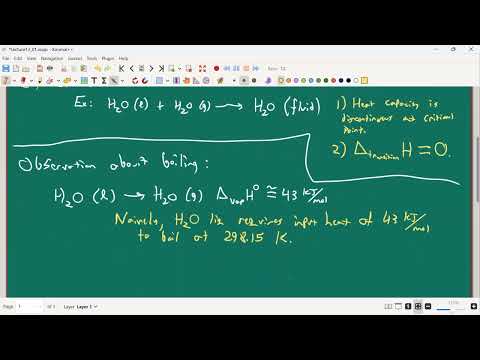
- For water boiling or melting, heat capacity diverges at the transition and the transition enthalpy is nonzero.
- Boiling continues to require heat input even though the temperature stays constant during the phase change.
- At a critical transition, such as liquid and gas merging into a supercritical fluid, Seifert describes heat capacity as discontinuous and transition enthalpy as zero.
- At 298.15 K, vaporizing water requires about 43 kJ/mol, consistent with water not boiling spontaneously at room temperature and pressure.
- Heating water to 373.15 K at 1 bar makes boiling begin, but the vaporization enthalpy remains nonzero.
- The apparent conflict is that boiling starts at 100 °C even though liquid water still requires energy to become vapor.
- Seifert writes the temperature-dependent vaporization enthalpy as the standard value plus the integral of gas heat capacity minus liquid heat capacity.
- Because the liquid heat capacity is treated as greater than the gas heat capacity, the vaporization enthalpy decreases as temperature rises.
- He estimates water’s vaporization enthalpy at 373 K at roughly 38 kJ/mol and relates a zero enthalpy difference to the critical point.
- Enthalpy accounts for internal energy, including the energy needed to disrupt hydrogen bonding, but not the change in molecular arrangement.
- Liquid water has short-range organization: each molecule is generally surrounded by about four neighboring waters in a hydrogen-bond network.
- The gas is more disordered, so vaporization has a positive entropy change that can favor the transition.
- For vaporization, ΔH is positive because heat is required, while ΔS is positive because gas is more disordered than liquid.
- The lecture compares the enthalpy cost with the temperature-weighted entropy contribution, TΔS.
- This balance leads to the Gibbs free energy definition at constant pressure: G = H − TS.
- For a process, ΔG < 0 indicates a thermodynamically favored forward direction, ΔG > 0 indicates the reverse direction is favored, and ΔG = 0 indicates equilibrium.
- Seifert connects these signs to product-favored and reactant-favored reactions.
- He warns that entropy is commonly reported in J/(mol·K), while enthalpy and Gibbs energy are often in kJ/mol, requiring a factor-of-1000 unit conversion.
- Using standard values, Seifert gives ΔHvap ≈ 43 kJ/mol and ΔSvap ≈ 118 J/(mol·K).
- At 298.15 K, TΔS is about 35.2 kJ/mol, leaving ΔG near +7.8 kJ/mol.
- The positive result explains why vaporization is not favored for bulk water under room-temperature conditions.
- For a rough estimate at 373.15 K, Seifert uses an enthalpy near 40 kJ/mol and assumes the entropy change remains 118 J/(mol·K).
- That approximation gives TΔS near 44 kJ/mol and ΔG near −4 kJ/mol, indicating vaporization is favored.
- He notes the estimate is not exact because entropy also changes with temperature; at the boiling point, liquid and vapor are at phase equilibrium and ΔG is zero.
- For CH₄ + 2 O₂ → CO₂ + 2 H₂O, Seifert identifies a strongly negative combustion enthalpy, roughly −450 to −500 kJ/mol.
- He estimates a positive entropy change using approximate gas heat-capacity values: 7R/2 for diatomic gases and 9R/2 for polyatomic gases, yielding about 2R for the reaction.
- The resulting negative ΔG suggests combustion is thermodynamically favored, yet methane and oxygen can remain together in a tank without reacting.
- Seifert distinguishes the eventual equilibrium direction predicted by thermodynamics from the time required to reach it.
- Water vaporization can be observed promptly at its boiling point, while methane and oxygen may persist without combustion at room temperature.
- ΔG contains no time variable, so it cannot determine whether a reaction takes microseconds, years, or longer.
- Boiling mainly requires molecules to escape intermolecular hydrogen-bond interactions, without changing water’s chemical identity.
- Methane combustion requires breaking and forming chemical bonds, including rearranging bonds in CH₄ and O₂ before forming CO₂ and H₂O.
- Breaking stable chemical bonds costs energy, so combustion can require a high-energy intermediate route even when the overall reaction releases energy.
- A reaction mechanism consists of intermediate chemical steps, some of which can be energetically unfavorable even when the total ΔG is negative.
- The energy needed to reach the high-energy state is the activation energy, or barrier, and a spark can supply the initial energy for methane combustion.
- Chemical kinetics will quantify how reaction rates depend on these barriers; Seifert identifies kinetics as a later course topic.
Transcript excerpt
0:00 Let me know if there's anything I can do for otherwise continue on. Um I want to introduce something finish up a few things about enthalpy today. Very very short comments. Um there's a new homework out um that is about enthaly entropy and about calculating them. And we'll see that it also ties into Gibs free energy with phase transitions. And these are the things that we're going to talk about today. Um we're going to try to finally bring things together. Um, and it'll allow us to introduce the idea of free energy of delta G as you guys remember from Gen Cam. Um, let's we'll I'm going to try to justify why it matters. Um, and why it's going to be the most useful number for us in this class going forward. Um, it's going to just tie everything together for us nice. Um, so the homework is out. It's
0:48 out for two weeks. Um, you know, it's due in two Wednesdays, which means it's due on that Friday roughly. Um, it's mostly just Excel. um teach you guys how to integrate something in Excel. Goes through kind of how what's called numerical integration. You take a function and integrate it, but you don't have a function, you just have numbers, x's and y's. I'll teach you how to do that. Um it may require a little bit of intervention in class. We talk about Excel. So, just if you guys get lost, you don't know what the you're doing. Um just let me know and we'll talk about it in class. Plenty of time. It's a really really good uh technique to learn. Um, I wish I learned how to numerically integrate things. Uh, I know it doesn't seem like you want to ever do that. Like half the time most people are
This is the start of the transcript. Save this video free for the whole transcript, searchable and time-coded.
Related notes
Summary, takeaways, and chapters were generated by AI from the video's transcript and may contain errors. The video belongs to its creator, Nathan Seifert.