Lec19 Review2 for Final M2001 Summer26
 Watch on YouTube →
Overview
Shahera Jannah reviews trigonometry, logarithms, exponential functions, polynomial inequalities, rational-function asymptotes, compound interest, and quadratic applications in preparation for the M2001 final. Across worked examples and practice-final questions, she emphasizes checking domains and all solutions, using graphs or unit-circle reasoning for non-special angles, and showing enough work to justify every answer because the final exam offers little or no partial credit on some questions.
Key takeaways
- For trigonometric equations, solve the algebra first, then use the domain and quadrant signs to find every valid angle; for example, cos x=1/2 on 0 to 2π gives 60 and 300 degrees.
- Logarithm solutions must be checked in the original equation because every log argument must be strictly positive; in the example with roots -6 and 4, only x=4 is valid.
- For a polynomial inequality, factor, order all real zeros, and track sign changes using multiplicity; odd-multiplicity roots switch signs, while even-multiplicity roots do not.
- Rational-function asymptotes come from the simplified denominator and the degrees of the numerator and denominator; equal degrees yield the ratio of leading coefficients.
- Use inverse natural logarithms to solve continuous-compounding problems: $16,000 growing to $19,500 at 3.8% continuously takes about 5.21 years.
- Show a checkable method for non-obvious answers, including unit-circle reasoning, a sign chart, an asymptote calculation, or a period calculation, because unsupported answers may receive no credit.
Chapters
0:00
Final-Exam Grading: Show Work for Non-Special Angles
- Shahera Jannah says angles above 90 degrees and answers in quadrants III or IV need supporting work, such as a unit-circle sketch or angle calculation.
- Answers like 135 degrees or 11π/7 are not self-justifying; students should make their reasoning visible to instructors.
- She warns that some final-exam questions receive either full credit or zero, unlike the partial credit offered on the quiz.
3:00
Simplifying a Trigonometric Quotient with Reciprocal Identities
- Rewrite secant as 1/cosine, tangent as sine over cosine, and cosecant as 1/sine.
- Apply keep-change-flip when dividing the resulting fractions; the sine and cosine factors cancel to leave sin²x.
- Jannah identifies this kind of simplification as a likely final-exam question and stresses careful fraction inversion.
5:00
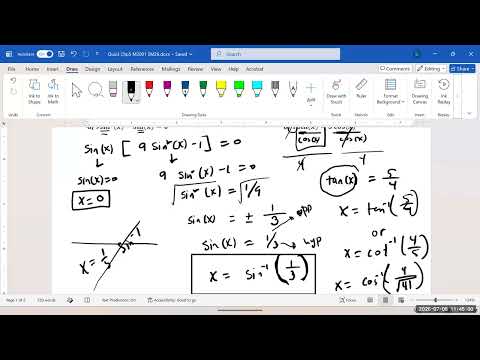
Solving a Sine Equation with Factoring and a Restricted Domain
- Factor the equation as sin x(9 sin²x - 1)=0, then solve each factor separately.
- The sine-zero solutions depend on whether endpoints such as 0 or 2π are included in the stated domain.
- From sin²x=1/9, take both algebraic square-root signs first, then use the domain to decide which values are possible.
- Since 1/3 is not a special-triangle ratio, write x=sin⁻¹(1/3) for a calculator rather than treating inverse sine as multiplication.
10:00
Turning a Sine-Cosine Equation into Tangent
- For an equation involving 4sin x=5cos x, divide both sides by 4cos x to isolate tan x=5/4.
- The equivalent cotangent form is cot x=4/5, illustrating that dividing by sine instead gives the reciprocal ratio.
- Use an inverse trigonometric function, such as tan⁻¹(5/4), to express the angle for a calculator.
13:00
Finding Sine and Cosine Solutions Across 0 to 2π
- Factor sin x(2cos x-1)=0; the sine factor gives the included solutions 0 and π when 2π is excluded.
- From cos x=1/2, use the 30-60-90 triangle to identify a 60-degree reference angle.
- Cosine is positive in quadrants I and IV, so the two solutions are 60 degrees and 300 degrees.
- Convert the angles to radians as π/3 and 5π/3, showing the degree-to-radian conversion for the less immediate result.
19:30
Solving a Squared-Cosine Equation in Four Quadrants
- Rearrange the cosine equation to cos²x=1/4, then take both signs: cos x=±1/2.
- The 45-degree reference angle and the sign of cosine identify four solutions over 0 to 2π: 45, 135, 225, and 315 degrees.
- Convert the four angles to π/4, 3π/4, 5π/4, and 7π/4.
- Jannah asks students to show the quadrant and reference-angle reasoning rather than listing the larger angles without explanation.
23:00
Cosecant Equations, Impossible Values, and Radian Conversion
- Factor the equation as csc x(csc x-2)=0; csc x=0 is impossible because it would require 1/sin x=0.
- Solve csc x=2 using sin x=1/2, then use the positive sine values in quadrants I and II.
- The solutions are 30 and 150 degrees, or π/6 and 5π/6.
- For answers beyond a first-quadrant special angle, support the result with a unit circle, graph, or other visible reasoning.
29:00
Expanding Logarithms with Products, Quotients, and Powers
- Expand a logarithm of a product into a sum and move denominator terms to the expression with minus signs.
- Convert radicals to fractional exponents and use the power rule, as in log(p⁴)=4log p and log(q⁵)=5log q.
- Simplify log 100 to 2 for common logarithms, then combine the terms into one expression.
- To condense logs, reverse the rules: coefficients become exponents, addition becomes multiplication, and subtraction becomes division.
34:00
Solving Logarithmic Equations and Rejecting Invalid Roots
- Combine log₃(x-3)+log₃(x+5) into one logarithm before rewriting the equation in exponential form.
- After multiplying the logarithm arguments, solve the resulting quadratic, which gives candidate roots x=-6 and x=4.
- Check the original arguments: x=-6 makes logarithm inputs negative and is invalid, while x=4 gives positive inputs.
- Jannah notes that multiple-choice options may include extraneous roots, so checking the log domain is essential.
41:00
Natural Logs, Logarithm Domains, and Exponential Equations
- Rewrite ln(2x-3)=5 as e⁵=2x-3; the exponent 5 applies to e rather than multiplying e by 5.
- For a logarithm to be defined, its argument must be strictly positive; solving 81-27x>0 gives x<3.
- Express x<3 in interval notation as (-∞,3), using a parenthesis because 3 is excluded.
- Solve 6^(x²+x)=36 by rewriting 36 as 6², equating exponents, and factoring x²+x-2=0 to get x=-2 or x=1.
45:30
Factoring a Quartic as a Quadratic in x²
- Set the equation x⁴-13x²+36=0 equal to zero and factor it as (x²-9)(x²-4).
- Apply difference of squares to obtain (x-3)(x+3)(x-2)(x+2)=0.
- The four solutions are x=-3, -2, 2, and 3; the example shows direct factoring without substitution.
53:00
Solving a Polynomial Inequality with a Sign Chart
- Factor the expression as x(x²-x-42)=x(x-7)(x+6), producing critical values -6, 0, and 7.
- Order the roots on a number line and test one value in the first interval using the factored expression.
- Because each factor has multiplicity one, the sign alternates at every root; the positive intervals are (-6,0) and (7,∞).
- Use parentheses at the roots when the inequality is strict, such as greater than zero.
59:00
Reading Polynomial End Behavior and Exponential Graph Reflections
- A polynomial with a negative leading coefficient and even degree has both ends pointing downward; a fourth-degree graph is a better match than a quadratic when the degree is four.
- For exponential transformations, a negative sign on the input x reflects the graph across the y-axis.
- A leading multiplier such as 2 in 2e^(-x)+2 changes vertical scale, while the final +2 shifts the graph upward.
- Check a transformed exponential's y-intercept by substituting x=0, using e⁰=1.
1:05:00
Rational-Function Asymptotes from Simplified Degrees
- Find vertical asymptotes from the denominator after simplifying; canceled factors instead indicate holes.
- For horizontal asymptotes, compare the numerator and denominator degrees: a smaller numerator degree gives y=0.
- When the degrees match, divide the leading coefficients; when the numerator degree is larger, there is no horizontal asymptote.
- For a denominator such as (x+3)(x-3) with no cancellation, the vertical asymptotes occur at x=-3 and x=3.
1:11:00
Exponential Growth, Decay, and Reflection Rules
- In y=abˣ, a base b greater than 1 produces growth, while a base between 0 and 1 produces decay.
- A negative sign in front of the function reflects the graph across the x-axis; a negative sign on x in the exponent reflects it across the y-axis.
- Use x=0 to test the y-intercept: 2eˣ has y-intercept 2 because e⁰=1.
- A vertical shift changes the horizontal asymptote, while multiplying the function changes its vertical values.
1:16:00
Choosing Rational Functions by Their Asymptotes
- For a denominator such as x²+1, setting it equal to zero gives no real solution, so it creates no real vertical asymptote.
- A rational function with equal numerator and denominator degrees has a horizontal asymptote determined by the leading-coefficient ratio.
- In a multiple-choice comparison, use vertical and horizontal asymptotes to eliminate formulas before doing unnecessary numerator factoring.
- For the listed choices, only the expression with leading terms 280x and 4x has horizontal asymptote y=70.
1:22:00
Continuous Compound Interest and Solving for Time
- Use A=Pe^(rt) for continuous compounding, with P=$16,000, A=$19,500, and annual rate r=0.038.
- Divide by 16,000 to isolate the exponential, then apply natural logarithms because ln is the inverse of eˣ.
- Solve t=ln(19,500/16,000)/0.038, which is approximately 5.21 years to the nearest hundredth.
- For periodic compounding instead, use A=P(1+r/n)^(nt), with n determined by the compounding schedule.
1:26:00
Finding a Projectile's Maximum Height from Its Vertex
- The projectile model h(t)=-16t²+22t+45 is a downward-opening quadratic, so its maximum occurs at the vertex.
- Use t=-b/(2a) to find the time of maximum height: t=11/16 seconds.
- Substitute 11/16 into h(t) to obtain a maximum height of about 52.56, rounded to the nearest hundredth.
- Jannah says students may use a scientific calculator but not a graphing calculator on the exam.
1:39:00
Practice-Final Review and Quiz Grading Corrections
- Jannah reviews quiz marks and explains that a clearly boxed final answer helps her identify the response before checking supporting work.
- She corrects a trigonometric graph by noting that period is 2π divided by the coefficient of x; for b=2, the period is π, not 2π.
- She describes the final as roughly 34 questions, with multiple-choice items and some mult part questions, plus five extra-credit points on a 105-point scale capped at 100.
- She urges students to use the Brightspace practice final and warns that final questions can include tempting distractors.
1:42:00
Testing Evenness with Absolute-Value Transformations
- The parent absolute-value function |x| is even because its graph is symmetric about the y-axis.
- Vertical shifts and vertical stretches preserve that symmetry, but a horizontal shift such as |x+1| generally makes the function not even.
- For a function involving an absolute value, inspect the whole transformed graph rather than deciding parity from the power of x alone.
1:49:00
Square-Root Domains and Identifying a Shifted Sine Graph
- For a square root in a denominator, require the radicand to be strictly positive; 3-x>0 gives x<3.
- For y=2sin x+6, the period remains 2π because the coefficient of x is 1, and the graph is shifted up six units.
- Substitute x=0 to check the y-intercept: 2sin 0+6=6, which helps distinguish the correct graph.
- Compare complete cycles to reject a graph that shows two cycles across an interval where the model has one.
1:56:00
Matching Rational Graphs and Using Quadrant Signs
- A graph with vertical asymptote x=2 and horizontal asymptote y=3 must match a rational expression whose simplified denominator and leading-coefficient ratio produce those values.
- When evaluating cosine from sin θ=1/5 in quadrant II, use the Pythagorean identity and make cosine negative because the x-coordinate is negative.
- For sinusoidal maximum and minimum questions, combine the midline with the amplitude: maximum is d+|a| and minimum is d-|a|.
2:03:00
Transformations, Polynomial Zeros, and Tangent Solutions
- To transform |x| into a graph shifted three units right and reflected across the x-axis, use -|x-3|.
- Find polynomial zeros by setting each factor equal to zero; a fourth-degree expression can be factored in stages using x² terms and difference of squares.
- The parent exponential graph has horizontal asymptote y=0 and no vertical asymptote; its y-intercept is not (0,0).
- For tan²x=3 on 0 to 2π, tan x=±√3 gives 60, 120, 240, and 300 degrees, which must then be converted if radians are requested.
2:06:00
Exponent Rules, Trigonometric Ratios, and Showing the Method
- When a power is raised to another power, multiply exponents; for example, (8^(2x-3))^(1/2) becomes 8^((2x-3)/2).
- For a 210-degree angle, identify quadrant III and the 30-degree reference angle before evaluating trigonometric ratios.
- Cosecant is the reciprocal of sine, so a sine value of -1/2 corresponds to csc θ=-2.
- Jannah reiterates that evaluation questions still require a visible method, such as a reference-angle sketch, unit-circle mark, or algebraic step.
2:08:00
Finding a Tangent Period from One Cycle
- The tangent parent period is π/b, unlike the 2π/b period used for sine and cosine.
- Measure the displayed tangent cycle from one matching point to the next; the example spans π/4.
- Equating π/b=π/4 gives b=4, even though the question labels the coefficient with a different letter.
- Jannah closes by reminding students that the final lasts two hours, begins at 11, and requires arriving on time.
2:10:00
Final Exam Logistics and Closing Reminders
- The closing reminder is to manage time carefully during the two-hour final and avoid arriving late.
- The review's recurring exam strategy is to show work, verify domains, and check quadrant or period choices instead of relying on an unsupported answer.
Summary, takeaways, and chapters were generated by AI from the video's transcript and may contain errors. The video belongs to its creator, Shahera Jannah's Math World! 😁😎.