Lec1 Sec1.3 M2001 Lines, Slope, X & Y intercepts, Eq of Lines through 2pts & through 1pt & Slope.
 Watch on YouTube →
Overview
Shahera Jannah introduces the M2001 course, its Brightspace and WebAssign resources, grading and attendance rules, then teaches Section 1.3 on lines. The mathematics covers slope and its four line types, intercepts, graphing from slope-intercept form, and finding line equations from two points or from a point and slope; the section’s parallel/perpendicular-line and application topics are deferred.
Key takeaways
- For two points, calculate slope as (y₂ − y₁)/(x₂ − x₁), keeping each point’s x- and y-coordinates paired under the same subscript.
- Horizontal lines have slope 0 and vertical lines have undefined slope because their horizontal change is zero.
- For Ax + By = C, the intercepts are (C/A, 0) and (0, C/B); solving for y gives the unambiguous slope −A/B.
- To graph y = mx + b, plot (0, b), then use the rise and run encoded by m to locate another point.
- A line equation can be found from two points by calculating m first and then b = y − mx; with a known slope and one point, only the intercept calculation is needed.
- WebAssign homework is assigned by the topics covered and is planned to be due Tuesday at midnight; in-class quizzes occur at the start of class and have no makeups.
Chapters
0:00
Shahera Jannah Introduces Herself and the Brightspace Course Site
- Shahera Jannah describes her background in applied mathematics, pure mathematics, and mathematics education, and says she has taught at Baruch since 2020.
- Brightspace’s Content area contains course materials; announcements and syllabus documents are also available there.
- She directs WebAssign access problems to departmental supervisor Timothy, with the option to contact her for help forwarding an issue.
2:39
Class Schedule, Textbook Access, and Course Grade Components
- Class meetings are scheduled for Tuesdays and Fridays, with office help available after Friday class.
- The ebook purchase includes the WebAssign access code; Shahera cautions students not to buy a physical bookstore copy that lacks the code.
- The stated grade breakdown is 9% quizzes and attendance, 10% WebAssign homework, 30% final exam, and 51% across three in-class exams.
- Students must score at least 50% on the final to pass that exam requirement, and the overall course grade must reach 60% to earn a passing grade.
5:15
WebAssign Deadlines, Quizzes, Exams, and Attendance Rules
- WebAssign assignments are organized by covered topics rather than necessarily following textbook section order; the planned weekly deadline is Tuesday at midnight.
- In-person quizzes occur at the beginning of class, last 10–15 minutes, and have no makeups.
- Three in-class exams are planned, with at least one week’s notice; the final is scheduled for December 16 at 8:00 a.m.
- Students may miss three of 28 lecture days without an attendance penalty; two late arrivals count as one absence.
10:28
Classroom Device Rules, Calculators, and Academic Support
- Phones, laptops, and other electronics are not allowed during class; Shahera permits a tablet or iPad for note-taking.
- Only a basic scientific calculator is allowed, with functions such as logarithms and square roots; graphing calculators are prohibited.
- The tutoring center is on the building’s second floor, and students with approved disabilities can seek accommodations through the accessibility center.
- Shahera recommends asking questions and using tutoring when the fast pace makes a topic difficult to follow.
15:17
Course Calendar, Lecture Videos, Notes, and Practice Resources
- The planned in-class exams fall on the last lecture day of September, October, and November; the final date is December 16.
- Recorded lectures are posted on YouTube, and pre-lecture notes for Chapters 1–3 are available as PDF and Word files.
- Departmental materials include sample tests with answers, extra practice by section and chapter, and detailed worked solutions.
- The e-test resource offers an initial trial period, while Brightspace also links to tutoring appointments and counseling services.
20:04
Exam Format, Accommodations, and the Start of Section 1.3
- Shahera describes a two-part exam format: roughly 33 questions without a calculator and about 8–10 questions where a scientific calculator may be used.
- The final is expected to contain approximately 35–40 questions.
- At 23:51, the class begins Section 1.3, with objectives including slope, line graphs, intercepts, and equations from point-and-slope information.
- Parallel and perpendicular lines and real-world slope applications are listed as section goals but are not reached in this lecture.
23:51
Three Equation Forms for the Same Line
- A line can be written in standard form, Ax + By = C, with A, B, and C real numbers.
- Slope-intercept form, y = mx + b, exposes the slope m and y-intercept b directly.
- Point-slope form, y − y₁ = m(x − x₁), displays the slope and a known point (x₁, y₁).
26:39
Slope as Vertical Change Divided by Horizontal Change
- Slope measures a line’s steepness as the ratio of vertical change to horizontal change.
- For two points, the formula is m = (y₂ − y₁)/(x₂ − x₁).
- When labeling the points, the subscripts must stay paired: y₂ is matched with x₂, and y₁ with x₁.
28:44
Positive, Negative, Zero, and Undefined Slopes
- A line rising from left to right is increasing and has positive slope; one falling from left to right is decreasing and has negative slope.
- A horizontal line has zero slope because its vertical change is 0.
- A vertical line has undefined slope because its horizontal change is 0, making the slope denominator zero.
- The line’s direction can be identified from the sign of its slope.
32:50
Using Two Coordinates to Calculate Slope
- Shahera applies m = (y₂ − y₁)/(x₂ − x₁) to several pairs of points and emphasizes maintaining consistent point labels in numerator and denominator.
- She reviews signed subtraction, including how subtracting a negative changes to addition and how opposite-sign numbers are combined.
- The worked examples identify positive slope with an increasing line and negative slope with a decreasing line.
- A zero numerator gives a horizontal line; a zero denominator gives an undefined slope and a vertical line.
41:41
Finding Slope and Intercepts from Standard Form
- To find the x-intercept of Ax + By = C, set y = 0; to find the y-intercept, set x = 0.
- The intercept coordinates are (C/A, 0) and (0, C/B), provided the relevant coefficient is nonzero.
- A reliable way to find the slope is to solve the equation for y and read the coefficient of x; for Ax + By = C, this is −A/B.
- The lecture also presents a slope shortcut, but its stated sign is inconsistent; solving for y avoids that ambiguity.
47:03
Worked Intercepts for 11x − 8y = 80
- For 11x − 8y = 80, setting y = 0 gives the x-intercept (80/11, 0).
- Setting x = 0 gives the y-intercept (0, −10).
- Solving for y gives y = 11/8x − 10, so the line’s slope is 11/8.
- Shahera emphasizes writing intercepts as ordered pairs and reducing fractions when possible.
56:49
Graphing a Line from Its Slope-Intercept Equation
- For y = mx + b, plot the y-intercept (0, b) first.
- Write the slope as a rise-over-run fraction: the numerator determines vertical movement, while the denominator determines horizontal movement.
- A positive numerator means move up and a negative numerator means move down; a positive denominator means move right and a negative denominator means move left.
- Plot a second point from the slope and connect the points with a straight line.
58:49
Graphing y = −3x − 2 by Moving from the Y-Intercept
- The y-intercept of y = −3x − 2 is (0, −2), which is the first point plotted.
- Rewrite the slope −3 as −3/1: from the intercept, move down 3 units and right 1 unit.
- The equivalent slope 3/−1 lets students move up 3 and left 1 instead.
- Shahera uses a third point to make the line easier to draw without a ruler.
1:02:36
Practice Graphing y = −x + 3
- The y-intercept is (0, 3), and the slope is −1, or −1/1.
- Starting at (0, 3), move down 1 and right 1 to plot another point.
- Repeating the same movement produces additional points on the line; two points are sufficient to define it.
1:09:52
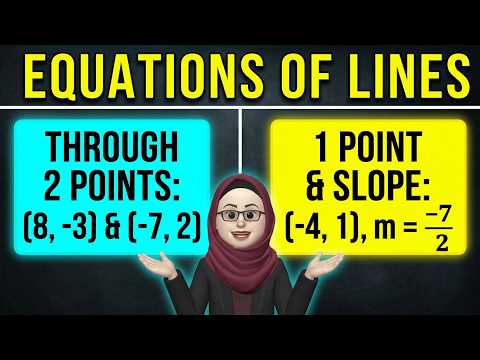
Finding a Line Equation from Two Points
- First calculate the slope from the two given points using the two-point slope formula.
- For the example points (8, −3) and (−7, 2), the slope is 5/−15 = −1/3.
- Substitute either point into b = y − mx to find the y-intercept; the example gives b = −1/3.
- The resulting slope-intercept equation is y = −(1/3)x − 1/3.
1:15:52
Finding an Equation from One Point and a Given Slope
- When the slope and one point are supplied, only the y-intercept remains to be calculated using b = y − mx.
- For slope −7/2 through (−4, 1), b = 1 − [(-7/2)(−4)] = −13.
- The resulting equation is y = −(7/2)x − 13.
- Shahera closes the math portion by assigning Section 1.3 homework and answering questions about the graph’s slope, calculator, ebook, and lecture recordings.
Summary, takeaways, and chapters were generated by AI from the video's transcript and may contain errors. The video belongs to its creator, Shahera Jannah's Math World! 😁😎.