Lec1 Chp1 M2001 Summer26 Slope, Eq of Lines, Paralle, Perpendicula Lines
Overview
Shahera Jannah introduces Baruch College’s five-week Math 2001 summer course, explaining its intensive workload, Brightspace and WebAssign resources, grading rules, and expectations for attendance and independent study. She teaches linear equations and slope, intercepts, graphing, equations of parallel and perpendicular lines, linear modeling, and introductory function tests and notation, emphasizing practice with point-slope form and the vertical line test.
Key takeaways
- For ax + by = c, the slope is −a/b, the x-intercept is c/a, and the y-intercept is c/b; intercept coordinates are (c/a, 0) and (0, c/b).
- Graph y = mx + b by plotting (0, b) and using m as rise over run; a negative slope can be followed in either direction while preserving the same line.
- Parallel lines share a slope, while perpendicular nonvertical lines have negative-reciprocal slopes whose product is −1.
- A linear model for the study-score example is y = −7x + 1380, while the package-sales example is N(p) = −(1/2)p + 250.
- The vertical line test captures the defining function condition: each input x must correspond to exactly one output y; algebraic shortcuts based only on y exponents can be unreliable.
- Math 2001’s accelerated structure requires sustained independent work: 27 homework sets accompany quizzes, two exams, and a final that requires at least 50 points to pass.
Chapters
- Shahera Jannah warns that the course compresses about five months of material into five weeks.
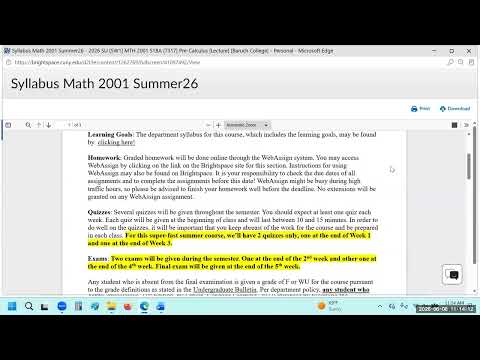
- The course includes 27 WebAssign homework sets, generally with at least 15 to 20 questions each, alongside quizzes, two exams, and a final.
- Shahera Jannah says she has about six years of teaching experience but is teaching Math 2001 for the first time.
- Students should check Brightspace announcements, including department notices, for course and registration information.
- The course content area includes the syllabus, class playlist, pre-lecture notes, homework, practice materials, and extra problems.
- Shahera posts lecture notes as both PDF and Word files; recordings allow students to revisit material, while worked solutions are developed in class.
- The class meets four days per week for five weeks, for 20 planned class days, with Fridays off.
- Office hours are Wednesdays after class, and the course uses an ebook bundled with WebAssign access.
- The stated grade weights are 9% for two quizzes, 51% for two exams, 10% for homework, and 30% for the final.
- The two-hour final is expected to have about 40 questions, mostly multiple choice, and students must earn at least 50 points on it to pass the course.
- Attendance is mandatory; recordings can help with an occasional absence but are not presented as a substitute for class participation.
- A basic scientific calculator is sufficient, and Shahera recommends campus tutoring for material that the accelerated class cannot fully cover.
- Chapter homework deadlines are scheduled for Mondays, including Chapter 3 on June 29 and Chapter 4 on July 6.
- Shahera says extensions will not be available and reserves time before exams for review rather than late homework.
- Students are directed to follow Baruch’s purchasing instructions to obtain WebAssign access at the lower institutional price.
- Homework can be completed in multiple sessions, and the first assignment shown allows 10 attempts per question.
- Chapter One priorities include linear functions, parallel and perpendicular lines, intercepts, domain and range, transformations, and inverse functions.
- Shahera notes that homework sections may not align exactly with her lecture order, so students should consult all posted notes.
- A line can be written in standard form, ax + by = c, slope-intercept form, y = mx + b, or point-slope form, y − y₁ = m(x − x₁).
- In slope-intercept form, m is the slope and b is the y-intercept; point-slope form combines a known point with the slope.
- For two points, slope is calculated as (y₂ − y₁)/(x₂ − x₁), the change in y divided by the change in x.
- Increasing lines have positive slope, decreasing lines have negative slope, horizontal lines have slope zero, and vertical lines have undefined slope.
- For the points (12, 15) and (10, −3), the slope is 9, so the line is increasing.
- A zero numerator with a nonzero denominator gives slope zero; a zero denominator makes the slope undefined, as with a vertical line.
- For ax + by = c, set y = 0 to find the x-intercept, c/a, and set x = 0 to find the y-intercept, c/b.
- Rearranging standard form into slope-intercept form gives slope −a/b; an x-intercept has coordinates (x, 0), while a y-intercept has coordinates (0, y).
- For 11x − 8y = 80, the slope is 11/8, the x-intercept is 80/11, and the y-intercept is −10.
- The intercepts are written as points, (80/11, 0) and (0, −10), to show where the line crosses each axis.
- Students practice applying −a/b, c/a, and c/b directly to a standard-form equation.
- Shahera checks the slope’s sign to classify the line and converts intercept values into coordinate pairs.
- For y = mx + b, plot b on the y-axis first, then use the slope as rise over run to find another point.
- For y = −3x − 2, start at (0, −2), move down 3 and right 1, and connect the points to graph a decreasing line.
- For y = x + 3, the y-intercept is 3 and the slope is 1, so repeated one-unit moves produce points on the line.
- A negative slope can be followed by moving down and right or up and left, depending on how its sign is assigned to rise and run.
- First calculate the slope from the two given points, then substitute that slope and either point into y − y₁ = m(x − x₁).
- To produce slope-intercept form, distribute and isolate y; the example’s slope calculation reduces to −1/3.
- When a point and slope are supplied, skip the two-point slope calculation and substitute directly into point-slope form.
- Shahera has students simplify the resulting equation into slope-intercept form and check the final result in class.
- Parallel lines have the same slope and, when distinct, different y-intercepts; horizontal lines parallel horizontal lines, and vertical lines parallel vertical lines.
- Perpendicular nonvertical lines have negative-reciprocal slopes, and multiplying their slopes gives −1.
- For a standard-form line ax + by = c, first find its slope using −a/b; a parallel line keeps that slope.
- A perpendicular line uses the negative reciprocal, so a slope of 5/8 corresponds to a perpendicular slope of −8/5.
- To write either requested line, identify the original slope, select the same slope or its negative reciprocal, and combine it with the given point in point-slope form.
- The worked parallel-line example uses slope 1/4 through (6, 7) and simplifies to y = (1/4)x + 11/2.
- The example pairs 130 minutes of daily study with a score of 470 and 142 minutes with a score of 386.
- Using score as y and minutes as x gives slope (386 − 470)/(142 − 130) = −7; substituting a point yields y = −7x + 1380.
- At a price of $100, the theater sells 200 packages per week; each $10 price increase reduces sales by 5 packages.
- With price p as the input and weekly sales N(p) as the output, the slope is −5/10 = −1/2 and the model is N(p) = −(1/2)p + 250.
- A function assigns exactly one output y to each input x; repeated y-values are allowed, but one x cannot have multiple y-values.
- A graph passes the vertical line test if every vertical line intersects it at most once; circles and vertical lines fail, while ordinary horizontal and slanted lines pass.
- The algebraic test is to solve for y and check whether each x produces exactly one y; an expression with positive and negative square-root branches can give two outputs.
- Shahera offers an odd/even-power shortcut for y, but the vertical line test or solving for y is the dependable check, especially for more complicated equations.
- Writing f(x) = mx + b or f(x) = x² identifies the output rule as a function; g(x) and h(x) can serve the same role.
- Function notation treats f(x) as the output corresponding to input x, making it easier to specify and evaluate a rule.
- To find f(−2) for f(x) = 10x² + 4x − 1, substitute −2 for every x and follow order of operations to get 31.
- Substituting h − 2 instead produces an algebraic expression; expansion and combining like terms illustrate how function evaluation connects to later difference-quotient work.
Transcript excerpt
0:08 Good morning everyone. >> How are you guys saying today? >> Is it me or you guys are close here? I'm almost so close for me. >> Okay. So, welcome to M 2001. If you're taking it for the first time, I'm also with you. I'm teaching it for the first time. Um, so I'm kind of nervous actually. I'm nervous because I'm going to cover five months materials in only four weeks. So it's really tough. I can teach but will be able to learn. That's silence. So if you think you are not a hardworking person or you don't have enough time to put behind this class, I would suggest drop to them. So you get at least some for your
0:57 tition fee. If you drop it after few days, yeah, you're not going to get involved back. Plus, if you have any summer job or if you have any heavy responsibilities that you cannot uh put enough time during this class, this class definitely is not for me. This is kind of like half of 10:30 and half of trigonometry. So if you already taken 10:30 at least first few chapters chapter chapter one two and three I think we find it easier for you and then chapter four five is so chology is very fun if you understand it sucks if you don't understand so again I'm warning you if you're not an hardworking person please drop this
1:45 class do not waste your time and break your brain for for nothing. Okay, take it in Polaroid screen. Then you'll have a smooth sensor. You can learn everything and you can get a great here. I don't think how much you going like I don't even know how much you're going to learn, but you're going to spend so many
This is the start of the transcript. Save this video free for the whole transcript, searchable and time-coded.
In this course
Related notes
Summary, takeaways, and chapters were generated by AI from the video's transcript and may contain errors. The video belongs to its creator, Shahera Jannah's Math World! 😁😎.