Lec21 Sec4.2,3,4 M2001
Overview
Shahera Jannah teaches sections 4.2, 4.3, and 4.4 of trigonometry, connecting the six trig functions to right-triangle ratios, the unit circle, and quadrant signs. Students learn three ways to find first-quadrant values, use special triangles and the Pythagorean theorem to evaluate all six functions, and review the topics planned for Quiz 2.
Key takeaways
- On the unit circle, a point at angle θ is (cos θ, sin θ), so cosine gives the x-coordinate and sine gives the y-coordinate.
- SOH-CAH-TOA gives sin θ = opposite/hypotenuse, cos θ = adjacent/hypotenuse, and tan θ = opposite/adjacent; the other three functions are reciprocals.
- The first-quadrant values for 30°, 45°, and 60° can be derived from 30-60-90 side lengths 1, √3, 2 and 45-45-90 side lengths 1, 1, √2.
- To identify a quadrant from trig signs, convert the given functions into x- and y-sign information; for example, positive sine and negative tangent imply Quadrant II.
- For an exact-value triangle problem, use a known trig ratio to label two sides, apply the Pythagorean theorem for the third, assign its sign from the quadrant, and then compute all six functions.
- The lecture's Quiz 2 review lists reference and quadrantal angles, first-quadrant unit-circle values, trig identities, and special-triangle problems, with no calculator required.
Chapters
- Shahera Jannah gets her notes and screen sharing ready for the online class.
- She mentions feeling dizzy after a medical blood draw and asks students to point out any teaching mistakes.
- The class reviews that section 4.1 was covered previously and that today's lesson combines sections 4.2, 4.3, and 4.4.
- Chapter 4 and 5 lecture notes are posted on Brightspace, and quiz scores are expected to be posted after grading.
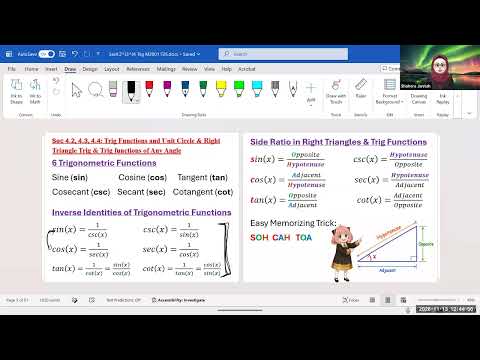
- The six functions are sine, cosine, tangent, cosecant, secant, and cotangent, commonly abbreviated sin, cos, tan, csc, sec, and cot.
- The reciprocal pairs are sin and csc, cos and sec, and tan and cot.
- The quotient identities are tan θ = sin θ / cos θ and cot θ = cos θ / sin θ.
- For a right triangle, sin θ = opposite / hypotenuse, cos θ = adjacent / hypotenuse, and tan θ = opposite / adjacent.
- The reciprocal ratios give csc θ = hypotenuse / opposite, sec θ = hypotenuse / adjacent, and cot θ = adjacent / opposite.
- The mnemonic SOH-CAH-TOA helps recall the sine, cosine, and tangent ratios.
- A unit circle has radius 1, and each point at angle θ has coordinates (cos θ, sin θ).
- The x-coordinate gives cosine, the y-coordinate gives sine, and tan θ is their ratio, y / x, when x is nonzero.
- The first-quadrant angles provide the reference values needed to build values in the other quadrants.
- Reference angles 30°, 45°, and 60° repeat across quadrants with the same absolute coordinate values and signs determined by quadrant.
- The quadrantal coordinates are 0°: (1, 0), 90°: (0, 1), 180°: (-1, 0), 270°: (0, -1), and 360°: (1, 0).
- The lecture notes that students may reproduce a unit-circle diagram during an exam only if they derive it themselves.
- The five finger positions represent 0°, 30°, 45°, 60°, and 90°; count fingers on each side of an angle, place the counts under square roots, and divide by 2.
- The left-side result gives cosine and the right-side result gives sine.
- Examples include cos 60° = 1/2, sin 60° = √3/2, and sin 45° = cos 45° = √2/2.
- The degree-to-radian pairs are 0° = 0, 30° = π/6, 45° = π/4, 60° = π/3, and 90° = π/2.
- Sine values follow the sequence √0/2, √1/2, √2/2, √3/2, √4/2; cosine values appear in reverse order.
- Using tan θ = sin θ / cos θ gives tan 0° = 0, tan 30° = 1/√3, tan 45° = 1, and tan 60° = √3.
- Tan 90° is undefined because its denominator, cos 90°, is zero.
- A 30-60-90 triangle has side lengths 1, √3, and 2, opposite 30°, 60°, and 90° respectively.
- A 45-45-90 triangle has equal legs of 1 and hypotenuse √2.
- These triangles provide exact side ratios for evaluating trig functions at 30°, 45°, and 60°; quadrantal values must be handled separately.
- Using the special triangles, sin 45° = √2/2 and cos 60° = 1/2; reciprocals give values such as csc 60° = 2/√3.
- The class catches and corrects an initial confusion: cotangent is adjacent / opposite, so cot 60° = 1/√3, not a hypotenuse-based ratio.
- The class simplifies compound ratios to a single fraction and accepts equivalent forms such as 1/√2 and √2/2.
- Because sine tracks y and cosine tracks x, sin θ > 0 together with cos θ > 0 places θ in Quadrant I.
- The combination sin θ < 0 and cos θ < 0 places θ in Quadrant III.
- For csc θ > 0 and tan θ < 0, y is positive while x is negative, so θ lies in Quadrant II.
- For sec θ > 0 and cot θ < 0, x is positive while y is negative, so θ lies in Quadrant IV.
- A 30° reference angle has sine magnitude 1/2 in every quadrant, but the sign changes with the y-coordinate.
- Sine is positive in Quadrants I and II and negative in Quadrants III and IV.
- Converting trig-function signs into x- and y-coordinate signs is the method for identifying a quadrant.
- Given cos θ = 21/29 and tan θ < 0, cosine is positive and tangent is negative, placing θ in Quadrant IV.
- The triangle has adjacent side 21 and hypotenuse 29; the Pythagorean theorem gives the opposite side magnitude √(29² - 21²) = 20, with y = -20 in Quadrant IV.
- The resulting values are sin θ = -20/29, cos θ = 21/29, and tan θ = -20/21.
- Taking reciprocals gives csc θ = -29/20, sec θ = 29/21, and cot θ = -21/20.
- Students begin a practice problem asking for the remaining trig values after converting a point or given information into a side ratio, such as 8/10 or 4/5.
- Shahera Jannah pauses for attendance and gives students time to work; the class also discusses scanning papers using the document feeder.
- The worked examples emphasize using the Pythagorean theorem to find the missing triangle side before calculating the remaining functions.
- Quiz 2 covers five topics: reference angles, quadrantal angles, first-quadrant unit-circle values, trig identities, and special-triangle questions.
- Reference-angle practice includes converting 450° to its coterminal angle, 90°, by subtracting 360°; its reference angle is 90°.
- The quiz is planned without a calculator and includes material from section 4.1 and sections 4.2 to 4.4.
- Students scoring below 90 on Quiz 1 may retake a similar quiz after completing Quiz 2, within the same time frame.
- With θ in Quadrant II and sin θ = 4/5, the opposite side is 4 and the hypotenuse is 5.
- The missing adjacent side has magnitude √(25 - 16) = 3, but its x-coordinate is -3 in Quadrant II.
- The primary functions are sin θ = 4/5, cos θ = -3/5, and tan θ = -4/3.
- The reciprocals are csc θ = 5/4, sec θ = -5/3, and cot θ = -3/4.
- Students are advised to begin section 4.1 homework and attempt whatever they can from sections 4.2, 4.3, and 4.4, leaving unfamiliar problems until after instruction.
- The exam is scheduled for the Tuesday after next, and Shahera Jannah plans to post a review sheet when it is ready.
- The class ends with a reminder to meet again on Thursday.
Transcript excerpt
0:04 Okay. So, give me a few minutes to pull up my um uh my notes and also let me see if I can log in from my other computer. Um, My dad is bloody. Oh, I went to the
1:53 doctor to see them today and um they took me nine bottles of blood. So, I really do feel kind of dizzy now. They told me I would feel that. Good thing you're doing it online. Otherwise, I don't think I would have been able to stand for two hours after giving nine bottles of water. Oh, not water. Nine bottles of bottle. Nine bottles of blood. Wow. Um, what I'm looking at Okay. So, we did 4.1
2:49 in our last class. So, 4.2 34. I posted the notes um lecture notes for chapter four and five. on Bright Space. Oh, I'm actually done grading your quiz. I just need to insert it on Bright Space. Uh, and many people didn't do well. Let me share my screen. >> Will the quiz scores be posted today? >> Yes. >> Okay. Last night I graded everyone's but I didn't have my laptop with me
3:36 yesterday so I couldn't also submit Okay. My brain is little fuzzy today. I'm feeling funny now. So I may make mistakes, many mistakes today while I'm teaching you. If you catch any mistake, let me know. Okay. My um I'm doing them intentionally.
4:27 Nope. Whatever mistake I'm going to make today, it will be because my brain is not working properly. Any question from anyone before I start? Any comment, concern, complaint? Nope. Okay. Um Okay. So this is 2 4.2 and I combine 4.2 two three four al together
5:16 and in these four in these three sections we're going to talk about the actual trigonometry the six trick
This is the start of the transcript. Save this video free for the whole transcript, searchable and time-coded.
In this course
Related notes
Summary, takeaways, and chapters were generated by AI from the video's transcript and may contain errors. The video belongs to its creator, Shahera Jannah's Math World! 😁😎.