Lec23 Review for Exam3 on Sec4.2,3,4 M2001
Overview
Shahera Jannah reviews trigonometric skills for Exam 3, including reciprocal and quotient identities, unit-circle values, angle conversion, reference angles, quadrant signs, and solving for missing triangle sides. She also works through function composition, piecewise functions, a 150-foot building distance problem, a Ferris wheel model, and a temperature equation, emphasizing written reasoning and correct calculator mode.
Key takeaways
- Use sine = y and cosine = x to translate trig signs into quadrant locations before drawing a triangle or evaluating a function.
- A reference angle must be positive, acute, and measured from the x-axis; use the terminal side's quadrant separately to determine the trig-function sign.
- When a trig ratio supplies two triangle sides, use the Pythagorean theorem to find the third and assign its sign from the quadrant before deriving other ratios.
- For degree-to-radian conversion, multiply by π/180; for radian-to-degree conversion, multiply by 180/π, and simplify the result.
- Inverse cosine and reciprocal cosine are different operations: arccos(1/2) gives 60° or approximately 1.05 radians, while secant is 1/cosine.
- In the temperature model T = C + 6 sin((π/12)H), 2 p.m. corresponds to H = 14; with T = 74, this gives C = 77.
Chapters
- Shahera Jannah explains that class will review material before Exam 3 and notes that several course sections remain.
- The exam format separates a no-calculator portion from a calculator portion, so students should prepare for both.
- She says exam problems will resemble the review sheet, with changed trig functions or values.
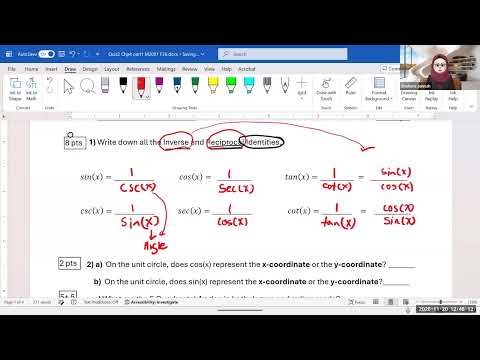
- The reciprocal pairs are sine and cosecant, cosine and secant, and tangent and cotangent.
- The quotient relationships are tangent x = sine x / cosine x and cotangent x = cosine x / sine x.
- Write an angle with each trig function, such as sin x = 1 / csc x, rather than leaving the function without an argument.
- SOH CAH TOA describes triangle ratios, while reciprocal and quotient relationships are trig identities.
- Cosine corresponds to the unit-circle x-coordinate, while sine corresponds to the y-coordinate.
- The quadrantal angles are 0, π/2, π, 3π/2, and 2π, equivalent to 0°, 90°, 180°, 270°, and 360°.
- At quadrantal angles, unit-circle coordinates provide trig values directly, so no reference triangle is needed.
- Convert radians to degrees by multiplying by 180°/π, which cancels the radian unit.
- Convert degrees to radians by multiplying by π/180°, canceling the degree unit.
- The examples simplify 5π/9 to 100° and 315° to 7π/4.
- Simplifying the resulting fraction is required, not optional.
- A reference angle is positive, less than 90°, and formed between the terminal side and the x-axis.
- For 150°, subtract from 180° to get a 30° reference angle; for 225°, subtract 180° to get 45°.
- For an acute negative angle such as −25°, use the positive angle 25° as its reference angle.
- For negative angles outside the acute range, first find a coterminal angle, such as −25° + 360° = 335°.
- For an angle greater than 360°, subtract 360° repeatedly to find a coterminal angle between 0° and 360°.
- The example 660° reduces to 300°, whose reference angle is 360° − 300° = 60°.
- The terminal side's quadrant matters because it determines the signs of the trig functions.
- For 0°, 30°, 45°, 60°, and 90°, the finger method gives sine and cosine values using the number of fingers on either side of the selected angle.
- For sine, count fingers to the right; for cosine, count fingers to the left, then take the square root of that count and divide by 2.
- For example, sin 60° = √3/2 and cos 60° = 1/2; at 45°, both sine and cosine equal √2/2.
- Use reciprocal relationships to find values such as csc 30° = 2 and quotient relationships to find cot 45° = 1.
- Given cos θ = 7/8 and cot θ < 0, cosine makes x positive while the negative cotangent requires y to be negative, placing θ in Quadrant IV.
- Treat cos θ = 7/8 as adjacent/hypotenuse = 7/8, then use the Pythagorean theorem to find the missing side: √(8² − 7²) = √15.
- In Quadrant IV, the y-coordinate is negative, so the completed triangle has opposite side −√15.
- Use the triangle ratios to obtain sin θ = −√15/8, tan θ = −√15/7, csc θ = −8/√15, sec θ = 8/7, and cot θ = −7/√15.
- Memorize the 30-60-90 side lengths 1, √3, and 2, with the side of length 1 opposite 30°.
- The 45-45-90 triangle has equal legs of 1 and hypotenuse √2.
- For radian examples, 11π/6 has reference angle π/6, 5π/4 has reference angle π/4, and 2π/3 has reference angle π/3.
- Keep the answer in the same unit requested: a reference angle derived from radians should be returned in radians.
- For sin(−135°), identify a 45° reference angle and a terminal side in Quadrant III, where sine is negative.
- The result is sin(−135°) = −√2/2, using either the 45-45-90 triangle or the special-angle finger method.
- For cot(11π/6), convert to 330° or recognize its 30° reference angle in Quadrant IV.
- Since cotangent is adjacent/opposite and Quadrant IV has positive x and negative y, cot(11π/6) = −√3.
- Sine and cosecant share the sign of y, while cosine and secant share the sign of x.
- Positive sine and cosine indicate Quadrant I; negative sine and cosine indicate Quadrant III.
- Positive cosecant with negative tangent implies y is positive and x is negative, so the angle is in Quadrant II.
- Positive secant with negative cotangent implies x is positive and y is negative, placing the angle in Quadrant IV; draw angles from the x-axis.
- Given cos θ = 21/29 and tan θ < 0, x is positive and y is negative, so the triangle lies in Quadrant IV.
- Interpret cosine as adjacent/hypotenuse = 21/29 and use √(29² − 21²) for the missing side.
- Assign the missing side a negative sign in Quadrant IV before calculating the other trig functions.
- For a decimal ratio such as sin θ = 0.8, rewrite 0.8 as 4/5 before constructing the triangle.
- For g(f(1)) with f(x) = cos(πx), evaluate the inner function first: f(1) = cos π = −1.
- Substitute the inner result into g; with g(x) = x² + 9x + 3, g(−1) = −5.
- For a piecewise function, choose the formula whose domain condition contains the input before substituting.
- The example evaluates f(0) using the x < 3 branch and f(81) using the x ≥ 3 branch; log₃81 simplifies to 4 because 81 = 3⁴.
- A 150-foot building viewed at an elevation angle of 42° forms a right triangle with height as the opposite side and horizontal distance x as the adjacent side.
- Set tan 42° = 150/x, then solve x = 150/tan 42°.
- The horizontal distance is approximately 166.59 feet.
- Set the calculator to degree mode for a degree input such as 42°; a mismatched degree or radian mode produces an incorrect result.
- The height model is h = −18 cos t + 22, and the target height is 13 feet.
- Substitution gives 13 = −18 cos t + 22, so cos t = 1/2.
- Apply inverse cosine, not the reciprocal of cosine; arccos(1/2) is 60° or approximately 1.05 radians.
- Because the model's expected time is in radians, the positive time is about 1.05 minutes; check the units and calculator mode.
- The temperature model is T = C + 6 sin((π/12)H), where H counts hours after midnight.
- At 2 p.m., H = 14, so the sine input becomes (π/12)·14 = 7π/6.
- With T = 74 and sin(7π/6) = −1/2, solve 74 = C − 3 to obtain C = 77.
- The π in the trig input indicates radians, so evaluate the sine term in radian mode.
- Shahera Jannah says exam questions will follow the review sheet's methods, with values or functions changed.
- Show enough work to demonstrate the reasoning, including quadrant selection, triangle setup, and algebraic steps.
- Bring a calculator for the calculator portion and verify its degree or radian setting against the problem.
Transcript excerpt
0:03 wrote seven of the opposite, which is also the y is less than zero. Whenever opposite is negative. >> notice that. >> So that that's like good. Like if I write that on the test, right? Okay. >> As long as you show like how do you know it's negative not positive? Yep. This is one and there's another one
0:50 first. All right, is everyone today guys? Okay, so we are going to do a review today. And then your exam is Tuesday. We have let me see how many files.
1:45 We have four five, six, seven, eight, one, three. So six more sections left. Maybe we'll be able to finish it. After the test, we six sections left. And and we don't have enough time. My plan initially was to have at least two lectures for review. But since we have six sections left, I don't think we'll be able to do two reviews. We can do only one review. Our last day of class will be Friday and your exam will will be Wednesday precalculus side. Usually precalculus later and algebra first. So
2:34 algebra have their exam Tuesday. That means your exam is on Wednesday. >> The final is on Wednesday, December 16th. >> Yeah, Wednesday, 8:00 a.m. in the morning. >> It's only 2 hours long, right? >> 2 hours from 8 to 10. And you are going to do around 40 questions in 2 hours. >> How many? >> 4 0 >> 40? >> around 4 0 >> And how many digits is going to be calculator? >> Uh at least 10. Okay, I'll like check the review. And then I'm going to go over quiz two. So So just like the exam, you're going to do part one without calculator. Once you are done around 9:30, you are
This is the start of the transcript. Save this video free for the whole transcript, searchable and time-coded.
In this course
Related notes
Summary, takeaways, and chapters were generated by AI from the video's transcript and may contain errors. The video belongs to its creator, Shahera Jannah's Math World! 😁😎.