Lec22 Sec4.2,3,4 Day2 M2001 Evaluating Trig functions
Overview
The lesson teaches how to evaluate trigonometric functions for angles beyond the first quadrant by locating the angle, finding a reference angle, using a 30-60-90 or 45-45-90 triangle, and applying the correct quadrant sign. It also covers quadrantal angles, coordinate-based trig ratios and reciprocals, missing triangle sides, and using inverse tangent to solve an angle-of-elevation problem.
Key takeaways
- For a nonquadrantal angle, evaluate the reference-angle ratio using a special triangle, then apply the sign determined by the original angle's quadrant.
- The 30-60-90 side lengths are 1, √3, and 2, while the 45-45-90 side lengths are 1, 1, and √2.
- At quadrantal angles, use the terminal point directly: x = cos θ and y = sin θ; ratios with a zero denominator, such as sec 270°, are undefined.
- A point (x, y) on a circle of radius r gives sin θ = y/r, cos θ = x/r, and tan θ = y/x; reciprocal functions follow from these ratios.
- For right-triangle word problems with opposite and adjacent sides known, use tangent and apply inverse tangent to isolate the angle.
Chapters
- The class postpones quiz review until Friday to make more progress through the current material.
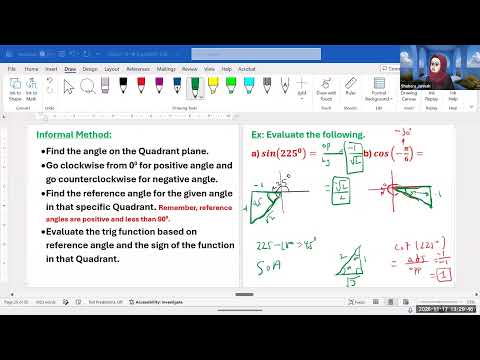
- For angles outside the first quadrant, draw the angle in standard position, identify its quadrant, and find its reference angle.
- For 225°, the reference angle is 225° minus 180°, or 45°.
- The 45-45-90 triangle has side lengths 1, 1, and √2; the 30-60-90 triangle has side lengths 1, √3, and 2.
- For sin 225°, use the 45° reference triangle and the third-quadrant sign to get −√2/2.
- For cot 225°, the third-quadrant coordinates are both negative, so the ratio x/y is positive and equals 1.
- A formal method adds 360° to a negative angle before locating its coterminal positive angle; a faster method draws the angle clockwise.
- For −30°, the reference angle is 30° and the terminal side lies in quadrant IV, where x is positive and y is negative.
- Build the reference triangle first, then use the requested ratio, such as cosine = adjacent/hypotenuse.
- The quadrantal angles are 0°, 90°, 180°, 270°, and 360°; they lie on an axis and do not use an ordinary reference triangle.
- Use x = cos θ and y = sin θ at axis angles; at 270°, the point is (0, −1), so sin 270° = −1 and csc 270° = −1.
- Since cos 270° = 0, sec 270° is undefined because it requires division by zero.
- Convert 11π/6 to 330° using 180°/π, then use the 30° reference angle in quadrant IV.
- At 330°, the reference-triangle sides have magnitudes 1, √3, and 2; quadrant IV makes the y-coordinate negative.
- For −135°, either draw clockwise or add 360° to get 225°; both methods give a 45° reference angle in quadrant III.
- Reduce 390° by subtracting 360° to get the coterminal angle 30°; therefore cos 390° = cos 30° = √3/2.
- For the quadrantal angle π, the terminal point is (−1, 0), so tan π = y/x = 0.
- The lesson evaluates other examples, including 7π/6 in quadrant III, by using its 30° reference triangle and the signs of both coordinates.
- For a point (−20, 21) with radius 29 in quadrant II, sin θ = 21/29 and cos θ = −20/29.
- The coordinate ratios give tan θ = −21/20, csc θ = 29/21, sec θ = −29/20, and cot θ = −20/21.
- The reciprocal identities pair sine with cosecant, cosine with secant, and tangent with cotangent.
- Find a missing right-triangle side with a² + b² = c²; for hypotenuse 10 and one leg 3, the other leg is √91.
- If cos θ = −8/17 and 0 < θ < π, the negative cosine places θ in quadrant II, where sine is positive.
- The remaining side magnitudes and quadrant signs determine the other trigonometric ratios.
- An angle of elevation is measured upward from the horizontal line of sight; an angle of depression is measured downward.
- For a 240-foot building and an observer 75 feet away, tangent θ = opposite/adjacent = 240/75.
- Apply inverse tangent to solve: θ = arctan(240/75); use a scientific calculator to obtain the angle in degrees.
Transcript excerpt
0:04 Uh your heart exam is next Tuesday. One is from today. >> Mhm. >> Oh, third exam. >> Exam not final and final exam will be last Tuesday. >> The materials up to today's We'll be in the exam one. So, let's see how much today and then we'll decide. >> Huh? >> I was trying to make one and then I got stuck because I don't know where to stop. That's why. So, today we are going to
0:52 decide where to stop. But before that, let me Actually, let me take let me leave the quiz for for Friday. Go over the quiz on Friday and let's start our materials. In that way, we can um finish at least little bit more materials. I'm not going to go over this M today. Let's um start the materials for today. Let's see how much you can finish. Uh At least I have to finish this till 4.4. But let's see. Okay. So today we are going to learn how
1:40 to evaluate bigger numbers for trig functions. So in your quiz you evaluate only the first quadrant like 30°, 60°, 40 sin 30°, cosine 60°, cotangent 45° those. The P quadrant is easy. If you have anything besides the P quadrant, you need to use reference angles. So the formal method of evalating frection is that if you have less than 90° less than 60° 360°, you use the reference angle from your given quadrant. For example, if you have uh let's say sine 200 for example 225. Simple. All you have to draw all you
2:29 have to do is draw your angle on the quadrant plane. 225 is on which quadrant? Third quadrant? 0 90 2025 here. So first draw your angle on your quadrants on the correct quadrants and then get the
This is the start of the transcript. Save this video free for the whole transcript, searchable and time-coded.
In this course
Related notes
Summary, takeaways, and chapters were generated by AI from the video's transcript and may contain errors. The video belongs to its creator, Shahera Jannah's Math World! 😁😎.