Lec2 Chp1 M2001 Summer26 Doman, Range, X- Y intercepts
Overview
Shahera Jannah reviews function notation and line concepts, then develops methods for finding x- and y-intercepts, testing symmetry, and determining domains and ranges from graphs and equations. The central techniques are to set the other coordinate to zero when finding an intercept, test symmetry by substituting negative variables, read interval boundaries from whether values are included, and exclude inputs that make an even-root radicand negative or a denominator zero.
Key takeaways
- Find x-intercepts by setting y = 0 and y-intercepts by setting x = 0, then report each intercept as an ordered pair when the question requests point format.
- For rational-function x-intercepts, factor and simplify first: canceling a common factor can create a hole, so a canceled numerator zero may not be an intercept.
- Test evenness with f(-x) = f(x) and oddness with f(-x) = -f(x); for implicit equations, compare after substituting negative variables.
- Read domain from x-values and range from y-values; a coordinate is excluded only when no graph point supplies it, even if one branch has an open endpoint.
- Determine equation domains by requiring every even-root radicand to be nonnegative and every denominator to be nonzero, then intersect the resulting restrictions.
- Use brackets for included finite endpoints, parentheses for excluded endpoints and infinity, and curly braces for a domain or range containing one isolated value.
Chapters
- Shahera Jannah directs students to Brightspace's class playlist for lecture recordings and pre-lecture solutions.
- WebAssign homework is organized by section; the first week is free, followed by four paid weeks for the five-week course.
- Chapter 1 homework is due the following Monday at midnight, and quiz 1 is planned for 15 to 20 minutes.
- For a line in standard form Ax + By = C, the class reviews finding intercepts by setting the other variable to zero.
- Parallel lines have equal slopes, while perpendicular slopes are negative reciprocals.
- Given a point and slope, use point-slope form, y - y₁ = m(x - x₁); when evaluating functions, substitute carefully and do not distribute powers across addition or subtraction.
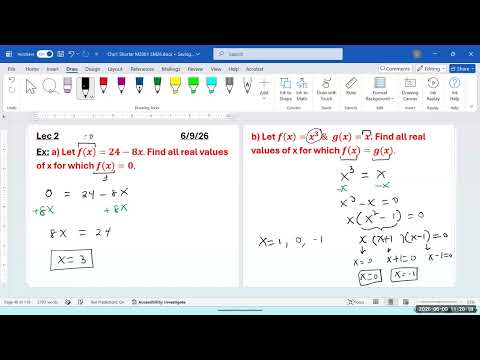
- For f(x) = 24 - 8x, finding where f(x) is zero means solving 0 = 24 - 8x, which gives x = 3.
- To find where f(x) = x³ and g(x) = x meet, set x³ = x and factor x(x - 1)(x + 1) = 0.
- The cubic and line intersect at x = -1, 0, and 1.
- An x-intercept is where a graph meets the x-axis, so its point has the form (x, 0).
- A y-intercept is where a graph meets the y-axis, so its point has the form (0, y).
- Graphs may have several, one, or no intercepts; examples include a parabola above the x-axis and a circle that misses both axes.
- Shahera Jannah has students read intercepts from plotted graphs and report them as ordered pairs.
- The graph examples distinguish multiple x-intercepts from a single y-intercept and also include a graph with no y-intercept.
- For WebAssign, check whether an answer requires a coordinate pair rather than just the intercept's numerical value.
- To find x-intercepts of y = 4x³ - 8x², set y = 0 and factor to obtain 4x²(x - 2) = 0.
- Setting each factor equal to zero gives x = 0 and x = 2, so the intercept points are (0, 0) and (2, 0).
- For the y-intercept, set x = 0; this example gives y = 0.
- For y = x² - 4, the difference-of-squares factorization (x - 2)(x + 2) gives x-intercepts at -2 and 2.
- The same quadratic has y-intercept (0, -4), found by substituting x = 0.
- For y = √(4x - 3), setting y = 0 and squaring gives x = 3/4; substituting x = 0 shows there is no real y-intercept.
- For rational functions, factor and simplify before solving for x-intercepts because canceling a common factor can reveal a hole.
- In (x + 2)/(x² - 4), factoring the denominator gives (x + 2)(x - 2); cancellation leaves 1/(x - 2), with x = -2 excluded from the original function.
- The simplified expression has no x-intercept, while substituting x = 0 gives a y-intercept of (0, -1/2).
- A graph is symmetric about the x-axis when reflecting its points across that axis leaves the graph unchanged.
- To test x-axis symmetry in an equation, replace y with -y and compare the result with the original equation.
- To test y-axis symmetry, replace x with -x; y = x² remains unchanged and is an example of an even function.
- A graph has origin symmetry when each point (x, y) has a matching point (-x, -y).
- For a function, the odd-function test is f(-x) = -f(x); y = x³ is a standard example.
- Origin symmetry differs from reflection across either coordinate axis, so the variables' signs must be considered together.
- For an equation such as x - y² = 12, replace x with -x to test y-axis symmetry and replace y with -y to test x-axis symmetry.
- The equation remains unchanged when y becomes -y because (-y)² = y², so it is symmetric about the x-axis.
- The equation does not remain unchanged when x becomes -x, so it does not have y-axis symmetry.
- A function is even when replacing x with -x leaves its output rule unchanged, as in y = 1/x².
- A function is odd when replacing x with -x negates its output, as in y = 2x³.
- Expressions with a mixture of even and odd powers require substitution and comparison rather than classification by one term alone.
- The term 2x³ is odd, but subtracting 8 produces 2x³ - 8, which is neither even nor odd.
- Testing x → -x shows the resulting expression is not the original function, so it is not even.
- Testing both coordinates for origin symmetry also fails, illustrating why a constant shift can break a cubic's origin symmetry.
- For an implicit equation, replacing y with -y tests x-axis symmetry, while replacing x with -x tests y-axis symmetry.
- Replacing both x and y with their negatives tests symmetry about the origin.
- Each test requires simplifying the substituted equation and comparing it with the original, rather than relying only on the equation's visible powers.
- For f(x) = x³/(x² + 1), substituting -x changes the numerator's sign while the squared denominator stays the same.
- Thus f(-x) = -f(x), and the function is odd with symmetry about the origin.
- The example shows that even powers in a denominator do not prevent a rational function from being odd.
- For x-axis symmetry, substitute -y and check whether the original equation returns.
- For y-axis symmetry and even functions, substitute -x; for origin symmetry and odd functions, change both x and y signs.
- Shahera Jannah emphasizes verifying the algebra for mixed-power expressions instead of guessing from a single term.
- The domain is the set of allowable input x-values, and the range is the set of resulting y-values.
- Write interval endpoints from smaller to larger; use brackets when an endpoint is included and parentheses when it is excluded.
- Infinity always takes a parenthesis, and a single isolated value is written with curly braces, such as {3}.
- A continuous V-shaped graph extending left and right without bound has domain (-∞, ∞).
- If its lowest point is at y = 3 and is included, its range is [3, ∞).
- A horizontal line y = 3 has domain (-∞, ∞) but range {3}, since every point has the same y-value.
- A vertical line x = 8 has domain {8} because only one x-value occurs, while its y-values extend without bound.
- For a graph with a hole at x = 0, the domain must exclude zero and split into (-∞, 0) and (0, ∞).
- The corresponding range depends on the graph's y-values; an excluded y-value is written with a parenthesis.
- For a graph made of separate pieces, record each piece's endpoint values and whether its endpoint is an open or filled point.
- A sample range includes the interval from 5 to 7, with a bracket at the included y = 5 point and a parenthesis at the excluded y = 7 point.
- List each interval from its lower endpoint to its higher endpoint, even when tracing the graph encounters them in the opposite order.
- A piecewise graph may appear to have gaps in individual branches, but a given x is excluded only if no point on any branch supplies a y-value.
- At x = -2 and x = 5, one branch can still provide a y-value even if another branch has an open endpoint there.
- The worked graph's branches collectively cover every real x-value, so its overall domain is (-∞, ∞).
- For the same multi-piece graph, the branches collectively cover y-values from negative infinity to positive infinity.
- A graph can be disconnected yet still represent a function, provided no vertical line intersects it more than once.
- Use the vertical-line test to distinguish a valid piecewise function from a graph with multiple y-values for one x.
- An even root, such as a square root or fourth root, requires a nonnegative radicand.
- A denominator cannot equal zero, so solve for and exclude every input that makes it zero.
- When both restrictions occur, solve them separately and keep only inputs that satisfy both.
- For √(x - 5), require x - 5 ≥ 0, giving domain [5, ∞).
- For 1/(x - 5), exclude x = 5 and split the domain into (-∞, 5) ∪ (5, ∞).
- A root in a denominator must satisfy both restrictions: its radicand cannot be negative, and the denominator cannot be zero.
- For an expression with √(x + 5) in the numerator and x - 5 in the denominator, the root requires x ≥ -5 and the denominator excludes x = 5.
- Combining the restrictions gives [-5, 5) ∪ (5, ∞).
- The method is to solve each condition first, then intersect the allowable intervals.
- For rational expressions with denominator restrictions at x = 0 and x = 5, divide the real line into intervals at both excluded values.
- Write open endpoints at denominator zeros, for example (-∞, 0) ∪ (0, 5) ∪ (5, ∞) when no other restrictions apply.
- A temporary software problem interrupts board work, so students are asked to solve and compare the interval answers.
- In one exercise, a numerator radical requires x ≥ 1 while a denominator factor excludes x = 3.
- Combining those conditions gives [1, 3) ∪ (3, ∞), with the radical's zero included and the denominator's zero excluded.
- A separate exercise has no numerator restriction, so its domain is determined entirely by where its denominator is defined.
- For a denominator containing √x, require x ≥ 0 and separately exclude inputs that make the full denominator zero.
- For a denominator involving √(4 - x²), require 4 - x² > 0 because the radicand must be positive and the denominator cannot be zero.
- The resulting domain is (-2, 2); Shahera Jannah closes by reminding students to complete homework before the next class.
Transcript excerpt
0:08 Good morning everyone again. How are you doing today? Today this room is warm, right? Warmer than yesterday. >> Not at all. >> Yep. So, if you were absent yesterday or if you want to revisit the class from yesterday, just you just have to go to our class um bright space and then on the left panel you see class playlist, click on the recording and then you'll see our last class here. Yep. I'm going to put um all of our recordings one after one. The newest one
0:55 will be on the top, the oldest channel at the bottom. So if you want to revisit the lecture, if you want to um if you want to see the solution for your questions on the pre- lecture notes on Brightpace, you can simply go there because I don't have any solution for anything on Brightpace. And also if you want you can subscribe. If you want to subscribe, click on the page and then see the subscribe button. Just click there. But you don't have to click on the bell icon because I don't want you to get um bored with all of my uh videos. I post a lot because I teach a lot. So don't enable the bell icon. Just subscribe. That's fine. Okay. Any question before you start?
1:45 Any comments? concern complain why are you able to look into web assign web assign the homework platform. So if you have no idea how to go to sign, you just have to go to bookmark icon either on the top panel or on the left panel and then they have section by section. You can click uh on those or if you are doing it for the first time definitely click on instructions for um to um get assign
This is the start of the transcript. Save this video free for the whole transcript, searchable and time-coded.
In this course
Related notes
Summary, takeaways, and chapters were generated by AI from the video's transcript and may contain errors. The video belongs to its creator, Shahera Jannah's Math World! 😁😎.