Lec18 Review1 for Final M2001 Summer26
 Watch on YouTube →
Overview
Shahera Jannah reviews core M2001 final-exam topics, including line slopes and models, even and odd functions, graph intervals, domain restrictions, difference quotients, transformations, composition, inverses, and piecewise functions. The review emphasizes repeatable procedures: identify the relevant inputs and constraints, apply formulas carefully, show reasoning, and check work against the exam choices.
Key takeaways
- For a linear model from two data points, assign the independent variable to x, calculate m = (y₂ - y₁)/(x₂ - x₁), then use b = y - mx; the study-score data produce y = -7x + 1380.
- Domain restrictions combine rather than replace one another: denominators cannot equal zero, square-root radicands must be nonnegative, and a square root in a denominator must be strictly positive.
- Function transformations can be decoded systematically: outside negatives reflect across the x-axis, inside negatives reflect across the y-axis, inside additions shift left, and outside additions shift up.
- Composition always proceeds from the innermost function outward, whether values come from formulas or graphs; open circles do not define function values.
- An inverse is found by swapping x and y and solving, while inverse domain and range exchange with those of the original function.
- Tangent and cotangent have period π, whereas sine and cosine have period 2π; domain restrictions can rule out otherwise equivalent angles.
Chapters
0:00
Parallel and Perpendicular Lines in Slope-Intercept Form
- For a line in standard form ax + by = c, find its slope as -a/b; parallel lines keep the slope and perpendicular lines use its negative reciprocal.
- The examples use slopes -7/6 and 5/8, giving perpendicular slopes 6/7 and -8/5.
- For a line through (6, 7) with slope m, solve b = y - mx; the parallel equation is y = 1/4x + 11/2 and the perpendicular equation is y = -4x + 31.
- For final-exam answers, write the resulting equation in y = mx + b form.
6:47
Linear Models from Study Scores and Ticket Sales
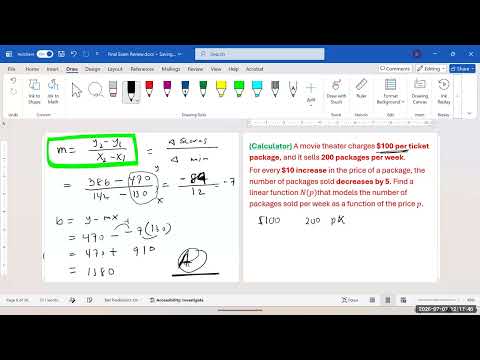
- Model study minutes as x and score as y; the data points (130, 470) and (142, 386) give slope (386 - 470)/(142 - 130) = -7.
- Substitute a point into b = y - mx to obtain the score model y = -7x + 1380.
- For ticket sales, price is the independent variable p and packages sold is n; increasing price from $100 to $110 lowers sales from 200 to 195.
- The ticket data imply slope -0.5 and model n = -0.5p + 250; solve the math, circle the choice, and enter its letter.
14:04
Classifying Even, Odd, and Neither Functions
- Test parity by replacing x with -x: an even function satisfies f(-x) = f(x), while an odd function satisfies f(-x) = -f(x).
- A quotient such as x³/(x² + 1) is odd because the numerator is odd and the denominator is even.
- The review notes that even plus even remains even, odd plus odd remains odd, and even plus odd is generally neither; adding a nonzero constant to an odd function is generally neither.
- On the final, explain why a function is even or odd rather than writing only its classification.
18:14
Reading Domain and Range from Disconnected Graphs
- Domain records x-values and range records y-values; use parentheses for open circles and brackets for closed circles.
- The first graph piece contributes domain (-2, 1) and range (-4, 3), with open endpoints.
- The second piece contributes domain (1, 3] and range [5, 7), so write the pieces as separate intervals joined by a union.
- Infinity always takes a parenthesis, and a hole or open endpoint is never included.
21:08
Finding Domains with Denominators and Radicals
- For rational expressions, exclude values that make any denominator zero; a denominator containing x and x + 5 excludes 0 and -5.
- A square-root numerator requires its radicand to be at least zero, while a square-root denominator requires its radicand to be strictly greater than zero.
- For sqrt(x + 1)/(x - 3), combine x ≥ -1 with x ≠ 3 to get [-1, 3) ∪ (3, ∞); for 1/sqrt(x + 1), the domain is (-1, ∞).
- For sqrt(x)/(1 - sqrt(x)), require x ≥ 0 and exclude x = 1, giving [0, 1) ∪ (1, ∞); for 1/sqrt(4 - x²), require -2 < x < 2.
31:36
Simplifying the Difference Quotient for a Quadratic
- The difference quotient is [f(x + h) - f(x)]/h, and the example uses f(x) = x² - 5x.
- Substitute x + h to get f(x + h) = (x + h)² - 5(x + h), then expand to x² + 2xh + h² - 5x - 5h.
- Subtract f(x) using parentheses so the signs change; the x² and -5x terms cancel.
- Factor out h from 2xh + h² - 5h and cancel it to obtain 2x + h - 5.
34:38
Applying Reflections and Shifts to Function Graphs
- A negative outside a function, as in -f(x), reflects its graph across the x-axis; a negative inside, as in f(-x), reflects it across the y-axis.
- An inside change f(x + 1) shifts left one unit, while f(x - 1) shifts right one unit; an outside +1 shifts the graph up one.
- For -f(x + 1), reflect across the x-axis and shift left one; for -f(x) + 1, reflect and then shift up one.
- For f(-x) + 1, reflect across the y-axis and shift up one; track how each key point moves.
39:24
Recognizing Shifts of Logarithmic and Exponential Graphs
- Use the parent graph as a reference: ln(x) crosses the x-axis at x = 1, while a basic exponential graph has horizontal asymptote y = 1.
- The logarithm example is shifted two units left and three units up, corresponding to a form such as ln(x + 2) + 3.
- The exponential example is identified as shifted two units right; an inside subtraction, such as f(x - 2), produces that horizontal shift.
- Eliminate answer choices by checking the direction and size of each translation against the graph's landmarks.
42:37
Combining Graph Reflections and Translations
- The graph examples distinguish an outside negative, which reflects across the x-axis, from a negative inside the input, which reflects across the y-axis.
- Apply the reflection and horizontal movement separately so the transformed graph's orientation and key points remain clear.
- A translation two units left and five units up is written f(x + 2) + 5.
- The final may ask students to select a transformed graph rather than draw one, but showing the movement helps justify the choice.
46:43
Evaluating Composite Functions from Formulas and Graphs
- For any composition such as g(f(1)), begin with the inside evaluation f(1), then substitute that result into g.
- For a graph-defined function, read the y-value at the required x; if one point is open and another is closed, only the included point gives the function value.
- In the graph example, g(3) = 5 and then f(5) = 5, so f(g(3)) = 5.
- For the graph-to-graph example, g(2) = 5 and f(5) = 7; reversing the order gives f(2) = 4 and then g(4) = 4.
51:56
Finding Inverse Functions and Using Inverse Domains
- Find an inverse by writing f(x) as y, swapping x and y, then solving the swapped equation for y.
- For f(x) = (3x - 2)/(x + 1), the inverse can be written as (-x - 2)/(x - 3), (x + 2)/(3 - x), or an equivalent form.
- The domain of f is the range of f⁻¹, and the range of f is the domain of f⁻¹; use this relationship to avoid unnecessary inverse calculations.
- To find the input whose original-function output is 1 for f(x) = sqrt(8x + 17), solve 1 = sqrt(8x + 17), which gives x = -2.
56:19
Evaluating Piecewise Expressions and Planning Final Review
- For each input in a piecewise expression, select the rule whose interval contains that input, evaluate it, and then combine the requested values with the given signs.
- The examples include evaluating a sine rule at -2 and 0, using a second rule at 5 with log₅(5) = 1, and a final rule at 10.
- For trigonometric periods, tangent and cotangent repeat every π, while sine and cosine repeat every 2π; respect the stated domain when choosing angles.
- Prepare with the green examples, quizzes, exams, and Brightspace practice exam; the stated final exam time is Thursday at 11:00 a.m.
Summary, takeaways, and chapters were generated by AI from the video's transcript and may contain errors. The video belongs to its creator, Shahera Jannah's Math World! 😁😎.