L21 Fatigue
Overview
Dr. Chris Black defines physiological fatigue as failing to produce the expected muscular force, distinguishes central from peripheral fatigue, and explains how impaired excitation-contraction coupling, hydrogen ions, and fuel depletion contribute. He then introduces exercise hormones as regulators of glucose and fatty-acid availability and fluid balance, setting up a closer look at blood-glucose control.
Key takeaways
- Physiological fatigue is a failure to produce the expected force, whereas weakness is an inability to generate the required force even when rested, and delayed soreness can reflect muscle damage rather than fatigue.
- Impaired excitation-contraction coupling, particularly disrupted T-tubule signaling or calcium release from the sarcoplasmic reticulum, is presented as a common cause of peripheral fatigue during sprints and resistance sets to failure.
- Hydrogen ions can interfere with several steps in muscle performance, including sarcolemma depolarization, calcium release and binding, glycolysis, calcium reuptake, and myosin ATPase activity.
- Creatine phosphate depletion can constrain very high-intensity exercise within roughly 20 to 30 seconds, while muscle glycogen depletion can undermine prolonged exercise after roughly 90 minutes to 2 hours of continuous running.
- Central fatigue can involve voluntary stopping, sensory feedback from pain and temperature, illness-related cytokines, altered neurotransmitter balance, or low blood glucose.
- Exercise hormones help mobilize glucose from liver and muscle glycogen and free fatty acids from adipose tissue, matching fuel availability to increased muscular energy demand.
Chapters
- Dr. Chris Black has students hold their arms out to demonstrate a task requiring sustained muscular force.
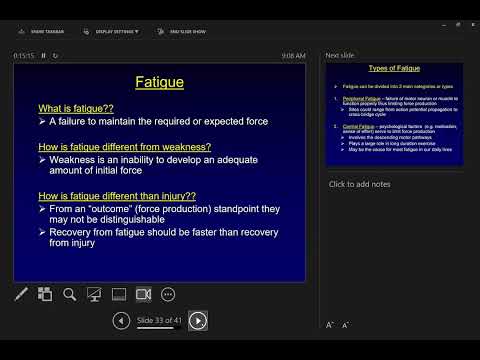
- Fatigue means failure to produce the desired or expected force, not sleepiness or ordinary tiredness.
- Students who stop despite being able to continue illustrate central fatigue; those who cannot keep their arms raised illustrate peripheral fatigue.
- Black distinguishes fatigue from weakness: inability to lift a hypothetical 50-pound dumbbell while fresh would be weakness, not fatigue.
- Delayed soreness after eccentric exercise reflects muscle damage to sarcomeres, which can reduce force for days, rather than fatigue itself.
- Central fatigue is a reduced drive from the motor cortex to alpha motor neurons and is more prominent in prolonged endurance exercise.
- Peripheral fatigue originates downstream of the alpha motor neuron and is common during brief, high-intensity efforts and sets taken to failure.
- Potential peripheral sites include action-potential propagation along the axon or sarcolemma and, less commonly, acetylcholine depletion at the neuromuscular junction.
- Black identifies impaired excitation-contraction coupling as the most common peripheral mechanism, especially disruption between T-tubule excitation and calcium release from the sarcoplasmic reticulum.
- Disrupted ionic gradients in T-tubules or inhibited calcium release through ryanodine receptors can limit muscle force.
- Repeated sprints and resistance-training sets to failure are examples where impaired excitation-contraction coupling may prevent further force production.
- During high-intensity exercise, hydrogen ions accumulate alongside lactate as pyruvate is converted, lowering pH and contributing to peripheral fatigue.
- Black describes acidity as making sarcolemma depolarization more difficult and inhibiting calcium release from the sarcoplasmic reticulum.
- Hydrogen ions can reduce calcium binding to troponin, impair calcium reuptake, inhibit phosphofructokinase in glycolysis, and slow myosin ATPase activity.
- Calcium handling can also be impaired when ATP turnover produces inorganic phosphate that binds released calcium; Black presents hydrogen as the primary fatigue-related factor.
- A high-intensity effort can use much of its muscle creatine phosphate within roughly 10 to 20 seconds; around 20 to 30 seconds, ATP supply may no longer match the required force.
- As creatine phosphate runs low, glycolysis and aerobic metabolism may not replenish ATP quickly enough to maintain sprint speed or complete another squat.
- Long-duration exercise can deplete muscle glycogen, potentially after about 90 minutes to 2 hours of continuous running in a typical person.
- Black links glycogen depletion to a marked decline in performance and motivation, describing it as involving central fatigue as well as fuel availability.
- Central fatigue appears as a reduced signal from the brain to skeletal muscle, including a voluntary decision to stop despite some capacity to continue.
- Black describes animal studies in which altered serotonin-to-dopamine balance reduces willingness to run on a treadmill.
- Immune cytokines during illness and falling blood glucose can also reduce motivation or neural drive; severe hypoglycemia can lead to loss of consciousness or coma.
- Pain and rising muscle temperature send sensory feedback to the central nervous system, which can inhibit force production during sustained effort.
- Disrupted ionic gradients may recover within a couple of minutes after exercise, while fatigue associated with hydrogen ions often resolves within about 3 to 15 minutes.
- Some impairments in excitation-contraction coupling can persist for hours or days, depending on the conditions that produced them.
- In response to a question about rhabdomyolysis, Black identifies elevated blood creatine kinase, myoglobin, and lactate dehydrogenase as indicators of muscle-cell damage.
- Dark brown or cola-colored urine is an urgent warning sign; Black advises seeking hospital care and discusses hydration as one way to reduce kidney stress.
- Black contrasts familiar anabolic hormones such as testosterone, growth hormone, and IGF-1 with hormones that regulate exercise performance and homeostasis.
- Endurance exercise requires coordinated changes in muscle metabolism, cardiovascular and pulmonary function, and fluid balance.
- Hormonal responses help make blood glucose and free fatty acids available to working muscles during prolonged exercise.
- The lecture previews further discussion of hormone-driven substrate use and kidney-related fluid regulation.
- Exercise increases energy demand, so muscles need greater substrate availability to produce enough ATP and sustain force.
- Mobilization releases stored fuel into the bloodstream: glucose comes from glycogen in the liver and skeletal muscles, while free fatty acids come from adipose tissue.
- Hormones regulate glycogen breakdown, especially in the liver, and help make circulating glucose and fatty acids available for muscle uptake.
- The lecture closes by explaining that the brain monitors blood glucose and that the body prioritizes keeping it stable; Black leaves the two main glucose-maintenance responses for the next class.
Transcript excerpt
0:02 All right, good morning. Okay, I was getting worried there for a second. We're going to solve that problem in just a minute. We're going to We're going to do some We're going to do some physical activity. Um I just wanted to pass around I don't know if you want to talk about it. I got a couple of folks that have yet to take the test. Um you should get that fixed up today um because of a couple of things. Ali is not here. She's actively grading them as we speak. She's working on them yesterday and on Monday. I would tell you that from what I was grading on the multiple choice cuz we got almost all the multiple choice graded during class when you guys were turning them in is they looked better. So, I don't know how you guys felt or thought about it, but it seemed like people were doing were doing all right
0:51 um with everything. So, we will we will hope that maybe fingers crossed we'll have those for Friday or Friday. Um we'll we'll see. Okay? All right. We need to finish up uh finish up the last little thing about metabolism and aerobic exercise and talk about a topic that's near and dear to my heart, which is fatigue. Then we're going to We'll do that for about 20 minutes or so. Then we'll jump into the formal control of anaerobic exercise and some things to start on onto our next uh next to the stuff. So, let's do let's do this. Everybody stand up. Everybody stand up. You can throw a little bit of space from
1:40 your neighbor. A little bit of space. Put your arms out like this. Okay. You should leave them out. Put them out.
This is the start of the transcript. Save this video free for the whole transcript, searchable and time-coded.
In this course
Related notes
Summary, takeaways, and chapters were generated by AI from the video's transcript and may contain errors. The video belongs to its creator, Exercise Physiology with Dr. Chris Black.