L26 Cardiovascular System and Exercise III
Overview
Dr. Chris Black explains how stroke volume is regulated by preload, afterload, contractility, and heart rate, then connects arterial diameter and blood-flow control to exercise. The lecture details local autoregulation, nitric oxide signaling, sympathetic control, and blood redistribution, including the shift from roughly 15% of resting blood flow to skeletal muscle to about 80% during exercise, before outlining blood composition and hemoglobin’s oxygen-carrying role.
Key takeaways
- Stroke volume depends on preload, afterload, contractility, and heart rate; very high heart rates can shorten diastole enough to reduce ventricular filling and stroke volume.
- Arteriole radius is a powerful flow-control mechanism because Poiseuille’s law makes flow proportional to the radius raised to the fourth power.
- During exercise, blood distribution shifts from about 15% of resting flow reaching skeletal muscle to roughly 80%, while cardiac output also rises four to five times.
- Active muscle increases local flow through metabolic vasodilation and endothelial nitric oxide release triggered by blood-flow shear stress.
- Sympathetic receptor types help determine where blood goes: alpha receptors favor vasoconstriction, while beta-2 receptors favor vasodilation.
- Hemoglobin enables high oxygen transport: each molecule binds four oxygen molecules, and each red blood cell contains about 250 million hemoglobin molecules.
Chapters
- Preload increases left-ventricular filling and stretch, while afterload reflects the aortic pressure the ventricle must overcome.
- Contractility is the force of ventricular contraction; sympathetic input and epinephrine and norepinephrine increase it, raising stroke volume and cardiac output.
- Hypoxia, acidosis, and prolonged oxygen deprivation can weaken cardiac contraction; severe deprivation may cause tissue necrosis, as in a heart attack.
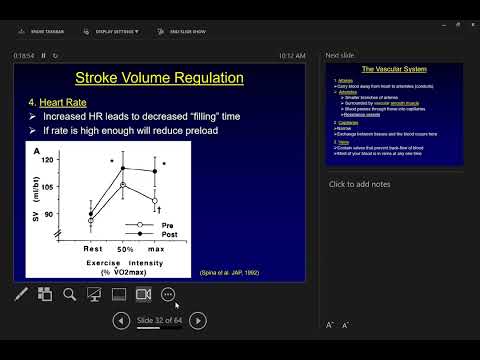
- As heart rate rises, diastolic filling time shrinks; at very high rates, lower preload can reduce stroke volume.
- An example study compared resting, 50% VO₂max, and maximal exercise before and after 12 weeks of aerobic training.
- Before training, stroke volume declined at maximal exercise; after training, that decline was no longer evident, in part because the left ventricle adapted to support filling.
- Arteries carry blood away from the heart and veins return it; pulmonary arteries are an exception to the usual pattern of oxygen-rich arterial blood.
- Arterioles, surrounded by smooth muscle, adjust their diameter to direct blood among tissues and are key resistance vessels for blood-pressure control.
- Capillaries are the sites of gas, nutrient, hormone, and ion exchange; venules collect blood from capillaries and feed it into veins, whose valves help prevent backflow.
- The endothelium lines the inside of arteries and veins, while smooth muscle around arteries and arterioles can constrict or relax the vessel.
- Atherosclerotic cholesterol and fatty deposits can impair endothelial function and the vessel’s responses, contributing to increased blood pressure and cardiovascular disease.
- Large arteries form macrocirculation; progressively branching arterioles and capillaries form microcirculation, where local blood supply is controlled.
- Blood flow rises with the pressure difference across a vessel and falls as resistance to flow increases; blood pressure is described as cardiac output multiplied by total peripheral resistance.
- In Poiseuille’s law, resistance depends on fluid viscosity and vessel length and is inversely related to the radius to the fourth power.
- Because small radius changes produce large flow changes, arteriole vasoconstriction reduces local flow and vasodilation increases it.
- At rest, more than half of blood flow goes to the splanchnic region, including the digestive system, liver, and kidneys; skeletal muscle receives about 15%.
- During exercise, roughly 80% of blood flow can be directed to skeletal muscle, compared with its much smaller resting share.
- Combining redistribution with a four- to fivefold increase in cardiac output can raise blood flow delivered to working muscle by about 25 times.
- After eating, flow increases to digestive organs; during heat stress, more flow is directed to skin to support heat loss.
- Local autoregulation increases flow to active tissue: higher oxygen use and accumulating acidity and potassium promote arteriolar vasodilation.
- Faster blood flow creates endothelial shear stress, which triggers nitric oxide release; nitric oxide relaxes smooth muscle and widens the vessel.
- During exercise or stress, sympathetic signals release epinephrine and norepinephrine; alpha receptors promote vasoconstriction, while beta-2 receptors promote vasodilation.
- This receptor pattern helps constrict vessels serving digestive organs while supporting flow to skeletal muscle and, when needed, skin.
- Blood transports oxygen and carbon dioxide, hormones, and nutrients, and also helps regulate body temperature and pH.
- Blood volume varies with body size and training; the lecture gives typical ranges of about 4 to 6 liters and up to 7 or 8 liters in some large, highly trained people.
- Plasma makes up about 55% to 60% of blood and is roughly 90% water; hematocrit accounts for about 40% to 45%, mostly red blood cells, with white cells and platelets comprising a small fraction.
- Red blood cells, also called erythrocytes, carry oxygen using hemoglobin, which contains iron and binds oxygen.
- Each hemoglobin molecule can bind four oxygen molecules, and a red blood cell contains about 250 million hemoglobin molecules.
- That capacity lets a single red blood cell carry up to roughly one billion oxygen molecules, far more than could be carried dissolved in blood alone.
Transcript excerpt
0:08 morning. >> Good morning. >> We got like two people that are like that's that's not the best. We have a we have a bad weekend or a weekend. No. >> So, okay. Just a little reminder here. We're looking at maybe Wednesday or Friday of next week for our test, not Monday. See kind of where we get to today and uh today and Wednesday. That will that will kind of give us the determination. So start make sure you're working on the short answer questions. Send stuff excuse me to me. Send stuff to Ally. Come see us.
0:57 come to office hours, take advantage of us, be able to give you feedback. Okay. All right. We left off on Friday talking about regulation of stroke volume, right? So, the amount of blood that gets ejected from the heart every time it beats. We covered the idea of preload. Covered the idea of afterload. Okay. So remember preload is how much blood ends up in the left ventricle. You get more in it stretches and you get a more forceful contraction. So more blood leaves. After load is in essence aortic blood pressure. The higher aortic blood pressure is the more difficult it is to get blood out of
1:45 the left ventricle. So what you want is you want preload to be as big as possible. You want after load to be as small or low as possible and the combination of those two things gets us the most. Okay. So we're going to cover the last two things today. We're going to start by talking about this idea or the concept of what we call contractility. Contractility. What this represents is the force of ventricular contraction. Now remember some of this right some of this is going to be covered under the
This is the start of the transcript. Save this video free for the whole transcript, searchable and time-coded.
In this course
Related notes
Summary, takeaways, and chapters were generated by AI from the video's transcript and may contain errors. The video belongs to its creator, Exercise Physiology with Dr. Chris Black.