L22 Hormones and Exercise I
 Watch on YouTube →
Overview
Dr. Chris Black explains how exercise-related hormonal changes help keep blood glucose available for the brain and working muscles. He contrasts steroid and peptide hormone signaling, then details insulin’s role in glucose storage and GLUT4 movement, muscle contraction’s insulin-like effect, and glucagon’s role in raising blood glucose during exercise.
Key takeaways
- Maintaining blood glucose during exercise depends on both limiting reliance on plasma glucose, through muscle glycogen and fat use, and replenishing it from liver glycogen and gluconeogenesis.
- Insulin is a peptide hormone from pancreatic beta cells; it promotes glucose uptake by moving GLUT4 transporters to muscle-cell membranes and encourages glucose storage.
- Muscle contractions independently stimulate GLUT4 movement, so working muscle can increase glucose uptake even as circulating insulin falls.
- Insulin levels decrease during exercise, while glucagon supports blood glucose by promoting liver glycogen breakdown and gluconeogenesis.
- Exercise can lower blood glucose through contraction-driven muscle uptake, so people using injected insulin need to account for the added hypoglycemia risk.
Chapters
- The body tightly regulates blood glucose because the brain depends on it; a decline can contribute to central fatigue and an urge to stop exercising.
- Working muscles can draw on muscle glycogen and fat instead of relying only on blood glucose.
- The liver helps replenish blood glucose by breaking down glycogen and making glucose through gluconeogenesis.
- Carbohydrate drinks such as Gatorade or gels can supply glucose during endurance exercise.
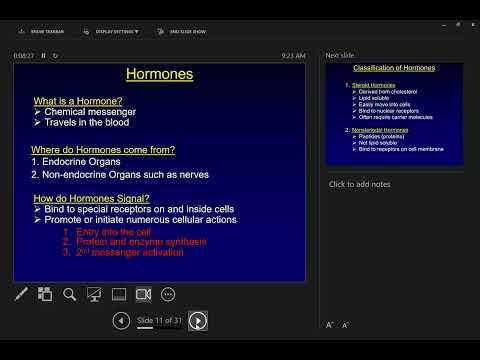
- Hormones are chemical messengers released into the blood that affect tissues with matching specialized receptors.
- Epinephrine and norepinephrine can act as hormones when carried in blood or as neurotransmitters when released by nerves.
- Hormone binding can trigger cellular processes such as enzyme activity, protein synthesis, or second-messenger cascades.
- The hormone’s chemical properties help determine whether it binds at a cell surface or enters a cell to bind an internal receptor.
- Steroid hormones, including testosterone, estrogen, and progesterone, derive from cholesterol, travel in blood attached to carrier proteins, and can cross cell membranes.
- Peptide hormones such as insulin are water-soluble, travel freely in blood, and typically bind to receptors on cell surfaces.
- The hypothalamus, pituitary, thyroid, adrenal glands, pancreas, kidneys, ovaries, and testes are among the endocrine organs identified.
- For each hormone, the lecture’s framework is to know its name, type, tissue of origin, and action related to blood glucose during exercise.
- Insulin is a peptide hormone released by pancreatic beta cells in the islets of Langerhans, especially when blood glucose rises after carbohydrate intake.
- Insulin promotes glucose uptake and storage as muscle or liver glycogen; when those stores are full, excess energy can be stored as fat.
- In muscle, insulin signaling moves GLUT4 glucose transporters from intracellular vesicles to the cell membrane, allowing more glucose to enter.
- Insulin’s glucose-lowering effects are important in diabetes, and the lecture highlights exercise as a way to improve blood glucose regulation in type 2 diabetes.
- Skeletal muscle contractions also move GLUT4 to the cell membrane, creating an insulin-like effect in the contracting muscles.
- This contraction-driven glucose uptake helps explain why exercise can lower blood glucose even when insulin is not elevated.
- For people using injected insulin, exercise can add to insulin’s glucose-lowering effect and increase the risk of hypoglycemia.
- The lecture notes that metformin can improve insulin sensitivity, while exercise provides an additional route for muscle glucose uptake.
- Glucagon is released by pancreatic alpha cells when blood glucose is low and acts in opposition to insulin.
- Glucagon supports blood glucose by promoting liver glycogen breakdown and gluconeogenesis; the lecture also describes mobilization of fat from adipose tissue.
- During exercise, insulin levels fall rather than rise, while muscle contractions provide the GLUT4-mediated glucose uptake muscles need.
- The class closes by linking the rise in glucose demand during exercise to glucagon’s blood-glucose-raising role.
Transcript excerpt
0:01 All right. On Wednesday, we were talking about hormones. We hadn't really gotten into hormones yet, but we were we were working our way there. Talk about how hormones are during aerobic exercise, we're going to use hormones to help us control blood glucose levels, okay? At all costs, I'm going to say this on Wednesday, I want to reiterate it again. At all costs, the body wants to try to maintain constant levels of blood glucose. We're really, really good at this because of hormones and some other things that are going on, okay? So, we need the blood glucose to be constant because the brain uses the glucose.
0:51 If your blood glucose dips even a little bit, then central fatigue occurs. Central fatigue occurs. Brain senses lower blood glucose levels, so the brain just basically says, "Let's shut it down. All of this stop. We don't want to risk going any lower on our blood glucose. Let's just be [clears throat] honest. Stop exercising. You feel tired. You feel fatigued. You feel crappy. Shut it down." Okay? So, to allow for this increased energy demand that we have during exercise, okay? You start running, you start biking like we did in lab this week, and immediately, one of the things that happens is we're going to start trying to use and pull blood glucose out of the
1:38 blood. So, we want to try to do something to make sure that it doesn't fall too And we can prevent a blood glucose fall in two ways. You can do one of two things. We actually do both of them simultaneously, but you can keep something from falling by not using. Okay? So, can shift and say don't use glucose from the blood, use glucose from muscle glycogen. That's one way.
This is the start of the transcript. Save this video free for the whole transcript, searchable and time-coded.
Related notes
Summary, takeaways, and chapters were generated by AI from the video's transcript and may contain errors. The video belongs to its creator, Exercise Physiology with Dr. Chris Black.