L27 Cardiovascular System and Exercise IV
Overview
Chris Black explains how exercise raises cardiac output and redirects blood flow to meet working muscles’ oxygen needs, while heart rate, stroke volume, blood pressure, and oxygen extraction change in distinct ways. He connects these responses to mechanisms including venous return, the Frank-Starling law, reduced peripheral resistance, the Fick equation, and the effects of rising heart rate on ventricular filling.
Key takeaways
- Cardiac output increases with exercise intensity because both heart rate and stroke volume rise, but heart rate continues increasing after stroke volume commonly plateaus around 50 to 60% of VO2 max.
- At very high heart rates, diastolic filling time can shrink dramatically, from about 0.5 seconds at rest to roughly 0.13 seconds near 180 beats per minute, limiting ventricular filling and potentially lowering stroke volume.
- During maximal exercise, blood flow shifts sharply toward muscle and skin: their combined share can reach 80 to 85%, compared with roughly 15 to 25% at rest, while digestive and kidney shares fall.
- During aerobic exercise, systolic pressure generally rises with intensity, while diastolic pressure stays relatively stable or falls slightly; breath-holding during a Valsalva maneuver can instead produce extreme pressures.
- The Fick equation, VO2 = cardiac output × a-vO2 difference, shows that oxygen consumption depends on both blood delivery and tissue oxygen extraction.
- More circulating blood can raise preload and stroke volume, while greater red blood cell volume can increase oxygen-carrying capacity; both mechanisms can contribute to higher VO2 max.
Chapters
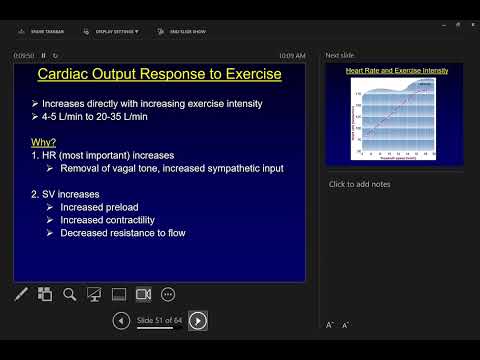
- Cardiac output rises to match oxygen delivery with oxygen uptake, through increases in heart rate and stroke volume.
- Blood shifts away from the splanchnic organs, including the liver, kidneys, stomach, and intestines, toward skeletal muscle and skin.
- Brain blood flow remains relatively stable, while coronary blood flow increases to support the heart’s greater workload.
- Systolic blood pressure rises during exercise, while diastolic pressure generally stays relatively constant.
- Cardiac output rises roughly linearly with treadmill speed, cycling resistance, or percentage of VO2 max, from about 5 L/min at rest to 20 to 25 L/min near VO2 max in the example.
- Heart rate closely tracks work rate and VO2 max, which is why watches and Oura rings use it to estimate exercise intensity.
- At low intensity, heart rate rises mainly as parasympathetic input from the vagus nerve is withdrawn.
- At higher intensities, sympathetic activity and epinephrine and norepinephrine further increase heart rate.
- Stroke volume increases with exercise intensity, then commonly levels off around 50 to 60% of VO2 max.
- Greater venous return raises preload, while norepinephrine increases left-ventricle contractility and skeletal-muscle vasodilation lowers afterload.
- Preload and contractility eventually approach their functional limits, helping explain why stroke volume stops increasing.
- At about 180 beats per minute, diastolic filling time can shrink to roughly 0.13 seconds; in less-trained people, stroke volume may then decline.
- At rest, roughly 20 to 25% of cardiac output goes to digestive organs and about 20% to the kidneys; during maximal exercise, those shares can fall to about 3 to 5% and 2 to 4%.
- The reduced digestive blood flow helps explain why exercising soon after eating can cause stomach discomfort.
- The heart receives about 4 to 5% of cardiac output at rest and during exercise, but the much larger exercise cardiac output means substantially more blood in absolute terms.
- The brain’s percentage of cardiac output may fall during exercise, while its absolute blood flow remains relatively similar.
- The example shows cardiac output increasing from about 5 L/min at rest to around 30 L/min during maximal exercise in a well-trained person.
- As intensity rises, a greater percentage of cardiac output goes to skeletal muscle and skin, while the share going to splanchnic organs falls.
- Combining a four- to fivefold increase in cardiac output with a shift from roughly 15 to 20% to 80 to 85% for muscle and skin can raise skeletal-muscle blood flow by about 20 to 25 times.
- During aerobic exercise such as walking, running, or cycling, systolic pressure rises with intensity, while diastolic pressure generally remains stable or may fall slightly as muscle vasodilation reduces peripheral resistance.
- Arm exercise produces a more pronounced blood-pressure response than leg exercise at comparable intensity because the smaller arm muscle mass causes a smaller overall drop in resistance.
- Holding the breath and bearing down during a Valsalva maneuver can cause extreme pressure responses; measurements during resistance exercise have reached about 480/350 mmHg.
- Breathing through resistance exercises helps avoid the exaggerated pressure response, a particular concern for older adults and people at risk from aneurysms.
- During exercise, water moves from blood plasma into contracting skeletal muscle, temporarily reducing plasma volume.
- The fluid shift concentrates the blood and raises hematocrit, increasing red blood cells as a proportion of blood volume.
- The temporary movement of fluid into muscles contributes to the visible and felt muscle pump after resistance exercise.
- Arteriovenous oxygen difference, abbreviated a-vO2 difference, measures the oxygen content difference between arterial blood entering tissue and venous blood leaving it.
- Working muscle extracts more oxygen during exercise, increasing a-vO2 difference compared with rest.
- The Fick equation states that oxygen consumption, VO2, equals cardiac output multiplied by a-vO2 difference.
- Because cardiac output equals heart rate multiplied by stroke volume, VO2 can also be expressed as heart rate × stroke volume × a-vO2 difference.
- The class applies the Fick equation to explain why Chris Black’s predicted maximum heart rate, about 25 to 30 beats per minute lower than students’, can limit maximum cardiac output and VO2.
- A red blood cell transfusion can raise VO2 max by improving oxygen-carrying capacity and increasing the oxygen available for extraction by tissues.
- The discussion links blood volume to preload: more circulating blood can increase end-diastolic volume, stroke volume, and therefore cardiac output.
Transcript excerpt
0:02 All right. So we're going to finish the cardiovascular system today. And what we're going to cover today very simply is as you go from rest to exercise, what changes? Why does it change? How does it change? So we're going to cover those primary variables that we've that we've already we've already sort of talked about up until now. Okay? So we'll start with a very basic summary. This you absolutely have to know. This is definitely going to be something that's going to show up on the test next week. Okay? But as you move from resting to walking or doing jumping jacks or whatever it might be. Okay? We are going to see an increase in cardiac output. That increase in cardiac output is going
0:49 to help us match oxygen delivery to oxygen uptake. Okay? So we've got to have an increase in cardiac output. Who remembers what are the two things that contribute to cardiac output? What are our two variables that contribute to cardiac output? Stroke volume and heart rate. So if I told you that cardiac output goes up, what do you imagine happens heart rate and stroke volume? They're both going to go up. Okay? So heart rate's going to increase. Stroke volume's going to increase and then then do a weird thing that we'll talk about. Stroke volume goes up and then it levels off after a certain period of time. Okay? We're going to see a shift in where
1:36 blood is in your body in response to exercise. Blood is going to shift away from the splanchnic region. So away from liver, kidneys, stomach, intestines away from there. And it's going to go primarily to skeletal muscle and [clears throat] to your skin. Okay? Skin's dissipate the skeletal muscle to make sure that we've got everything
This is the start of the transcript. Save this video free for the whole transcript, searchable and time-coded.
In this course
Related notes
Summary, takeaways, and chapters were generated by AI from the video's transcript and may contain errors. The video belongs to its creator, Exercise Physiology with Dr. Chris Black.