L23 Hormones and Exercise II
Overview
Chris Black explains how thyroid hormone, catecholamines, cortisol, growth hormone, insulin, and glucagon help regulate metabolism and fuel use during exercise. The lesson connects their endocrine sources and exercise responses to maintaining blood glucose, mobilizing fat to spare muscle glycogen, and preserving plasma volume through aldosterone and antidiuretic hormone.
Key takeaways
- During exercise, insulin falls while muscle contractions stimulate glucose uptake, helping prevent excessive removal of glucose from the bloodstream.
- Glucagon and catecholamines help maintain fuel availability by promoting liver glycogen breakdown, while catecholamine release rises sharply with exercise intensity and peaks during all-out sprints.
- Growth hormone and cortisol support fat mobilization, helping working muscles use more fat and spare limited muscle glycogen.
- Cortisol supports blood-glucose maintenance through gluconeogenesis and fat mobilization, and its exercise response may rise early before declining after roughly 30 to 60 minutes.
- Exercise-related movement of water into muscle can reduce plasma volume by 5 to 10 percent; aldosterone and ADH respond by increasing kidney retention of sodium and water.
- Thyroid hormone T3 and T4 are presented as permissive signals that help other metabolic processes function effectively, rather than as the primary direct drivers of exercise fuel changes.
Chapters
- The thyroid gland produces T3, triiodothyronine, and T4, thyroxine, which regulate metabolic activity.
- Hyperthyroidism is associated with a faster metabolism and jitteriness, while hypothyroidism can slow metabolism and contribute to sluggishness and weight gain.
- Thyroid hormone is described as permissive: it helps other hormones and processes exert their effects during exercise.
- Epinephrine and norepinephrine are released from the adrenal medulla and prepare multiple body systems for activity.
- Their effects include increased heart rate, cardiac contraction force, blood pressure, breathing, metabolic rate, liver glycogen breakdown, and fat mobilization.
- Stress and anticipation can also raise these hormones, producing effects such as flushing, sweating, and an anticipatory increase in heart rate.
- Cortisol is a steroid hormone produced by the adrenal cortex and helps maintain blood glucose between meals.
- It promotes protein breakdown and gluconeogenesis, the production of glucose from non-carbohydrate precursors, and mobilizes fat from adipose tissue.
- Cortisol also suppresses inflammation, which helps explain the use of corticosteroid treatments for conditions such as joint inflammation and poison ivy.
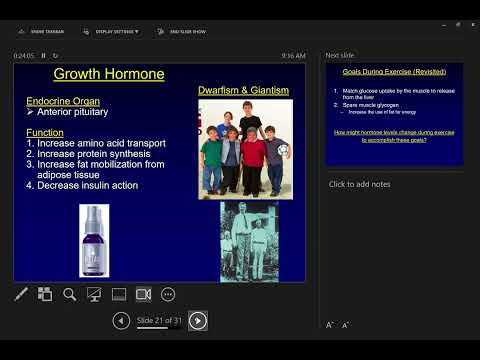
- Growth hormone comes from the anterior pituitary and increases amino-acid transport and protein synthesis.
- During exercise, it rises, promotes the release of free fatty acids from adipose tissue, and blunts insulin activity.
- The lecture links too little growth hormone with pituitary dwarfism and excessive secretion with gigantism.
- A key exercise goal is to match muscle glucose uptake with glucose released from liver glycogen so blood glucose remains relatively stable.
- Sparing muscle glycogen matters because muscle-glycogen depletion can contribute to central fatigue.
- Mobilizing adipose fat supplies an alternative fuel and reduces reliance on muscle glycogen.
- Insulin comes from pancreatic beta cells and falls during exercise; muscle contractions stimulate glucose uptake, reducing the need for insulin-driven uptake.
- Glucagon comes from pancreatic alpha cells and rises, promoting liver glycogen breakdown and fat mobilization to support blood glucose and energy supply.
- Epinephrine and norepinephrine from the adrenal medulla rise with exercise, while growth hormone from the anterior pituitary increases fat availability.
- Cortisol from the adrenal cortex can rise early in exercise and then decline after roughly 30 to 60 minutes; it supports gluconeogenesis and fat mobilization.
- Across three hours of exercise, blood glucose stays relatively stable while insulin declines; glucagon, catecholamines, and other fuel-mobilizing signals generally rise.
- Epinephrine and norepinephrine increase more steeply as exercise intensity rises, with a particularly large surge during all-out sprinting.
- Sprint-related catecholamine surges increase liver glycogen breakdown and can briefly raise blood glucose above the amount being taken up.
- Free fatty acids rise during exercise through the combined effects of cortisol, catecholamines, growth hormone, and glucagon.
- Exercise shifts water from the blood into working muscle, driven by metabolites that create osmotic pressure and by elevated blood pressure; plasma volume can fall by 5 to 10 percent.
- Sweat loss can compound the fluid shift, increasing the risks of dehydration, overheating, and cardiovascular strain.
- Aldosterone from the adrenal cortex increases kidney sodium reabsorption, while antidiuretic hormone, ADH, from the posterior pituitary increases water retention.
- Together, aldosterone and ADH reduce urine output and help maintain plasma volume; their effects can remain elevated for a day or two after exercise and contribute to plasma-volume expansion.
Transcript excerpt
0:01 All right, we'll continue then talking about hormones and how we have how we manage everything here. What happens if during exercise? But this is first great. Okay. So going to work through a few more hormones. Remember what I want you guys to know about the hormones are where do they come from? What's their indocrine organ? Are they a peptide or a steroid hormone? What are their actions? And then what what happens to them during
0:50 activity? Okay. What happens to them during exercise? All right. So, we covered the pancreatic hormones on arthritic insulin and we have glucagon. So, we're going to start today talking about thyroid hormone. It's a really really fascinating uh hormone. Thyroid hormone comes in a couple of different flavors. T3 and T4. You have trioto thyroid which is T3. That's the tri or you have T4 which is thyroxine and thyroid hormone comes obviously from the thyroid gland which is here in your throat on the front side of your throat. Okay. [clears throat] And the big thing the thyroid hormone does is thyroid hormone regulates metabolism.
1:39 Right. Regulates metabolism and we notice how it regulates metabolism very much so in people that are high in thyroid or low in thyroid. So hypo thyroidism or hyperthyroidism. And what we see is people that have very high levels of thyroid hormone have very fast metabolisms and their personality in some ways tends to reflect all that. That's a very strange type of thing that people that are very high in thyroid are a little jittery and like they're strung out on uh on caffeine to a certain extent. Hypo thyroidism is people tend to be kind of sluggish. Okay. And what you will know the
2:27 spectrum of hypothyroidism is as thyroid hormone levels change and metabolism
This is the start of the transcript. Save this video free for the whole transcript, searchable and time-coded.
In this course
Related notes
Summary, takeaways, and chapters were generated by AI from the video's transcript and may contain errors. The video belongs to its creator, Exercise Physiology with Dr. Chris Black.