L28 Pulmonary System and Exercise I
Overview
Chris Black introduces pulmonary physiology during exercise by tracing how ventilation brings air to the alveoli, how oxygen and carbon dioxide diffuse and travel in blood, and how breathing responds to exercise. Key quantitative examples include about 600 million alveoli, 98% of blood oxygen carried on hemoglobin, and the sharp fall in oxygen partial pressure at Mount Everest that reduces the diffusion gradient.
Key takeaways
- Minute ventilation is calculated as tidal volume multiplied by breathing frequency, making it the pulmonary counterpart to cardiac output.
- Only air that reaches the alveoli can participate in gas exchange; air retained in the conducting zone contributes to anatomical dead space.
- At sea level, the oxygen partial-pressure difference between alveolar air and resting venous blood is about 65 mmHg, while altitude sharply reduces that diffusion gradient.
- Hemoglobin carries about 98% of blood oxygen, and the exercise-related rightward Bohr shift helps unload oxygen where muscle temperature rises and pH falls.
- Most blood CO₂ travels as bicarbonate, formed when CO₂ reacts with water and carbonic acid dissociates into bicarbonate and hydrogen ions.
- Arterial CO₂ is a primary driver of breathing regulation; movement-related signals cause an immediate exercise response, followed by chemoreceptor-driven increases.
Chapters
- Chris Black introduces pulmonary ventilation, oxygen transport, and diffusion between blood and tissues as the lecture's main topics.
- Pulmonary ventilation exchanges atmospheric oxygen for carbon dioxide, while breathing also contributes to acid-base balance by removing CO₂.
- The class plans to cover the gas-exchange threshold and acid-base regulation after reviewing pulmonary function.
- Minute ventilation, VE, is the volume of air moved per minute and equals tidal volume multiplied by breathing frequency.
- Pulmonary diffusion moves O₂ from alveoli into blood and CO₂ from blood into alveoli down partial-pressure gradients.
- Gas transport circulates oxygen primarily on hemoglobin, while internal or tissue diffusion exchanges O₂ and CO₂ between capillaries and tissues.
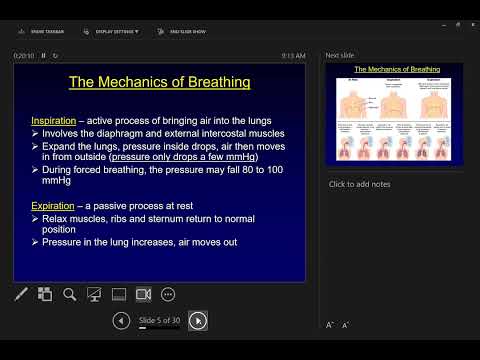
- During inspiration, the diaphragm contracts and descends; chest-cavity volume rises, lung pressure falls below atmospheric pressure, and air flows inward.
- At rest, expiration is generally passive as the diaphragm relaxes, chest volume decreases, and lung pressure rises above atmospheric pressure.
- The intercostal muscles help move the rib cage during breathing; forced expiration can recruit additional muscle activity.
- The conducting zone includes the trachea, bronchi, and bronchioles; it warms, humidifies, and filters air but does not exchange gases.
- The respiratory zone includes respiratory bronchioles and alveoli, where pulmonary gas exchange occurs.
- Each breath leaves some air in anatomical dead space, while alveolar ventilation is the portion that reaches the alveoli.
- An average person has about 600 million alveoli, with a combined diffusion surface area roughly equal to half a tennis court.
- Gas exchange occurs across the thin respiratory membrane where alveolar cells meet the surrounding pulmonary capillaries.
- The short diffusion distance helps oxygen move from alveolar air into red blood cells and carbon dioxide move in the opposite direction.
- Capillaries are narrow enough that red blood cells often pass through one at a time, bringing them close to the alveolar exchange surface.
- At sea level, atmospheric pressure is about 760 mmHg; oxygen's partial pressure in dry air is about 159 mmHg, while CO₂ is about 0.2 mmHg.
- Humidified alveolar air has an O₂ partial pressure near 105 mmHg and CO₂ near 40 mmHg; resting venous blood arrives at about 40 mmHg O₂ and 46 mmHg CO₂.
- At Mount Everest's summit, atmospheric pressure is about 253 mmHg and oxygen partial pressure falls to roughly 53 mmHg before further effects of humidification.
- The reduced oxygen gradient at altitude makes oxygen diffusion into blood more difficult and helps explain why exertion feels harder at elevation.
- About 98% of blood oxygen is carried bound to hemoglobin, allowing blood to transport roughly 70 times more oxygen than plasma alone could carry.
- A hemoglobin molecule can bind four O₂ molecules, and normal blood oxygen saturation is commonly around 97% to 99%.
- During exercise, increased temperature and lower pH shift the oxyhemoglobin dissociation curve to the right, making oxygen unloading to tissues easier.
- Blood carries about 7% to 10% of its CO₂ dissolved in plasma and roughly 20% to 33% bound to hemoglobin as carbaminohemoglobin.
- Approximately 60% to 70% of CO₂ is transported as bicarbonate, HCO₃⁻.
- CO₂ combines with water to form carbonic acid, which dissociates into hydrogen ions and bicarbonate, linking CO₂ transport with blood buffering.
- Exercise increases breathing depth and frequency, raising minute ventilation to deliver more oxygen, remove more CO₂, and help maintain pH.
- Brainstem respiratory centers regulate breathing using inputs that include arterial CO₂ and hydrogen-ion levels, peripheral chemoreceptors in the carotid and aortic regions, lung stretch receptors, and muscle and joint signals.
- Breathing rises in two phases: an immediate movement-related response, followed by a more gradual response driven largely by chemoreceptor input.
- Ventilation remains elevated after exercise to support recovery processes including temperature regulation, lactate clearance, and creatine-phosphate restoration.
Transcript excerpt
0:04 3 4 5 6 7 8 10 >> Okay. See you. What you got? Yeah, we're going to do the exam next Friday. Next Friday. Okay. I didn't realize that was going to be such a popular decision, but yes, we'll do the exam next Friday. We'll do jeopardy on play jeopardy on Wednesday and then we'll we'll lecture today. We may get through all of this today. I don't know. We'll see. If not, we'll finish it
0:50 Monday. We can start training and then we'll do the exam. Okay? All right. All right. So we finished the cardiovascular system and we can start talking now about pulmonary system. So breathing. What happens to breathing during exercise? Pretty obvious, right? Ventilation breathing goes up. We're going to talk a little bit about how do we breathe? What are the mechanisms that control breathing? We're going to talk about how we carry oxygen in the blood, how we move oxygen into and out of the lungs, how we diffuse it out of the blood into the our tissue. That's kind of the big the big side of things that we're going to cover here. Then we might not get to today, but
1:38 we'll talk about acid base balance and we'll talk about gas exchange threshold, which you guys did in lab. I've not seen Ty or Cole to talk about lab. How did you guys take lab this week? All right. It was okay. Friday we're not we're just we're already we're already locked in for the weekend. Okay. All right. Um I may periodically ask of you all to turn your laptops around and show me that you're not buying shoes or buying um plane tickets in various places as I said before everybody got in here. Um I was doing a teaching evaluation for one
This is the start of the transcript. Save this video free for the whole transcript, searchable and time-coded.
In this course
Related notes
Summary, takeaways, and chapters were generated by AI from the video's transcript and may contain errors. The video belongs to its creator, Exercise Physiology with Dr. Chris Black.