fnb100f260930b
Overview
Jeff Hunk explains how the yield curve, maturity risk, inflation expectations, and borrower-specific risk premiums shape borrowing costs. He connects rising real rates to capital spending on AI data centers, discusses default and liquidity risk in bond markets, and concludes with course and textbook access guidance.
Key takeaways
- A normal yield curve generally slopes upward because investors demand additional yield for the uncertainty and maturity risk of lending over longer periods.
- Jeff's cost-of-capital framework combines a nominal base rate with default-risk, liquidity-risk, and maturity-risk premiums.
- Jeff links rising real rates to increased demand for investment capital, especially bond-financed AI data-center construction by companies such as Google and Meta.
- Disinflation means inflation is slowing, not that prices are falling; Jeff presents the Federal Reserve's target as approximately 2%.
- BBB and higher corporate bond ratings are described as investment grade, while lower-rated bonds are generally classified as speculative or junk bonds and require greater compensation for default risk.
- Jeff associates an inverted yield curve, where long-term yields fall below short-term yields, with an increased likelihood of recession.
Chapters
- Jeff Hunk opens the Wednesday class by greeting students and checking who is present.
- He asks students to turn on cameras and says a later screenshot may be used to judge whether they are active and engaged.
- Jeff reviews the prior lesson on implementing monetary policy through open market operations.
- He gives a Federal funds rate range of 3.75% to 4% and a one-year Treasury bill yield of about 4.25% as current examples.
- The classroom snapshot also lists five-year Treasury yields near 5.04%, ten-year yields near 5.20%, and thirty-year yields near 5.25%.
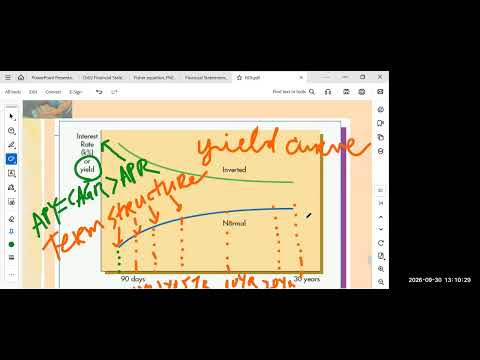
- Plotting yields from short maturities to long maturities creates a yield curve, which represents the term structure of interest rates.
- A normal curve slopes upward: longer-maturity bonds generally offer higher annualized yields than shorter-maturity bonds.
- Jeff links the higher yields on long-term bonds to maturity risk, since uncertainty increases as the investment horizon extends.
- Jeff defines cost of capital as the cost of raising or borrowing funds, while distinguishing it from a single quoted interest rate.
- He presents nominal interest as comprising a real return plus an inflation adjustment, invoking the Fisher equation.
- The base interest rate must compensate lenders for expected inflation and provide a real return.
- Jeff uses a recent CPI reading of 3.4% as a reference point and anticipates that a September inflation reading will be released in October.
- He distinguishes disinflation from falling prices: inflation can remain positive while its rate of increase declines.
- He describes the Federal Reserve's inflation target as about 2% and argues that manageable inflation is more compatible with growth than zero inflation.
- Jeff identifies oil prices as a major inflation driver and discusses crude oil trading below $100 per barrel in the market snapshot he checks during class.
- He says stabilizing oil prices, consumer staples, and wages could help inflation ease, while noting that future oil prices depend on geopolitical conditions.
- A lengthy political discussion considers how economic conditions and public reactions could affect the U.S. midterm elections.
- Jeff attributes stronger investment demand to capital expenditure, or capex, on physical assets such as data centers.
- He names Google and Meta among AI companies building data centers to compete for future AI markets.
- He argues that large-scale bond borrowing to finance this investment increases demand for capital and can push real interest rates and nominal borrowing costs upward.
- Using Meta's Muse as an example of an agentic assistant, he raises concerns about sharing credit-card or bank details with AI systems and the consequences of a data breach.
- Jeff identifies default risk as a central concern for lenders and explains that higher borrower risk generally requires a larger risk premium.
- For companies, he describes ratings from AAA down toward D and says BBB and higher are investment grade, while ratings below BBB are commonly called junk bonds.
- He distinguishes lower-rated bonds that may default but retain recovery potential from more severe default cases with little or no prospect of recovery.
- He gives a rough default-risk premium range of 0% to 8%.
- Jeff summarizes cost of capital as a nominal base rate plus default-risk, liquidity-risk, and maturity-risk premiums.
- He contrasts the usual upward-sloping yield curve with an inverted curve, where long-term yields fall below short-term yields.
- He associates yield-curve inversion with an impending recession and directs students to his ROI and macro part 10 lesson for a fuller explanation.
- Jeff reminds students that ROI 2 begins on Friday and says quiz access depends on satisfying the course release conditions.
- In response to a question, he says in-person meetings are planned for the second Wednesday of each month, including October and November, with December dependent on the course calendar.
- Jeff explains that he cannot reliably monitor Zoom chat while lecturing and asks students to email questions instead.
- He finds a student's message in the spam folder and says he will restore it and reply.
- He asks the student to resend questions from a previous Zoom session because session chat messages are no longer available afterward.
- Jeff directs students to the course information tile and the Connect site links near the bottom of that page.
- He clarifies that a separate course announcement is informational and does not itself contain a registration link.
- He notices an outdated textbook instruction referring to fall 2025 and says he will correct it.
- Jeff explains that temporary textbook access has expired and that continued access requires purchase.
- He distinguishes the Connect code option for students who already have a code from the full digital experience option, which includes the ebook.
- He says the two purchase paths lead to the same destination and clarifies that access applies to this course's book, not another course's textbook.
Transcript excerpt
4:15 All right. All right. Good afternoon, everyone. Good afternoon. Happy Wednesday. Happy Wednesday to everyone. Good afternoon. How's everybody? Let's see who's here. Let's see who's here. I sent out greetings. Okay. Uh Whitmore, hi. I see Whitmore uh greeted back, although not verbally, but I could see on the uh in this, you know, gallery. Uh, and I see >> myself because there's a lot of >> Holy Mato Yani, Ian, uh, Brandon
5:01 and Valentina, Sahira, and Ty Andre. Uh, except for uh, like three people. Uh, only three people have their cameras on. I a four including Brandon. But you know uh I've been telling you uh camera is preferred right camera is preferred. So please turn on your camera if your camera is not on. Valentina, please. Sahira, Elenni, Haley, Ian, please turn on your cameras because at some point later I will take a screenshot and in the screenshot if your camera is not on I will have to consider and assume that you are inactive, right? Not
5:53 only disengaged uh not not only inactive but also disengaged. Okay. So, please turn in your camera. All right. All righty. All righty. So, in our last class, we discussed how the monetary policy uh is um implemented through open market operation. In other words, we discussed the mechanism of the open market operation. Now so uh today uh one uh last question remains and I believe I part you know partially explained this um currently interest rates are rising I mean fed Fed funds rate was raised in September FOMC
6:44 meeting right uh so fed funds rate is in the range of 3.75 and 4% %. Okay. And then that means fed funds rate is short-term basically one year, right? And uh another short-term rate that you
This is the start of the transcript. Save this video free for the whole transcript, searchable and time-coded.
In this course
Related notes
Summary, takeaways, and chapters were generated by AI from the video's transcript and may contain errors. The video belongs to its creator, Jeff Hunk.