fnb100f260909b
Overview
Dr. Jeff Hong uses a house investment example covering 2005 to 2016 to explain holding-period returns, rental cash flows, and why an 11-year total return cannot simply be divided by 11 to find an annual return. He demonstrates Excel formulas and reusable soft coding, contrasts arithmetic and geometric averages, and explains compounding with a 10% bank-deposit example.
Key takeaways
- Holding-period return combines capital gain or loss with cash flow during the period, then divides the combined amount by the initial asset price.
- An 11-year total return is not an annual return divided by 11, because annual growth compounds on the changing value of the investment.
- The geometric average, calculated as (future value / present value)^(1/n) - 1, gives the constant annual growth rate that matches the start and end values.
- Arithmetic averages suit measurements collected at one time, while time-series returns for one asset need a compounding-aware measure.
- Reusable Excel models should derive the number of years from date data and use formulas such as COUNT rather than hard-coded values.
- A $10,000 deposit earning 10% annually reaches $11,000 after one year and $12,100 after two years because the second year's interest applies to the accumulated balance.
Chapters
- Dr. Jeff Hong reviews the previous class's house-value example and postpones the planned hands-on exercise because classroom computers are unavailable.
- He navigates the course modules and asks students to download the spreadsheet file rather than simply open it.
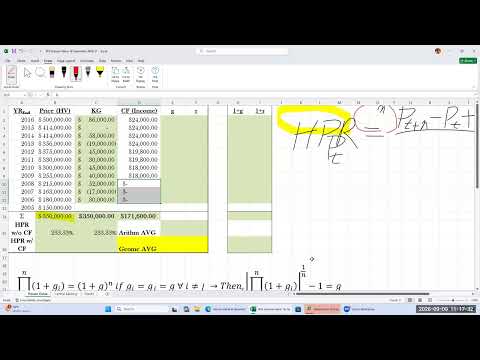
- Hong defines holding-period return from time t through t+n as the change in price plus any cash flow during the period, divided by the initial price.
- For a house used as a home, the example has no rental cash flow, so the return comes from capital gain or capital loss.
- The spreadsheet calculates annual capital gains by subtracting each year's house value from the following year's value.
- In the rental-property scenario, cash flow is positive and represents rental income received during the holding period.
- Hong uses Excel summation to aggregate the cash flows and adds that amount to capital gain before dividing by the initial house price.
- Including the first three years of zero cash flow does not change the sum, but he keeps them for structural consistency across the spreadsheet.
- The house example covers 11 years, from 2005 to 2016, and Hong cautions against treating total holding-period return divided by 11 as the annual return.
- He advises calculating the period from the year data, such as 2016 minus 2005, instead of manually typing 11 into a reusable model.
- Hard-coded values can make a spreadsheet fail in a new context, while soft-coded formulas adapt when copied or reused.
- Hong calculates each annual house-price growth rate as that year's capital gain divided by the previous year's house value.
- An arithmetic average sums the 11 annual growth rates and divides by their count, using Excel's COUNT command rather than manually entering the number of years.
- Dividing the total holding-period return by 11 gives a result of roughly 21% in the example, which Hong contrasts with the average of the yearly rates.
- Hong distinguishes cross-sectional data, such as measuring all students' heights at one time, from time-series data, such as annual prices for one house.
- The house-price series has an overall upward trend even though some individual years show negative or zero growth.
- Because each year's house value builds on the previous year's value, an arithmetic average overlooks compounding and overstates the equivalent constant growth rate.
- Hong gives the geometric-average formula: (future value divided by present value) raised to the power of 1/n, minus 1.
- For the house example, the 2005 value is the present value, the 2016 value is the future value, and n is the elapsed 11 years.
- He emphasizes calculating n from the spreadsheet data rather than hard-coding it, and identifies the geometric average as the constant annual rate that incorporates compounding.
- Hong illustrates compounding with a hypothetical $10,000 deposit earning 10% annually: it grows to $11,000 after year one and $12,100 after year two.
- In year two, interest is earned on the full $11,000 balance, so the interest is $1,100 rather than the original $1,000.
- A bank rate fixed at 10% is already a constant annual growth rate, while variable yearly house-price changes require a geometric average to find an equivalent compounded rate.
- Hong says the class has run out of time before he can finish the planned spreadsheet demonstration and asks students to bring laptops to the next Wednesday session.
- He asks students who did not sign in to Zoom to provide their first and last names for attendance.
- Hong notes that class sections are offset by holidays and tells students to watch for advance notices about upcoming course items.
Transcript excerpt
0:16 recording in progress. >> All right. So, let me show my screen. Joshua. So, uh I didn't even This isn't me. I mean, uh whoever logged into this station, that wasn't me. Let's Let's do uh anyway. me. So, uh, what's happening
1:19 that you need? Oh. [clears throat] to space. Okay, I'm in. Oh, who wants me? So if you remember from our last class which was last Wednesday um everyone [clears throat] everyone is aware and everyone knows that uh if if you go to the bottom of our course
2:08 modules. Right. Okay. Let me click load more. Right. Don't just stay there. 902. Right. Our class recording. we were [clears throat] we were beginning to talk about the um uh house value example, right? So, um uh since we I was going to do the um uh this exercise hands-on, but we don't have any computer. This is not a computer left. So, we'll do this next time and instead we're going to move on
2:57 right to um uh the next video and I will explain to you every once in a while um as we go along what all right I oh without okay let me okay let me stop then since we
4:01 So I want to watch uh and [clears throat] even if this session is being recorded. But I'll be using the uh Oh, this is not even white board. I don't pay. They have a lot of small chalks here. I brought some light chalk uh markers. So this file right I told you to download this file which is you know um uh you know don't just open it download
4:50 that was the file that you saw last time and so it's downloaded you open So you might wonder, oh Uh now I I don't think this is going to be
This is the start of the transcript. Save this video free for the whole transcript, searchable and time-coded.
In this course
Related notes
Summary, takeaways, and chapters were generated by AI from the video's transcript and may contain errors. The video belongs to its creator, Jeff Hunk.