fnb100f260910
Overview
Jeff Hong connects investment returns to macroeconomic interest rates, explaining how inflation, borrowing demand, and Federal Reserve policy influence business investment and asset returns. He distinguishes nominal from real interest rates, illustrates the inflation adjustment with a 5% nominal rate and 3% expected inflation, and explains how lender spreads and borrower risk premiums shape loan pricing.
Key takeaways
- A nominal return does not measure the gain in purchasing power: a 5% interest rate with 3% inflation yields an approximate 2% real return.
- Rate increases cool inflation by raising borrowing costs, encouraging saving, and making business hiring and capital expenditure harder to finance.
- Strong economy-wide demand can raise interest rates endogenously as firms borrow to expand production, even apart from a Federal Reserve rate change.
- Banks generally charge borrowers more than they pay depositors, and the difference between lending and borrowing rates is their spread.
- Credit risk affects loan pricing: the lecture illustrates a 10-percentage-point risk premium when a high-risk borrower pays 15% instead of a prime borrower's 5%.
- Volcker-era Federal Funds rates near 20% show how aggressive monetary tightening can curb inflation, but also sharply constrain borrowing and economic activity.
Chapters
- Jeff Hong reviews ROI and CAGR, the compounded annual growth rate used to summarize returns over time.
- Interest rates and growth rates can use monthly or quarterly units, but annual rates provide the usual reference point.
- A 10% CD rate represents growth in deposited money through compounding.
- The practical goal of finance is to maximize ROI while accounting for investment risk.
- Because higher returns commonly involve higher risk, compare alternatives with similar risk and select the one with the higher return.
- The lecture frames risk management as maximizing returns for a chosen level of risk, not simply chasing the highest return.
- Bank savings accounts and CDs are presented as relatively low-risk ways to earn interest, with returns that vary as market rates change.
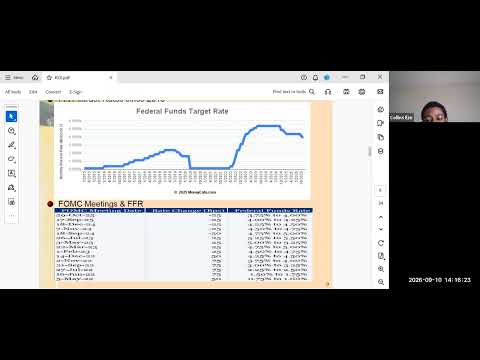
- The Federal Funds rate was held near 0% to 0.25% for years after the 2008 financial crisis, then rose during the recovery and fell again during the pandemic.
- The lecture's historical chart shows the Fed Funds rate rising rapidly from 2022 as the Federal Reserve responded to high inflation.
- Jeff Hong identifies inflation as the major economic concern around mid-2022, when headline inflation reached roughly 9% at its peak.
- The lecture compares measures including CPI, PCE, and trimmed-mean inflation, which excludes extreme price changes before calculating an average.
- The chart discussion links the inflation spike to public concern about rapidly rising grocery and other household costs.
- Moderate inflation accompanies economic growth; the Federal Reserve has traditionally treated about 2% as its target, while the lecture notes that 3% may feel more realistic.
- If wages rise 10% while prices rise 5%, workers can still gain purchasing power despite inflation.
- If wages rise 5% but inflation reaches 10%, real wages fall by about 5% because prices erode the paycheck's purchasing power.
- When inflation is high, central banks raise interest rates to make borrowing more expensive and cool demand.
- Higher deposit rates can encourage saving, moving money away from immediate consumer spending.
- Businesses facing higher loan costs may delay hiring, expansion, and capital expenditures such as plants and equipment.
- Banks pay depositors a borrowing rate from the bank's perspective, then charge borrowers a higher lending rate to earn a spread.
- Companies use borrowing to fund capital expenditure, including production facilities, equipment, and capacity expansion.
- The lecture contrasts borrowing with stock issuance, noting that firms do not typically conduct public offerings whenever they need new funds.
- The Federal Open Market Committee sets the direction of policy rates and holds several meetings each year.
- Jeff Hong describes the post-meeting press conference as an important source of guidance for markets.
- He contrasts the communication styles of Ben Bernanke, Janet Yellen, and Jerome Powell with a less predictable approach attributed in the lecture to Kevin Warsh.
- The Jackson Hole Economic Symposium in Wyoming brings together central bankers and other global economic leaders, and its discussions can shape market expectations.
- The lecture interprets comments that employment is solid and inflation remains a priority as a possible signal of further rate increases.
- It emphasizes evaluating job quality, such as whether reported job gains are full-time or temporary, rather than relying only on the headline count.
- Jeff Hong argues that Federal Reserve chairs may need to resist political pressure for lower rates when inflation remains a concern.
- The 1970s combined weak growth with inflation, a condition known as stagflation.
- Federal Reserve Chair Paul Volcker raised the Fed Funds rate to around 20% in the early 1980s to suppress inflation.
- The lecture contrasts that severe tightening with the attractive risk-free deposit returns banks could offer, while noting how high rates constrain economic activity.
- Depositors act as lenders to banks, while banks act as borrowers and pay deposit interest.
- Banks lend deposited funds at a higher rate than they pay, creating a lending-borrowing spread that supports their business.
- Rising lending rates make loans more burdensome, while lower rates make borrowing easier.
- Interest rates can rise exogenously when the Federal Reserve raises policy rates or endogenously when demand for borrowing strengthens.
- Jeff Hong describes interest as the price of borrowing money: stronger loan demand tends to push that price higher.
- Businesses are major borrowers because they seek funds to expand production when demand for their products is growing.
- When household incomes and economy-wide demand grow, businesses may borrow to increase capacity and meet higher sales.
- The lecture uses technology hyperscalers and data centers as examples of firms seeking substantial funding amid expanding demand.
- Governments also borrow, including through Treasury bond sales, but business investment is highlighted for its broad economic effects.
- Lenders need rates that compensate for expected inflation; the lecture uses 3% expected inflation plus a 2% real return to illustrate a 5% baseline rate.
- Borrowers with excellent credit, illustrated by scores above 820, can qualify for lower rates because their repayment histories indicate lower default risk.
- A borrower charged 15% instead of a 5% prime rate pays a 10-percentage-point risk premium for higher credit risk.
- The lecture defines the real interest rate as the nominal interest rate adjusted for inflation: approximately nominal rate minus inflation.
- With a 5% nominal rate and 3% inflation, the real return is about 2%, while the 3% inflation component is an inflation premium.
- Real returns can be positive, zero, or negative depending on whether nominal interest exceeds, equals, or falls below inflation.
- Jeff Hong says the ROI concept check announcement has been issued and that the related activity is scheduled to appear on September 18.
- Students must meet the release conditions listed in the announcement attachments before the activity becomes visible.
- The closing exchange addresses students checking course materials on phones and tablets, and Jeff Hong asks students to turn on cameras next class.
Transcript excerpt
1:02 All right. All right. Good afternoon, everyone. Good afternoon. Good afternoon. All right. How's everybody? Let's see. Uh who's here? Okay, I see uh Alex and Valerie. Uh yes, one, right? And Dennis Juni Holland, right? Oshola, please turn on your camera, please. Nicholas, Nicholas Alexander, because I believe we have two Nicholases in this class. Um, Nicholas, please turn on your camera. And another Nichol We have Yeah.
1:50 Nicholas L and Nicholas Alexander. >> Oh, >> and we have also Noel >> and Sahara. Noel and Sahara, please turn on your camera. >> All right. So, um, we are >> so we are done with the, uh, the first part. I mean, you know, ROI. Basically we know how to uh calculate the uh >> uh tagger or geometric average remember that's you know short for compounded annual growth rate right c a g r and I uh I've been telling you uh the the
2:36 basic um the The growth rates and interest rates are all basically um expressed >> as annual rate. Annual rate right. Hence why there is you know uh a term kaggard I mean c I mean if interest rate can be expressed in any units like you know monthly rate quarterly rate I mean we can uh we can use quarterly rate monthly rate that's fine but you know basically it is based on the annual rate right annual rate is the uh basis so then quarterly rate would be uh annual ual rate divided by four. Monthly rate would be annual divided by uh 12. So it's not
3:25 a big deal, right? But the whole point is uh um interest rate is the same thing as growth rate, right? Because if you put your money into a savings account or CV, right, it pays interest.
This is the start of the transcript. Save this video free for the whole transcript, searchable and time-coded.
In this course
Related notes
Summary, takeaways, and chapters were generated by AI from the video's transcript and may contain errors. The video belongs to its creator, Jeff Hunk.