fnb100f260903
Overview
Dr. Jeff Hong develops the holding-period return formula using a house bought for $150,000 at the end of 2005 and sold for $500,000 at the end of 2016, then compares living in it with renting it out. He shows how to calculate capital gains and rental income in Excel, explains why dividing a multiyear return by 11 misstates annual performance, and introduces geometric averaging through the mathematics of compound interest.
Key takeaways
- For a house bought for $150,000 and sold for $500,000 after 11 years, scenario 1 holding-period return is capital gain divided by the initial price, with rental cash flows excluded.
- When the same property is rented, holding-period return adds rental income to capital gain before dividing by the purchase price; zero-rent years can remain in the dataset for structural consistency.
- Dividing a cumulative return by the number of years does not produce a valid annualized return, and even the arithmetic mean of yearly returns ignores compounding.
- The weighted-average formula accounts for unequal importance, such as course credits in a GPA; the simple average is its special case when every weight is equal.
- With annual compounding, $10,000 earning 10% for 10 years becomes $10,000 × (1.10)¹⁰, approximately $25,937, rather than $20,000 from simple interest.
- In Excel, locking a denominator with F4 prevents a relative cell reference from shifting when a formula is copied across columns.
Chapters
- Jeff Hong asks students to use names matching the class roster so Zoom attendance can be credited.
- Students who missed the September 1 class can watch its recording and access the course materials in Brightspace.
- Click “Load more” and “Show all announcements” to find content hidden by truncated course pages.
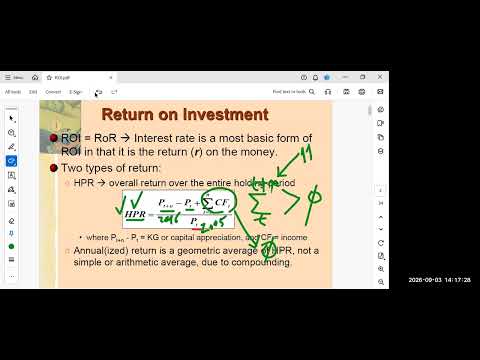
- The formula compares the ending price, P at time t plus n, with the starting price, P at time t.
- Time subscripts mark years, months, or quarters; they are not clock times.
- A holding-period return includes the price change and, when applicable, cash flows received while holding the asset.
- The house example assumes a purchase at the end of 2005 and a sale at the end of 2016, an 11-year holding period.
- A rented house can generate rental income as a cash flow; a home used only by its owner has no rental cash flow in the example.
- The ending house price minus the purchase price is capital gain, also called capital appreciation; K denotes capital to avoid confusion with C for cost.
- Scenario 1 treats the house as the owner’s home, so rental cash flow is zero and return comes from capital gain.
- Scenario 2 rents the house out, so the return formula includes both capital gain and accumulated rental income.
- Holding-period return means the total return across the full period, rather than a return for a single year.
- Hong explains that a Zoom display name that does not match the roster can make attendance difficult to verify.
- He checks the attendance report when a student asks why their name is missing and notes that a completed report requires the class to end.
- Students are instructed to use their formal roster names, including the correct last name, when signing in.
- Students open the first Excel file in Module 1 alongside the accompanying PDF and confirm access with a green-check reaction.
- Year-end closing prices provide consistent observations, even though real estate purchases and sales can occur at any point during a year.
- The exercise records a $150,000 purchase price at the end of 2005 and a $500,000 sale price at the end of 2016.
- The 11-year total capital gain is the 2016 price minus the 2005 price.
- A yearly capital gain is calculated as the current year-end price minus the previous year-end price.
- Dragging Excel’s fill handle, the thin black cross at a cell’s lower-right corner, copies and adjusts the formula for other rows.
- For the no-rental scenario, holding-period return is total capital gain divided by the initial $150,000 purchase price.
- Pressing F4 locks the denominator cell, such as B13, so it does not shift when a formula is dragged across columns.
- Hong emphasizes that the spreadsheet calculations encode arithmetic and logic rather than requiring advanced Excel knowledge.
- The rental scenario adds cumulative rent to capital gain before dividing by the original purchase price.
- The example assumes no rent in years 1 through 3 and rental income from year 4 onward.
- Monthly rent multiplied by 12 gives annual rent; keeping zero-rent years in the 11-row range preserves a consistent data structure.
- Dividing the house’s roughly 233% holding-period return by 11 produces about 21.21%, which Hong identifies as an invalid annual average.
- A simple arithmetic mean applies to observations collected at the same time, such as classmates’ heights, not directly to a cumulative multiyear return.
- The duration can be calculated from year labels in Excel rather than manually typing 11 into a formula.
- Annual house-price growth is calculated by dividing each year’s capital gain by the prior year’s price.
- Averaging the yearly growth rates is better than dividing the cumulative return by 11, but still overstates the compounded annual rate.
- Hong uses a rolling snowball to illustrate how growth builds on the larger value produced by earlier growth.
- The arithmetic mean sums observations x₁ through xₙ and divides by the number of data points.
- A weighted mean multiplies each observation by its weight, sums those products, and divides by the sum of the weights.
- The GPA example assigns different course credits as weights, showing why averaging grades equally can give the wrong GPA.
- In the GPA example, a four-credit math course should count more than a lower-credit course when computing the average.
- For a fair six-sided die, each payoff from $1 to $6 has probability 1/6, so expected payoff is a probability-weighted average.
- When all weights are equal, the weighted-average formula reduces to the simple arithmetic mean.
- A time series records observations from the same subject over time, unlike heights measured across different people at one point in time.
- House prices and stock prices can rise or fall from year to year while exhibiting a longer-term trend.
- Because each period’s growth applies to the value carried forward from earlier periods, annualized time-series returns must account for compounding.
- A $10,000 principal earning 10% grows to $11,000 after year 1 and $12,100 after year 2 because interest earns further interest.
- The year-3 balance is $12,100 multiplied by 1.10, or $13,310, rather than the $13,000 implied by simple interest.
- Hong derives the general future-value relationship: principal multiplied by (1 + r) raised to n.
- For 10 years at 10%, the $10,000 account grows according to $10,000 × (1.10)¹⁰, not by adding a one-time 100% simple return.
- The rolling snowball analogy represents the growing base on which each year’s return is earned.
- The geometric average is the annual rate that accounts for compounding; Hong pauses the derivation for the next Tuesday class.
Transcript excerpt
0:34 in progress. All right. Good afternoon everyone. Good afternoon. Good afternoon.
1:21 >> Good afternoon. I see a few people still without any camera. Please uh please turn on your camera, please. Uh, I see Oshola with no camera. Sonobu Doris, thank you. Uh, is Oh, Dennis, I'm sorry. Dennis, thank you. >> All right. Uh, Sahara, please turn on your camera. Noel, please turn on your camera. All right. So um uh we didn't do much on we couldn't do much on uh Tuesday. Of course that was the first day and I had to basically walk you through the uh uh the layout of the uh bright space
2:12 uh and uh basic ground rules. Uh so uh I will have to assume that you have watched all the videos that are due. Now there is someone named Zoom user but you know uh that that's not going to count because that's not attendance because I don't know who you are right think about it. >> I'm sorry. Is it me? >> Yeah. Please put the name. Please sign in with your formal name please. is I mean the name that were you the name that matches your full name on the roster. I mean but were you here last time? >> I couldn't log in so I just was able to now because I had to get my email
2:58 figured out. >> Oh, okay. But please >> I don't know why it didn't prompt me. Usually prompts me to sign in with my name. Um but I is it okay if I put in chat just for this class and I'll try to log in with my school email next time? >> Well, I guess you can currently I mean you need to uh change that sign in name. I mean uh maybe not
This is the start of the transcript. Save this video free for the whole transcript, searchable and time-coded.
In this course
Related notes
Summary, takeaways, and chapters were generated by AI from the video's transcript and may contain errors. The video belongs to its creator, Jeff Hunk.