fnb100f260930a
Overview
Jeff Hunk explains how nominal interest rates and business borrowing costs combine real returns, inflation expectations, and risk premia, then uses Treasury yields to introduce the term structure and yield curve. He contrasts the normal upward-sloping curve with inversions, which he presents as a recession warning that has preceded many downturns but can be obscured by fiscal and monetary stimulus.
Key takeaways
- A useful framework for borrowing costs is a nominal base rate, which already reflects inflation expectations, plus risk premia for borrower default, liquidity, and maturity.
- Rising inflation can lift nominal rates, but investment demand can also push rates higher by increasing real returns; Jeff's example is AI data-center CAPEX by hyperscalers and major technology firms.
- The normal yield curve slopes upward because long-term bonds expose investors to more uncertainty and interest-rate price risk than short-term securities.
- An inverted yield curve, such as a negative ten-year Treasury yield minus the federal funds rate, signals market expectations of weaker future growth and has often preceded recessions, though it is not a guarantee.
- Large fiscal and monetary stimulus can interrupt the usual link between yield-curve inversion and recession; Jeff cites the pandemic period and later stagflation as exceptions.
Chapters
- Jeff Hunk opens the Wednesday class by checking attendance and asking students to enable cameras for engagement.
- The lesson follows a prior session on open-market operations and moves to components of interest rates.
- Jeff defines cost of capital as the cost of borrowing or raising funds, represented in class notes as the cost of capital rather than simply the nominal rate.
- He distinguishes nominal interest rates from real returns, describing nominal rates as real interest plus an inflation adjustment.
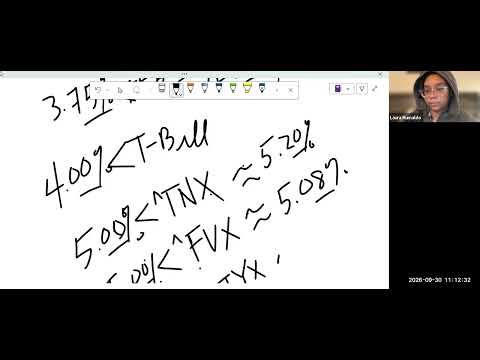
- The class cites a federal funds target range of 3.75% to 4%, a five-year Treasury yield of 5.04%, and a ten-year yield of 5.20%.
- Jeff contrasts current rates with the early 1980s, when the federal funds rate reached 20% as policymakers sought to curb high inflation.
- He says high rates weighed on stock-market performance in earlier decades, while the stock market began rebounding from the mid-1980s.
- The normal term structure has higher annualized yields for longer maturities, from short Treasury bills to 30-year bonds.
- Jeff identifies inflation as one driver of rising nominal rates and describes oil-price increases, associated in the lecture with restricted supply during conflict with Iran, as a major source of inflation.
- He also names food, rent, and wages as components of the inflation basket, noting that their price trends differ from oil.
- Disinflation means inflation is still occurring but its rate is declining; Jeff says a trend toward the Federal Reserve's 2% target would reduce the case for further rate increases.
- Jeff argues that real rates can rise when demand for investment increases, separately from inflation.
- He uses AI hyperscalers and major technology companies building data centers as examples of capital expenditure, or CAPEX.
- Heavy demand for physical capital and investment funding can push up real borrowing costs and therefore nominal rates.
- Jeff models the cost of capital as a base nominal rate plus risk premia, including compensation for risks beyond inflation.
- Default risk reflects whether a borrower can make promised payments; he relates individual credit scores and business credit ratings to lenders' assessments.
- He gives an illustrative default premium range of roughly 0% to 8%, potentially reaching 10% for very risky borrowers, and identifies ratings below BBB as speculative-grade or junk bonds.
- Liquidity risk is the possibility that a bond, especially one from a small or little-known issuer, cannot be sold readily for cash.
- Jeff explains that longer maturities carry more uncertainty and greater price sensitivity to changes in market interest rates.
- He gives a typical maturity-risk premium range of 0% to 2%, helping explain why long-term yields are normally above short-term yields.
- A term structure lists yields by maturity; connecting those points produces the yield curve, with yield used as an annualized return.
- In a normal economy, long-term yields generally exceed short-term yields, producing an upward-sloping curve.
- An inverted yield curve has short-term yields above long-term yields and can indicate that markets anticipate a recession; Jeff points students to ROI and Macro 10 for the underlying logic.
- Jeff compares the federal funds rate, shown as a blue line, with the ten-year Treasury yield, shown as red, and marks recessions with gray bars.
- He reviews inversions around downturns including the 1970s, early 1980s, 1990s, 2000, and the period before 2020.
- He characterizes inversion as a strong but imperfect warning, estimating an 80% to 90% chance of a subsequent recession rather than a certainty.
- Jeff attributes the brief 2020 downturn and the lack of a recession after the 2022 to 2025 inversion to large fiscal and monetary stimulus, while describing persistent inflation with weak growth as stagflation.
- He explains that the ten-year Treasury yield minus the federal funds rate is negative during an inversion; he also notes that analysts commonly track the ten-year minus two-year Treasury spread.
- Jeff closes by directing students to ROI and Macro 10 to study the reasoning behind inverted yield curves before the ROI 2 test.
Transcript excerpt
1:19 All right. All right. Good morning, everyone. Good morning. Good morning. Happy Happy Wednesday. Good morning, everyone. All right. Let's see who's here. We have uh Okay. Good morning, Kaden. Good morning. Um, let's see. We have Issa and we have uh Kina. Uh, we have Kadron and Jerish. And we have Max and Wenshang. Max, Wenshang, Kron, uh, please turn in your camera if you can. Okay, that's uh, Max.
2:07 Wang Kadron, can you guys hear me? >> Please turn on your camera. >> Camera is preferred although it's not mandatory. Okay. All righty. So, we have uh basically so far six people. Oh, Shares, that's not that's not a camera. All right. Show profile picture. >> Uh please turn on your camera. All righty. I just admitted and only kids coming. Okay. All righty. Middle. Okay. Middle. I pressed that
2:57 middle. Why? Let me just give you that small popup window. Alrighty. So today then uh Okay, Ali is here. Alli can still Okay. All right. And one after another. You guys are coming in one after another. Okay. Let's see. So please turn on your camera, right? Please turn on your camera. >> Uh at some point I will need to take a screenshot. I will need to take a screenshot so that I would uh have some confirmation that everyone is engaged. Not just logged in but fully engaged
3:48 with the class. So please turn on your camera. Right, Chris Parah, turn on your camera. Ali, Kadron. It almost uh seems like Max and Wen Shang and Kadron are not here because they are so unresponsive. Alli and Ari, could you turn on the camera, please? Now, let's see. Uh so, we are much larger uh now 14 people. All righty. So, let's get started. So in our last class uh we look we took
This is the start of the transcript. Save this video free for the whole transcript, searchable and time-coded.
In this course
Related notes
Summary, takeaways, and chapters were generated by AI from the video's transcript and may contain errors. The video belongs to its creator, Jeff Hunk.