fnb100f260902b
Overview
Dr. Jeff Hong explains holding period return (HPR) as the asset’s price change plus cash flows received during ownership, divided by the initial price, and clarifies how time subscripts and consistent measurement dates make the formula usable across investments. Using a house bought for $150,000 at the end of 2005 and sold at the end of 2016, he demonstrates annual capital-gain calculations in Excel and compares returns with and without rental income, while noting that annualized returns help compare investments held for different lengths of time.
Key takeaways
- Holding period return is calculated as ending asset value minus initial asset value, plus cash flows received during ownership, all divided by the initial value.
- Investment prices should be measured at consistent dates, such as end-of-year observations, when comparing annual data; otherwise, the calculation mixes different parts of the year.
- A $100 purchase that reaches $300 with no dividends produces a 200% holding-period return, because the $200 gain is divided by the $100 initial investment.
- Cash flows differ by asset: rent and loan interest are contractual payments, while stock dividends are optional and may be zero.
- Excel’s fill handle can propagate annual capital-gain formulas, but results outside the ownership period, such as the pre-purchase 2004 observation, are irrelevant and should be excluded.
- Annualized return makes investments with unequal holding periods more comparable, while rental income raises HPR relative to a house’s capital-gain-only return.
Chapters
- Dr. Jeff Hong opens class remotely after turning back on the way to campus because of severe motion sickness.
- The lesson addresses holding period return notation before moving into the assigned return-on-investment example and Excel model.
- HPR, or holding period return, is described as the total return earned during the time an asset is held.
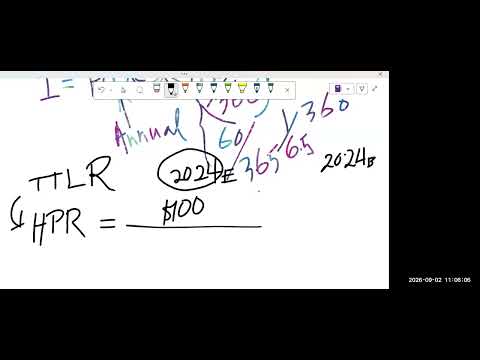
- A price such as $100 needs a time marker, for example an end-of-2024 price, so it is not confused with prices from other dates.
- Hong uses subscripts such as B and E to distinguish beginning-of-year and end-of-year observations.
- Comparisons should use consistent observation points, such as end-of-year prices compared with other end-of-year prices.
- A mid-2024 price should not be directly compared with an end-of-2026 price when constructing a uniform annual data series.
- Actual purchases and sales can happen at any time, but consistent dates make annual return data easier to interpret.
- The generalized HPR numerator includes the ending price, the initial price, and the sum of cash flows received from time t through t+n.
- The notation t+n identifies the end of the holding period: if t is 2024 and n is 2, the ending observation is 2026.
- Ending price minus initial price is capital gain; a positive difference is a gain and a negative difference is a capital loss.
- Hong explains that K is the conventional economics symbol for capital.
- A rental house can generate monthly rental income, which is added across the holding period using the summation symbol, sigma.
- Stocks may pay dividends, such as $1 per quarter or $8 over eight quarters, but dividends are not a contractual obligation and can be zero.
- Loan interest and rent are contractual obligations, unlike stock dividends, which are paid from profits at the company’s discretion.
- The same framework applies across houses, stocks, and bonds: calculate price change and include any cash flows received.
- For a stock purchased at $100 and later valued at $300 with no dividends, the holding-period return is 200%: the $200 gain divided by the $100 initial price.
- The generalized formula uses the purchase price at time t, the ending price at t+n, and all cash flows received in between.
- Annualized return is needed when comparing investments held for different periods, because a two-year return and an eleven-year return are not directly comparable.
- The class is directed to download the Excel model before studying the house example.
- The example assumes a house was bought for $150,000 at the end of 2005 and sold at the end of 2016, an 11-year holding period.
- The house’s annual value sometimes increased, sometimes fell, and remained flat between 2014 and 2015.
- Hong distinguishes realized capital gain at sale from annual changes that can still be calculated using year-by-year house-value data.
- Annual capital gain is calculated as the current year’s house value minus the prior year’s value, represented as P_t minus P_t-1 or P_t+1 minus P_t depending on the chosen reference year.
- Excel’s fill handle, the small square at the selected cell’s southeast corner, copies formulas down a column while adjusting cell references.
- The copied formula can produce an irrelevant value before the 2005 purchase date, so the 2004-to-2005 calculation should be ignored for this holding period.
- Summing annual gains produces the same total price change as subtracting the initial house value from the 2016 value.
- Scenario one treats the house as a personal residence, with no rental income and return coming from the change in house value.
- Scenario two treats it as a rental property, adding rent to capital gains when calculating HPR.
- The framework also maps to stocks, where dividends may be optional, and bonds, where interest is generally a contractual payment to the investor.
- The rental-property example leaves the first years without rent to represent time needed for renovation or conversion to meet building-code requirements.
- Hong reports a 233% holding-period return for the capital-gain-only calculation in the house example and explains that adding cash flows changes the total return.
- The lesson ends with a plan to complete the Excel exercise hands-on at the next Wednesday class because the following Monday has no class.
Transcript excerpt
1:47 All right. All right. Good morning, everyone. Good morning. >> Good morning. I'm first of all, my apology for not uh making it to uh campus today. I was on the way And uh I fell uh very sick. I I was you know I usually don't have motion sickness but I had so much motion sickness I almost you know um uh short of just you know uh vomiting. Uh so I had to uh I had to turn back. Uh hopefully next Wednesday I'll be uh better. But anyway, uh it it's also, you know, I
2:36 mean um meeting online is also uh it has its benefits because uh I can you know I don't have to uh shout in because in the classroom usually I I have to shout uh okay still so uh let's Uh first >> uh let's take care of um let's take care of something that might uh panic that might make some of you panic. Right? So um but it's not that uh it's not that difficult. Um so first of all this formula right um
3:30 where is there if there's a way I can maybe I can draw on this. Okay, let me let me use I think this will do. Touch and drag to see. Is it must be okay. First of all, uh it okay. I like to make it thicker.
4:34 Okay. So HDR right hold that stands for holding period return of course holding period return. Okay. And then PT uh price at time t. Right. So I explained already uh last time that uh the subscripts are time markers. They are not any uh actual they are not actual numerical values but it's time marker. So suppose you bought uh Nvidia stock back in 2024. >> That price you paid is key 2004.
This is the start of the transcript. Save this video free for the whole transcript, searchable and time-coded.
In this course
Related notes
Summary, takeaways, and chapters were generated by AI from the video's transcript and may contain errors. The video belongs to its creator, Jeff Hunk.