fnb100f260929
 Watch on YouTube →
Overview
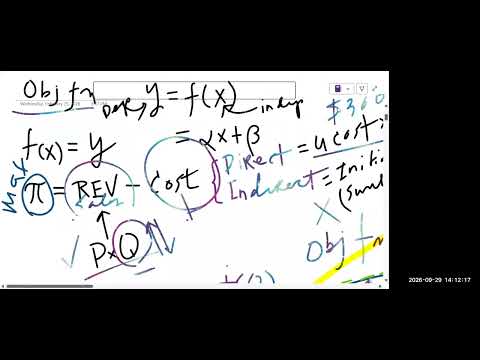
Jeff Hunk introduces financial statements as the foundation for fundamental analysis, explaining how the income statement, balance sheet, cash flow statement, and retained earnings statement serve different purposes. The class develops an income statement from sales revenue, defined as price times quantity sold, through operating expenses, EBIT, interest, taxes, and net profit, then connects direct production costs to capital, labor, and natural resources.
Key takeaways
- Sales revenue can be calculated as price times quantity sold; for a business with multiple products, total revenue is the sum of each product's price multiplied by its units sold.
- The income statement reports profit or loss, while the balance sheet, cash flow statement, and retained earnings statement provide different information and are connected to it.
- The income statement sequence taught in class is operating profit or EBIT, then EBT after interest, then EAT or net profit after taxes.
- Direct costs relate to production inputs and correspond broadly to COGS in accounting; indirect costs are associated approximately with operating expenses, though the categories are not exact equivalents.
- Manufacturing uses capital, labor, and natural resources as production inputs; capital includes physical equipment and facilities, not only money.
- Completing the three introductory financial statements videos and receiving their check marks is required to unlock the related quiz.
Chapters
- Jeff Hunk opens the Tuesday class, checks the 11-person roster, and asks students to enable cameras so he can confirm participation.
- Students are asked to download the financial statements materials in both PDF and Excel formats.
- Jeff notes that inconsistent student login names can complicate attendance records, though this class appears to have few naming issues.
- The introductory financial statements videos numbered 1, 2, and 3 are due by the end of September 29.
- Students need to complete each video and obtain its check mark to satisfy release conditions and access the associated quiz.
- Jeff recommends checking course announcements and preparing access to Connect.
- Jeff describes company fundamentals as financial-statement-derived measures and ratios used to assess business strength.
- He uses high inflation, high interest rates, and recession as examples of economic pressures a profitable company may withstand.
- The income statement is identified as the primary place to find a company's reported profit.
- The four statements listed are the income statement, balance sheet, cash flow statement, and retained earnings statement.
- The income statement, also called the P&L or profit and loss statement, reports profit or loss.
- Jeff presents the cash flow and retained earnings statements as dependent on information from the income statement and balance sheet.
- Jeff defines sales revenue mathematically as price multiplied by quantity sold, arguing that the formula is clearer than a purely verbal definition.
- For a single Dell laptop priced at $500, selling 10 units produces $5,000 in revenue; selling zero produces zero.
- For a retailer such as Best Buy with multiple products, total revenue is the sum of each product's price multiplied by its quantity sold.
- Sales revenue comes from a company's operating activity, such as manufacturing and marketing a product or buying and reselling goods.
- Investment income is described as passive income earned from a company's portfolio of assets.
- Jeff compares corporate income allocation to personal finances: after necessary expenses, savings can be invested, while a company may invest profits in growth or in stocks and bonds.
- Company expenses are divided into direct costs and indirect costs.
- Jeff connects direct costs with total variable cost in microeconomics and cost of goods sold, or COGS, in accounting.
- He relates indirect costs approximately to total fixed costs and operating expenses, or OPEX, while noting the accounting categories are not exactly equivalent.
- OPEX means operating expenses, distinguishing it from OPEC, the Organization of the Petroleum Exporting Countries.
- Subtracting expenses from income produces operating profit, which Jeff treats as the first measure of profit rather than the final result.
- Operating profit is also called EBIT, meaning earnings before interest and taxes.
- Jeff distinguishes gross income from profit and notes that operating profit remains before interest and tax obligations are deducted.
- Operating activity runs from production or purchasing through the sale of goods, with manufacturing and retail serving as contrasting examples.
- EBIT measures the result of that operating activity before debt costs and taxes.
- Jeff explains that a business may earn an operating profit but still have to deduct interest and taxes before reaching its final profit.
- After interest is deducted from EBIT, the remaining amount is earnings before taxes, or EBT.
- Jeff uses taxable income as the plain-language counterpart to EBT in his explanation of the income statement sequence.
- He explains that interest is paid before taxes because it is treated as a business expense and is generally tax-deductible.
- The discussion connects interest expense to borrowing, including bank or private-credit financing for startups and bond issuance by established companies.
- After taxes are deducted from EBT, the result is earnings after taxes, or EAT.
- Jeff identifies the final amount as net profit because expenses, interest, and taxes have been subtracted from earlier totals.
- He uses gross versus net weight as an analogy: net represents the amount left after specified items are removed.
- The lecture reserves income mainly for gross revenue while acknowledging accounting sometimes uses income and profit interchangeably.
- Direct cost is defined as the cost of inputs used directly in production.
- For a manufacturer such as Dell, Jeff identifies production equipment, labor, and raw materials or natural resources as relevant inputs.
- Physical capital means production equipment and facilities; financial capital can fund the purchase or construction of those assets.
- Jeff contrasts the classical economics factors of land, labor, and capital with modern manufacturing's emphasis on natural resources and raw materials.
- He links land's historical importance to agrarian economies, where agricultural output helped feed armies and create exportable wealth.
- The Industrial Revolution shifted economic growth toward manufacturing, with steel and other natural resources supporting factories and machinery.
- Jeff recaps that direct costs correspond to production inputs and connects them to COGS in accounting and total variable cost in microeconomics.
- He says the next class will continue the direct-cost discussion on Thursday.
- A student asks about upcoming work; Jeff checks announcements and notes that the September 29 deadline remains open until the end of the day, with a late penalty for missed work.
Transcript excerpt
1:34 All right. Good afternoon everyone. Good afternoon. >> Good afternoon. >> Good afternoon. Happy Tuesday. Happy Tuesday to Good afternoon. >> Let's see. Uh let's see. Uh who's here? Oh. Let me check. Uh, so there are 11 people. I see. Camila um, and Alex, Luna, and Nicholas, Jun Lee and Dennis, uh, Nicholas Lang and Wonky. Wonky, please turn on your camera. Uh, Sahara, Sahara, um, turn on your
2:23 camera, please. >> Yes, please turn on your camera. Yes, one. Collins, please turn on your camera. Sashara, please turn on your camera. >> Okay. >> And all right. I would really appreciate it cuz later [clears throat] by the end of the class I will take a screenshot and you know if you're unresponsive I need to make sure that you are responsive and those who haven't you know those there are cameras off I would automatically assume that they are unresponsive unresponsive uh raises red flag right you know [snorts] all righty So uh today we are
3:12 moving on to uh module two or topic two which is you know um uh financial statements. So um before we begin uh so it's module two right and I want you to first of all uh download this file financial statements uh excel both PDF and Excel okay but you know uh let's Let's see. I believe this is the video, right? Let's take a look. Okay.
4:01 >> All right. Understanding the financial statements is crucial as well as fundamental to investing. A sound knowledge and firm understanding of business finance is the first step in fundamental analysis of financial instruments in terms of their return on investment from microeconomic or the firm's perspective. It is therefore critical to be able to distinguish between the different purposes of the income statement and the
This is the start of the transcript. Save this video free for the whole transcript, searchable and time-coded.
In this course
Related notes
Summary, takeaways, and chapters were generated by AI from the video's transcript and may contain errors. The video belongs to its creator, Jeff Hunk.