ENGR 201 Fall 2026 - Lecture 18 - Truss Analysis - Method of Sections
Overview
Bruno Guidio explains the method of sections for finding axial forces in selected truss members: calculate whole-truss reactions when needed, cut through the target members, and apply equilibrium to one side of the cut. Two worked examples show how to solve up to three unknown member forces, choose moment centers strategically, and interpret positive and negative results as tension or compression.
Key takeaways
- The method of sections is most efficient when a cut crosses no more than three unknown members, because a planar free body provides three independent equilibrium equations.
- Choose the section side that has the fewest unknown external loads and support reactions; in the second example, the left section could be solved without first finding reactions.
- Moment centers can replace force-component equations: choosing a point where two unknown member forces pass through it eliminates both and isolates the third.
- A negative member-force result means the assumed direction was wrong; with tension assumed, a negative value identifies compression.
- Imaginary extensions of truss lines can identify useful moment centers and lever arms, but they are geometric aids, not physical members or applied forces.
- In the worked examples, the first truss yields F_GC = 500 N tension, FG = 800 N compression, and F_BC = 800 N tension; the second yields F_BE = 3,750 lb compression, F_BC = 5,250 lb tension, and F_D = 3,000 lb compression.
Chapters
- Bruno Guidio introduces the lecture on truss analysis and the method of sections.
- The upcoming exam covers support reactions and equilibrium, centroids, and trusses; centroid tables will be provided.
- Truss homework is due the following Thursday, with more practice Tuesday and an exam review Thursday.
- Truss members are modeled as two-force members carrying either tension or compression.
- The method of joints treats a joint as a 2D particle and solves force equilibrium in X and Y.
- Assuming tension is a consistent convention: a positive result confirms tension, while a negative result indicates compression.
- The method of sections is useful when only a few truss-member forces are needed.
- A cut creates a free body analyzed with three planar equilibrium equations: force in X, force in Y, and moment.
- A section crossing three unknown members can generally be solved directly; a cut through four unknowns requires additional information or another analysis step.
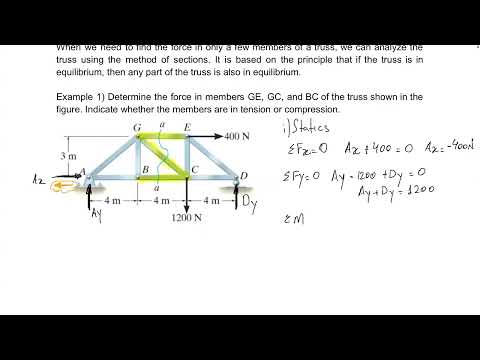
- For the first truss, the external horizontal load is 400 N and the vertical load is 1,200 N.
- Whole-truss equilibrium gives A_x = -400 N, A_y = 300 N, and D_y = 900 N.
- The negative A_x result means its actual direction is opposite the initially assumed arrow.
- The section cut crosses the three target members FG, GC, and BC, leaving three unknown axial forces.
- Guidio selects the left-hand portion, retaining the A-B-G structure, its external loads, and the reactions A_x = -400 N and A_y = 300 N.
- Each cut-member force is initially drawn in tension, pointing away from the retained section.
- The inclined member uses a 3-4-5 triangle, so sin θ = 3/5 and cos θ = 4/5.
- Vertical equilibrium isolates F_GC: the 300 N reaction balances its vertical component.
- The result is F_GC = 500 N in tension, consistent with the assumed direction.
- Taking moments about C eliminates the forces whose lines of action pass through C and isolates FG.
- Using the 3 m lever arm for FG and the 8 m arm for the 300 N reaction gives FG = -800 N.
- The negative sign means FG is in compression; imaginary extensions of truss lines may help locate moment centers but add no forces.
- After establishing FG as compressive, consistent force directions in horizontal equilibrium give F_BC = 800 N in tension.
- The right-hand section is also valid and contains the 900 N reaction at D and the external 400 N and 1,200 N loads.
- Either side of a cut must yield the same member forces; choose the side with the clearest known loads and reactions.
- The second cut passes through the target members on a diagonal rather than at 90 degrees; a section path need only divide the truss.
- Selecting the left section avoids support reactions, so that side can be analyzed without first solving the whole truss.
- The worked solution nevertheless calculates reactions before selecting the right section, allowing comparison of both valid approaches.
- Whole-truss equilibrium gives C_x = 0, C_y = 7,000 lb, and E_y = 10,000 lb.
- For the inclined member, the geometry is a 6-8-10 triangle, giving sin θ = 8/10 and cos θ = 6/10.
- Guidio selects the right-hand section and notes that students who chose the left side can continue with their original free-body diagram.
- Vertical equilibrium gives F_BE = -3,750 lb, so the member is in compression rather than the assumed tension.
- Taking moments about E isolates F_BC and gives 5,250 lb in tension.
- Taking moments about B isolates the remaining member force, F_D = -3,000 lb, indicating compression.
- An inclined force may be split into X and Y components when taking moments; at a chosen point, one component can have zero moment arm while the other does not.
- A moment equation about another point may give both components nonzero moment contributions, depending on their lines of action.
- Truss practice continues Tuesday, followed by a broader exam review Thursday.
Transcript excerpt
0:05 Okay. Lecture 18, engineer mechanics. The name of the father, son, holy spirit. Amen. Direct the lord beseech you our actions by holy inspirations and carry their own by grace assistance that every prayer and work of ours may begin always from you and through you come to completion through Christ our Lord. Amen. Son, holy spirit. Amen. Okay. So, today we're going to continue on thrust analysis. Then we're going to continue on TR analysis. We're going to do the other method. So, we discussed about the
0:53 method of joints last Tuesday. this Thursday. Today we're going to talk about the meth sections. Okay, keep in mind that I think was last yeah yesterday I post the homework for the trust problems. Uh after today's class you are able to go there and get it done. however, is due next Thursday and Tuesday. We're going to just do more trust problems uh here in class. Okay? So, we still have Tuesday to cover trust, but you can after today's class just go over there and get it done if you have time during the uh the weekend or next few days. Okay? And then Tuesday, we kind of do
1:41 the trans more problems and Thursday we do the review. Okay? kind of Tuesday is going to be also the review for for trust because I don't have time to do like a full trust problem on Thursday. It's going to be just a few points here and there and going to focus on the other points. Sounds good. Okay. Uh remember for the exam I will cover the three topics that we cover since from example number one which is the reactions like this equilibrium equations for a body case of the force in X Y and the moment find the reactions
This is the start of the transcript. Save this video free for the whole transcript, searchable and time-coded.
In this course
Related notes
Summary, takeaways, and chapters were generated by AI from the video's transcript and may contain errors. The video belongs to its creator, Bruno Guidio, PhD.