ENGR 201 Fall 2026 - Lecture 14: 2D Equilibrium of a Rigid Body (more examples)
 Watch on YouTube →
Overview
Bruno Guidio, PhD, develops 2D rigid-body equilibrium through a fixed-support beam, an L-shaped body on an inclined roller, a biomechanics example, and an airplane model. The examples apply force and moment balance, support-reaction idealization, and strategic moment selection, including a 1.5 kg arm with a 160 N load-cell reading and a 1,800 kg airplane with 3,000 N thrust at 12 degrees.
Key takeaways
- A planar rigid body has three independent equilibrium equations: sum FX = 0, sum FY = 0, and sum of moments about any point = 0.
- A fixed support contributes three unknown reactions, AX, AY, and MA; a pin contributes two force reactions, and a roller contributes one force normal to its contact surface.
- A negative reaction solution does not invalidate the calculation; it indicates that the actual force points opposite the direction assumed in the free-body diagram.
- Choosing a support as the moment center can eliminate its unknown reactions; in the L-shaped example, moments about A isolate B and give B = 245.9 lb.
- An applied couple such as the 500 lb-ft moment enters the moment equation directly, without multiplication by a distance.
- Taking moments about the elbow in the arm model eliminates joint reactions and yields a reported triceps force of 1,831.8 N.
Chapters
- A 2D rigid body in equilibrium satisfies sum of forces in X, sum of forces in Y, and sum of moments about any point equal to zero.
- Pin supports provide X and Y reactions, while a roller provides one reaction perpendicular to its contact surface.
- Reaction directions drawn on a free-body diagram are assumptions; a negative answer means the actual direction is opposite.
- Bruno asks students to show their free-body diagrams and assumptions in homework and exams.
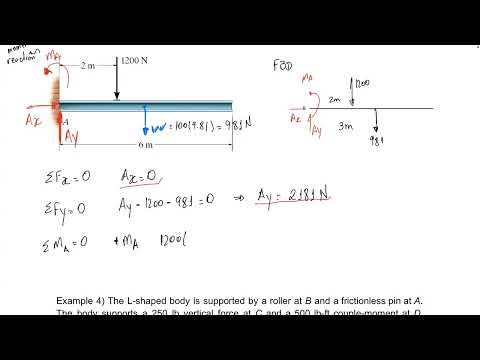
- A fixed support at A prevents horizontal and vertical translation and rotation, so its unknowns are AX, AY, and moment MA.
- For the 100 kg beam, Bruno calculates a 981 N weight acting at the beam's midpoint.
- The free-body diagram also includes a 1,200 N downward load 2 m from A and the beam weight 3 m from A.
- This example introduces a concentrated reaction moment, measured in newton-meters, rather than a force multiplied by a lever arm.
- The next example uses a pin at A and a roller at B on an inclined surface.
- The pin contributes AX and AY, while the roller reaction B acts perpendicular to the surface.
- Because B is inclined to the global axes, its horizontal and vertical components must be used in the force equations.
- Bruno distinguishes the single unknown reaction magnitude B from its two components, BX and BY.
- The inclined roller reaction is resolved into BX and BY so it can be included in the global X- and Y-force balances.
- The component expressions must both use the same reaction magnitude B, leaving three independent unknowns: AX, AY, and B.
- The surface inclination is 60 degrees, and the reaction direction is perpendicular to that surface.
- Drawing reference axes and the right triangle around B helps identify which angle belongs in each sine or cosine.
- Bruno relates the 60-degree surface angle to the reaction triangle and notes that the complementary angle is 30 degrees.
- The component adjacent to the 60-degree angle is B cos 60, and the opposite component is B sin 60.
- The same components can be expressed using 30 degrees, with the roles of sine and cosine exchanged.
- The free-body diagram includes a 250 lb force, a 500 lb applied couple, and the stated geometric distances.
- Students work on sum FX, sum FY, and a moment equation for the L-shaped body.
- The 500 lb-ft applied couple contributes directly to the moment balance and has no lever-arm distance.
- A force creates a moment through its perpendicular distance, but a couple is already a moment.
- The class considers moments about different points and discusses how support reactions can disappear from a moment equation.
- Taking moments about A eliminates both unknown pin reactions AX and AY.
- Moments about other points can still solve the system, but may leave more unknown reactions in the moment equation.
- Bruno recommends support points because reactions applied at the chosen point have zero moment arm.
- For this geometry, taking moments about A leaves only the unknown magnitude B in the moment equation.
- The moment equation about A combines the components of B at 3 ft and 7 ft, the 250 lb force at 4 ft, and the 500 lb-ft couple.
- Bruno gives the roller reaction as B = 245.9 lb.
- Substitution into the force balances gives AX = -213 lb and AY = 127.05 lb.
- The negative AX result means the actual horizontal reaction is opposite the direction assumed in the free-body diagram.
- The arm is idealized as a rigid body pinned at elbow joint O, with the load cell modeled as a contact support.
- The load cell reading supplies a known 160 N force, and the 1.5 kg arm has a 14.7 N weight acting at its given center of gravity.
- The unknown of interest is the triceps tension F, not the pin reactions OX and OY.
- The free-body diagram includes the joint reactions, arm weight, load-cell force, and triceps force.
- Taking moments about O removes the unknown elbow reactions from the equation.
- The example uses moment arms of 0.30 m for the 160 N load-cell force, 0.15 m for the 14.7 N arm weight, and 0.025 m for the triceps force.
- Bruno reports a triceps force of 1,831.8 N from the moment balance.
- The example shows how an equilibrium problem can provide one support reaction and ask for a muscle force instead of asking for all reactions.
- The airplane is modeled as a 2D rigid body, with its weight acting at the given center of gravity G.
- The main wheels at B are locked and do not skid, so B provides horizontal and vertical reactions; the unbraked contact at A provides AY.
- The 1,800 kg airplane has a weight of 17,658 N, and the engine thrust is 3,000 N at 12 degrees.
- The thrust direction and locked-wheel reaction are interpreted physically: BX opposes the airplane's tendency to move along the ground.
- Resolve the 3,000 N thrust into 3,000 cos 12 degrees horizontally and 3,000 sin 12 degrees vertically.
- The horizontal force balance relates BX to the horizontal thrust component, approximately 2,934 N.
- The vertical balance includes AY, BY, the 17,658 N weight, and the vertical thrust component.
- For moments, a force may be moved along its line of action to a point with known coordinates, simplifying the lever-arm calculation.
- The full airplane exercise compares equilibrium with the engine on and with thrust removed, although the class only sets up the engine-on case.
- Bruno notes that a moment equation can be taken about A, G, or B after establishing the force and geometry data.
- The lecture closes with assigned homework on two-dimensional rigid-body equilibrium.
- The next topic will continue using reactions as part of subsequent mechanics problems.
Transcript excerpt
0:01 All right, lecture 14 for 30201. We're going to continue talking about the equilibrium of a rigid body today. In the name of the Father, Son, Holy Spirit, amen. Direct our Lord we seek you our actions by holy inspirations and carry them on by grace's assistance. That our preparing work of ours may begin always from you and through you come to completion through Christ our Lord. Amen. Father, Son, Holy Spirit. Amen. All right. Okay, so we are going to continue talk about
0:52 the equilibrium of a rigid body. We discussed last Tuesday that now because we're talking about body in the equilibrium we have three equations. Sum of the forces in X, sum of the forces in Y, and sum of the moments about any point of your rigid body, of your system. And because we want to keep the equilibrium, okay, and that's why and also the rotation we need some uh restrictions, something that is going to restrict our body to move. And in this case are the supports, okay? And having supports they're going to bring support reactions uh in the problem. And then we discuss a
1:39 little bit about different supports and what are those support reactions that they introduce to the problem. And then we understand that pretty much what we're going to try to find right now is the value of those support reactions, okay? Of those unknowns. And then we discussed that because we have three equations, we're going to solve problems up to three unknowns. Sounds good? So, AX Oh, sorry. AY, BX, BY in this first problem, in word, they were the first the unknowns for the problems, the support reactions, that later on we found. Okay? Over there. We also mentioned that sometimes we can get a negative sign in
This is the start of the transcript. Save this video free for the whole transcript, searchable and time-coded.
Related notes
Summary, takeaways, and chapters were generated by AI from the video's transcript and may contain errors. The video belongs to its creator, Bruno Guidio, PhD.