ENGR 201 Fall 2026 - Lecture 17 - Truss Analysis - Method of Joints
 Watch on YouTube →
Overview
Bruno Guidio introduces truss analysis as a way to determine the internal axial forces carried by two-force members, distinguishing tension from compression and explaining why external equilibrium alone does not establish structural safety. He demonstrates the method of joints using particle-equilibrium equations, first solving a 500 N, 45-degree triangular truss and then a second truss with 600 N and 200 N member-force results.
Key takeaways
- For an ideal truss, smooth pin-connected members with loads applied only at joints can be modeled as two-force members carrying axial tension or compression.
- Whole-truss equilibrium determines support reactions, but individual joint equilibrium is needed to find internal member forces and assess what each member must carry.
- The method of joints supplies two equations per planar joint, so the most efficient starting point is a joint with no more than two unknown member forces.
- Assuming every unknown member force is tensile makes sign interpretation consistent: a positive result confirms tension, while a negative result indicates compression.
- In the first example, the triangular truss carries 500 N tension in AB and AC and approximately 707 N compression in the 45-degree member BC.
- Tension members can be vulnerable at reduced-area connections, while compression members must be checked for buckling; equilibrium calculations alone do not establish structural safety.
Chapters
- Bruno Guidio connects the course's earlier topics, particle equilibrium, rigid-body equilibrium, and centroids, to the new topic of structural analysis.
- The examples focus on trusses, while the two-force-member concept also applies to structures such as cranes and vehicle frames.
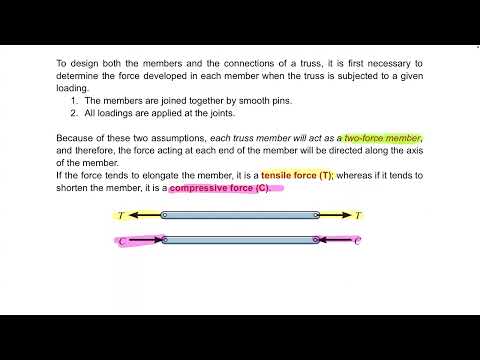
- A two-force member carries force along its axis, either tension that elongates it or compression that shortens it.
- Trusses commonly use triangular arrangements for stability, with members found in structures such as roofs and bridges.
- Truss analysis asks how external loads are distributed among individual members rather than assuming every member carries the same load.
- Finding support reactions establishes external equilibrium, but does not reveal the internal force in each truss member.
- Guidio illustrates that a member rated for 2 kN would not be adequate if internal analysis showed it carrying 4 kN.
- The paper demonstration contrasts tensile tearing with compression buckling, showing why the type of force matters as well as its magnitude.
- The idealized truss has straight, separate members connected by smooth pins, with no friction at the connections.
- Pin connections are called joints or nodes, and the truss model assumes external loads are applied at those joints.
- Under these assumptions, each member carries axial tension or compression rather than bending or torsion.
- The method of joints solves member forces by applying equilibrium at one joint at a time.
- The method of sections analyzes a cut portion of the truss and is useful when only a few member forces are needed.
- Guidio introduces the method of joints in this lecture and reserves the method of sections for the following class.
- A truss in equilibrium requires each individual joint to be in equilibrium.
- Before solving joints, calculate support reactions using whole-body equations: sum of forces in X, sum of forces in Y, and sum of moments.
- The first example is a three-member triangular truss with a 500 N external load and pin and roller supports.
- The first truss has a pin at A, with reactions AX and AY, and a roller at C, with reaction CY.
- Whole-truss equilibrium gives AX = 500 N to the left, CY = 500 N upward, and AY = 500 N downward.
- A negative reaction result means the actual direction is opposite the direction initially assumed.
- Each two-dimensional joint provides two equations: sum of forces in X equals zero and sum of forces in Y equals zero.
- Start at a joint with at most two unknown member forces after incorporating known support reactions.
- In the first triangular example, joints A, B, and C are all initially solvable because each has two unknowns.
- Guidio draws a free-body diagram of joint A and assumes unknown member forces FAB and FAC pull away from the joint, the standard tension convention used in class.
- Equilibrium in X gives FAC = 500 N, and equilibrium in Y gives FAB = 500 N.
- Both results are positive, so both assumed directions are correct and members AC and AB are in tension.
- At joint B, the known 500 N force in member AB and the 500 N external load are balanced against the unknown diagonal force FBC.
- Resolving the diagonal at 45 degrees produces a negative result of approximately 707 N under the tension assumption.
- The negative sign indicates compression, so member BC carries 707 N in compression, not a negative physical force.
- Forces shown on a joint are the member's action on that joint; the equal-and-opposite force on the member explains why the member itself can be in tension.
- Tension members may fail at connections where the cross-sectional area is reduced, while compression members require attention to buckling.
- The first example's results are AB = 500 N tension, AC = 500 N tension, and BC = 707 N compression.
- The second exercise begins with whole-truss equilibrium and support reactions, including CX = 600 N, CY = 200 N downward, and AY = 600 N.
- Joint C is a convenient starting point because its unknown members BC and CD align with the coordinate axes.
- Assuming tension for both unknowns, joint C gives BC = 600 N in compression and CD = 200 N in compression.
- At joint D, member BD forms a 3-4-5 triangle, so its horizontal component uses 3/5 and its vertical component uses 4/5.
- Joint D gives BD = 250 N in tension and AD = 450 N in tension.
- Solving the remaining joint gives AB = 750 N in compression; when reusing equations from one free-body diagram, retain the signed force value.
Transcript excerpt
0:01 All right. Lecture 17 Engineering 201 In the name of the Father, Son, Holy Spirit. Amen. Direct, O Lord, we beseech you, our actions by thy holy inspirations, and carry them on by thy grace and assistance, that every prayer and work of ours may begin always in you, and through you come to completion, through Christ our Lord. Amen. Father, Son, Holy Spirit. Amen. All right. Okay, guys. So, um >> [clears throat] >> we have been I studied since the first week, second week. We studied equilibrium of equilibrium of a particle. And then we studied also equilibrium of a body. Last week, we studied centroids.
0:51 And we have find that equilibrium point. Okay? And then we're going to start today analyzing structures. Okay? And when I say structure, it's not only civil engineering structure, but structure, frames, uh structure elements, structure systems, in the most different uh field that we have in class. Okay? Um today as I mentioned, we there is this word called truss, okay, which is a specific word that when you talk truss, we see like those trusses here for the civil engineering uh part. But again, I don't want you to be feel that we're just like a civil engineering class, okay? Because once I'm going to mention how these elements work,
1:38 and then we have those kind of same elements in different structure systems. Okay? However, in the truss, every single element is a specific element that I want to touch today. That's why I bring truss, because we're going to work with this specific element a bunch of times. Okay? However, we can find those elements in all the systems. And what what are those elements? Okay? What are those elements? Before I talk about trust, let me just go down here.
This is the start of the transcript. Save this video free for the whole transcript, searchable and time-coded.
Related notes
Summary, takeaways, and chapters were generated by AI from the video's transcript and may contain errors. The video belongs to its creator, Bruno Guidio, PhD.