ENGR 201 Fall 2026 - Lecture 22 - Internal Forces (Shear and Moment)
Overview
Bruno Guidio, PhD, introduces internal normal force, shear force, and bending moment in ENGR 201, showing how to find them by cutting a beam, choosing one side, and applying equilibrium equations with a consistent sign convention. Worked examples find the internal forces at two beam sections, explain how a point load changes shear, and use a 150 lb/ft distributed load to calculate zero shear and a negative 325 lb·ft moment at a midpoint cut.
Key takeaways
- At a beam cut, track three internal actions: normal force along the member, shear across the section, and bending moment about the cut.
- For the convention used in class, positive shear points down on a left-hand segment and up on a right-hand segment; positive tension points away from the cut.
- At the first example's section B, the internal actions are N = 0, V = +5 kN, and M = +15 kN·m; selecting either side gives the same result when signs are applied consistently.
- Crossing the 6 kN point load changes the example beam's shear from +5 kN at B to −1 kN at C, while its bending moment remains +15 kN·m.
- For a uniform 150 lb/ft load over 6 ft, use a 900 lb resultant for support reactions; for a 3 ft cut segment, use a 450 lb resultant at its 1.5 ft centroid.
- The second example's midpoint has zero shear and a −325 lb·ft bending moment; negative bending reverses the top-and-bottom tension/compression pattern relative to positive bending.
Chapters
- Bruno Guidio says exam grades will be posted after grading and that students can review the test solution in class.
- The stated passing threshold is C−, or 70%; students concerned about their grade are invited to contact Bruno.
- A new homework is due the following Thursday, and the final exam is scheduled for Tuesday, December 15 at 1:00.
- Earlier ENGR 201 work covered force vectors, particle and rigid-body equilibrium, support reactions, and truss analysis.
- The method of sections previously found tension or compression in truss members; beam cuts reveal additional internal actions.
- Analyzing a specific point matters because the force carried by a structure can vary from one location to another.
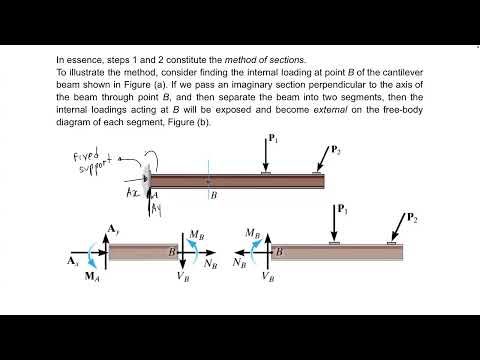
- A section cut exposes internal normal force N, shear force V, and bending moment M at the cut.
- Normal force acts along the member and represents tension or compression, extending the familiar truss-member concept.
- Shear tends to slide or cut across the section, while bending moment tends to rotate and bend the member.
- Positive normal force is assumed to pull away from the cut, indicating tension on either selected segment.
- For the left segment, positive shear points down; for the right segment, it points up.
- Positive bending moment is drawn upward on either cut face and corresponds to the beam's sagging, or “happy-face,” shape; the opposite curvature is negative.
- Guidio's procedure is to calculate support reactions, make an imaginary cut at the target point, select one side, then apply equilibrium.
- The first example's reactions are A_y = 5 kN and D_y = 1 kN, with D_x = 0.
- Students can choose the left or right free-body diagram, but must apply the corresponding shear sign convention consistently.
- At B, the left segment gives N_B = 0 and V_B = +5 kN from force equilibrium.
- Taking moments about the cut gives M_B = +15 kN·m; forces through the cut do not contribute to that moment equation.
- The right segment produces the same +5 kN shear and +15 kN·m moment, demonstrating that consistent sign conventions make either side valid.
- The cut at C is placed just after the 6 kN load, so the left free-body diagram includes that load.
- Normal force remains zero, while shear changes from +5 kN at B to −1 kN at C after accounting for the 6 kN point load.
- The bending moment remains +15 kN·m at C in this example, illustrating that internal forces can vary by section.
- A force perpendicular to a member contributes to shear, while a force parallel to it contributes to normal force.
- An inclined force generally contributes to both internal actions after it is resolved into member-aligned components.
- The relevant direction depends on the member's orientation, not simply on whether a force points vertically or horizontally.
- For the second beam, the 150 lb/ft load over 6 ft is replaced by a 900 lb resultant when calculating support reactions.
- Guidio reports vertical reactions of 700 lb at A and 700 lb at B; the midpoint section C is then analyzed using the left segment.
- At the cut, the distributed load over the 3 ft segment is represented by 450 lb acting 1.5 ft from the cut, rather than treating the full 900 lb as a local load.
- At C, vertical-force equilibrium combines −250 lb, +700 lb, and −450 lb to give V_C = 0.
- Moment equilibrium about the cut gives M_C = −325 lb·ft, identifying the local bending direction as negative.
- Positive bending puts the bottom fibers in tension and the top in compression; negative bending reverses those conditions, a distinction needed for later stress analysis.
Transcript excerpt
0:03 Okay. Lecture 22, engineering mechanics. The name of the father, son, holy spirit. Amen. Director the lord we beseech you. Our actions by holy inspirations and carry their own by grace assistance that every bread and work of ours may begin our spir and through to completion through Christ our Lord. Amen. All right. So before we start a few um announcements. So I I joke not joke kind of through as well. Okay. I have been creating the test. Uh I just during this lunch I finish the other class and start your class. I think I miss maybe three or four students. So after the class done, I'll go to my office, finish the
0:51 grading and post the grade to you. Okay. uh take a look at your grade. I'm going to bring the test on Tuesday for sure. Then I think today before we finish the class, I'll show you the solution. So at least you can think about it and maybe cry a little bit. Anyway, but I have to tell you once you see our day, you are not feeling comfortable with the class. thing I have to tell you the withdraw is tomorrow. Okay? So I have to tell you I'm a good professor. I want to I want to see you succeed. If you take my class and pay you're going to get you're going to hurt your GPA. If you're withdraw not going to hurt your GPA but professor I want
1:41 the best for you. Okay. But this is your decision. Okay. But if you need to talk to me once you see the grade please email me. We can meet online to board. Yeah, I'm talking about serious drawing. You don't work your GPA. Let's say okay and remember to pass the class
This is the start of the transcript. Save this video free for the whole transcript, searchable and time-coded.
In this course
Related notes
Summary, takeaways, and chapters were generated by AI from the video's transcript and may contain errors. The video belongs to its creator, Bruno Guidio, PhD.