ENGR 201 Fall 2026 - Lecture 19 - Truss Analysis - more problems
 Watch on YouTube →
Overview
Bruno Guidio reviews truss analysis with the method of sections and the method of joints, emphasizing that reactions are found first and that member-force signs must be interpreted consistently as tension or compression. Two worked examples apply these methods: an inclined-member truss with 45° and 26.57° angles, and a kip-based truss where the analysis identifies a zero-force member.
Key takeaways
- Whole-truss equilibrium must be solved before either truss method is applied, because the support reactions are external forces on every isolated joint or section.
- A section cut is most efficient when it crosses no more than three unknown members, and the moment center should be chosen to eliminate as many cut forces as possible.
- For the first example, the geometry produces alpha = 45° and beta ≈ 26.57°; inclined member forces must be resolved into components before applying equilibrium.
- A negative result under an assumed tension direction indicates compression; calculations remain consistent if the original arrow is retained with a negative value or reversed with a positive magnitude.
- In the second example, the reported solution identifies AD as approximately 3.38 kips in compression, CE as approximately 14.03 kips, and CD as a zero-force member under the given loading.
Chapters
- Bruno Guidio opens Lecture 19 with an announcement that the truss homework is due Thursday.
- The Exam 2 review is scheduled for Thursday, and the exam is scheduled for the following Tuesday.
- Students are asked to contact Guidio about grading concerns and meet with advisors during registration.
- Truss members are modeled as two-force members that carry axial tension or compression.
- Guidio connects the course sequence from external forces and support reactions to internal forces, then to stress and structural design.
- The lecture is positioned as the final class focused specifically on truss analysis before Exam 2.
- The method of joints applies two equilibrium equations, sum of forces in x and y, at a joint with no more than two unknown member forces.
- The method of sections applies sum of forces in x, sum of forces in y, and sum of moments to a cut section with up to three unknowns.
- For either method, first solve the whole-truss equilibrium to find support reactions and identify each solved member as tension or compression.
- The first example targets members GF, CF, and CD with a section cut, then uses joint F to find DF and EF.
- Guidio recommends choosing the left or right side of the cut according to which free-body diagram is easier to solve.
- The exercise begins by finding the whole-truss reactions before introducing internal forces at the cut.
- The selected section is the right side of the cut, with internal forces labeled for GF, CF, and CD.
- The free-body diagram includes the right-side reaction reported as 475 and an external 3 kN load.
- Guidio marks dimensions of 4 m and 2 m so moment arms can be used directly.
- The geometry gives angle alpha as arctan(4/4), or 45°.
- For the second member, the rise of 2 m over a 4 m run gives beta as arctan(2/4), approximately 26.57°.
- Each inclined internal force is split into horizontal and vertical components using sine and cosine before writing equilibrium equations.
- The section's force-balance equations initially contain multiple unknowns, so Guidio uses a moment equation first.
- Taking moments about F eliminates the forces whose lines of action pass through F and isolates CD.
- The 3 kN load also produces no moment about F because its line of action passes through that point.
- A moment equation about C combines the reaction, the 3 kN load, and both components of the inclined GF force.
- Guidio reports GF as approximately 4.84 in magnitude, with a negative result under the initial tension assumption, so GF is in compression.
- A negative member-force result means the assumed direction was opposite to the actual force direction.
- Guidio demonstrates two equivalent ways to continue after GF is found to be in compression: keep the original arrow and use a negative value, or reverse the arrow and use a positive magnitude.
- Using horizontal force equilibrium with the correct directions gives CF as approximately 0.59 in magnitude and in compression.
- The same sign convention must be applied to every component when a free-body diagram is updated.
- At joint F, the known compressed members GF and CF are combined with the unknown members DF and EF.
- The joint equations use the previously calculated 45° and 26.57° angles to resolve member forces into x and y components.
- Guidio reports EF as approximately 6.71 in magnitude and compression, and DF as approximately 3 in the lecture's force units.
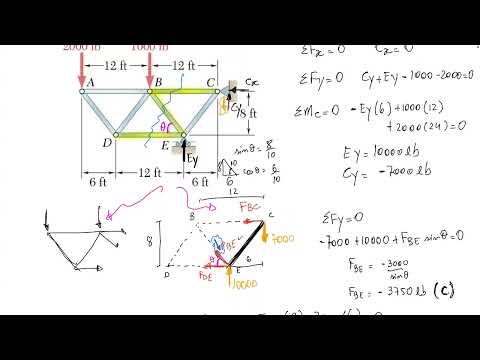
- The second problem asks for members AD, CD, and CE using a section, followed by additional member forces using the method of joints.
- Guidio gives students time to work collaboratively and compare support reactions before proceeding.
- The example revisits the same sequence: calculate reactions, draw a section free-body diagram, and solve the cut-member forces.
- The left-side free-body diagram includes a 9 kip load at A and a reaction of 6.6 at A.
- Guidio cautions that a marked 5 kip value is not an applied load on the isolated section; the point is used only as a reference for dimensions.
- The inclined-member geometry uses a 4-unit rise and a 7.5-unit run, giving an angle of approximately 28.07°.
- Taking moments about C eliminates cut-member forces whose lines of action pass through C.
- The moment balance uses the 6.6 reaction with a 7.5-unit arm and the 9 kip load with a 4-unit arm.
- Guidio reports AD as approximately 3.38 kips in compression based on the negative result under the assumed direction.
- The moment equation about D isolates CE by resolving its inclined force into sine and cosine components.
- Guidio reports CE as approximately 14.03 kips, then applies horizontal force equilibrium to determine CD.
- CD evaluates to zero force in this loading case; Guidio notes that a zero-force member can still provide structural stability.
Transcript excerpt
0:03 All right. So, lecture 19 engine mechanics one. In the name of the father, son, holy spirit. Amen. Direct the lord. We beseech you our actions by holy inspirations and car by grace assistance that every prayer and work of us may begin our you come to completion through Christ our lord. Amen. Father, son, holy spirit. Amen. All right. So uh here we are for the last lecture on th analysis. Uh today we're going to do I have two problems here to do both methods mostly the sections and by the end we're going to do one join. Okay. Uh so this is going to be kind of the review for the exam as well because on
0:51 Thursday we're going to do the review. So probably bring another problem for trust but not have time to solve completely. Okay. So, today, please let me know if you have any questions. Um, homework for trust is due Thursday, uh, if I'm not wrong. So, it's kind of a hard deadline because I want to post the solution on Friday or Saturday morning for for you to be able to study for the test, which going to be next Tuesday. Okay? So, this Thursday, we're going to review the I think three topics, right? topics for this exam number two. Great. All right. Uh I I took a look yesterday night, last night. Last night, it looks like the TA was able to grade everything
1:40 that was uh passed. Uh so if you have any questions about the grading or something that you do not agree, please let me know, okay? Uh then I can go there and take a look. Um I think that's that's pretty much any questions any questions at all. Okay. So today uh the registration start for a few of
This is the start of the transcript. Save this video free for the whole transcript, searchable and time-coded.
Related notes
Summary, takeaways, and chapters were generated by AI from the video's transcript and may contain errors. The video belongs to its creator, Bruno Guidio, PhD.