ENGR 201 Fall 2026 - Lecture 20 - Review Exam #2
Overview
Bruno Guidio reviews the three main topics for ENGR 201 Exam #2: composite-area centroids, equilibrium reactions, and truss analysis. He works through a centroid made from a triangle, rectangle, and removed quarter-circle; converts distributed and inclined loads into equivalent forces to solve beam reactions; and uses the method of sections to identify truss members in compression, tension, or zero force.
Key takeaways
- Composite centroids require signed areas: add the triangle and rectangle, subtract the quarter-circle, and use x̄ = Σ(xᵢAᵢ)/ΣAᵢ and ȳ = Σ(yᵢAᵢ)/ΣAᵢ.
- A rectangular distributed load is replaced by its load intensity times its length, located at the rectangle's midpoint; 2 kN/m over 5 m becomes 10 kN at 2.5 m.
- Resolve an inclined force into horizontal and vertical components before applying equilibrium; the 5 kN 3-4-5 example produces 3 kN and 4 kN components.
- A fixed support contributes two force reactions and one moment reaction; the example's 4 kip/ft load over 14 ft becomes 56 kip and leads to a 66 kip vertical reaction.
- For truss sections, a negative member force under a tension-positive assumption means compression; the worked cut finds CD at 80 kN in compression, HG at 80 kN in tension, and CG at zero.
- The exam is planned for 1 hour 15 minutes with about three questions, and the truss problem allows students to choose joints or sections.
Chapters
- Bruno Guidio says the exam is scheduled for Tuesday and allows 1 hour 15 minutes.
- The expected format is about three questions, one each on centroids, support reactions, and trusses.
- For the truss question, students may choose the method of joints or method of sections and will be asked for three member forces.
- The review covers vector and inclined forces, couple moments, and distributed loads in equilibrium problems.
- The truss problem permits either joints or sections, so students can focus on mastering one method.
- Guidio later clarifies that the test uses roller, pin, and fixed supports, not cables or other support types.
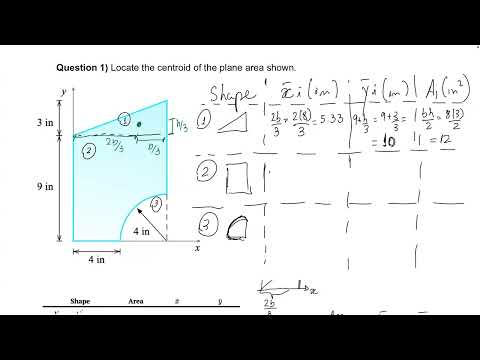
- The centroid problem begins by dividing the plane into simpler shapes and recording each shape's area and centroid coordinates.
- Guidio presents two valid decompositions: add a triangle and rectangle, or start with a full rectangle and subtract cutouts.
- A reference table of standard centroid locations will be provided on the exam, so students do not need to memorize those values.
- The class proceeds with three components: a triangle, an 8-by-9 rectangle, and a quarter-circle cutout.
- Guidio recommends organizing the work in a table with columns for shape, x-coordinate, y-coordinate, and signed area.
- The quarter-circle is treated as removed material, so its area is negative in the composite calculation.
- For the triangular component, the centroid lies one-third of the base and height from the right-angle corner.
- The triangle's local centroid distances must be converted to coordinates measured from the overall origin.
- The 8-by-9 rectangle has centroid coordinates of 4 and 4.5, with area 72 square units.
- For a quarter-circle of radius 4, each centroid offset from its straight edges is 4r/(3π).
- The cutout's global x- and y-coordinates are found by adding or subtracting that offset from the surrounding dimensions.
- Its signed area is −π(4²)/4, approximately −12.57 square units.
- The overall centroid is calculated with x̄ = Σ(xᵢAᵢ)/ΣAᵢ and ȳ = Σ(yᵢAᵢ)/ΣAᵢ.
- Use the same signed-area denominator for both coordinate calculations, including the negative quarter-circle area.
- Guidio advises calculating the total area once and reusing it in the x- and y-centroid equations.
- A 2 kN/m rectangular distributed load over 5 m becomes a 10 kN downward resultant.
- The resultant acts at the rectangle's centroid, 2.5 m from either end of the loaded span.
- A 5 kN inclined load with a 3-4-5 triangle resolves into 3 kN horizontal and 4 kN vertical components.
- The beam has a roller at A, which supplies Aᵧ, and a pin at the other support, which supplies Fₓ and Fᵧ.
- The horizontal equilibrium equation gives a 3 kN horizontal reaction, with its direction determined by the sign convention.
- Vertical equilibrium gives Aᵧ + Fᵧ = 14 kN; taking moments about F gives Aᵧ = 9.2 kN and Fᵧ = 4.8 kN.
- The moment equation includes the 10 kN resultant, the 4 kN vertical component, and the applied 35 kN·m couple.
- A fixed support at D supplies three unknown reactions: Dₓ, Dᵧ, and a reaction moment Mᴅ.
- The example includes a 16 kip horizontal force, a 10 kip vertical force, and a 4 kip/ft distributed load over 14 ft.
- The rectangular distributed load is replaced by a 56 kip resultant acting at the span's midpoint, 7 ft from either end.
- Horizontal equilibrium gives Dₓ = 16 kip, opposite the initially assumed direction.
- Vertical equilibrium balances the 56 kip distributed-load resultant and the 10 kip downward force, giving Dᵧ = 66 kip upward.
- Taking moments about D gives Mᴅ = −164 kip·ft under the assumed counterclockwise-positive convention, so the actual reaction moment is clockwise.
- A force applied at D creates no moment about D, while the couple moment Mᴅ must still appear in the moment equation.
- The truss exercise asks for forces in members CD, CG, and HG, and students may use joints or sections.
- The diagram uses 3 m bays; equal 3 m horizontal and vertical dimensions establish a 45-degree diagonal.
- Before cutting the truss, calculate the support reactions; the worked setup gives Aₓ = 0 and vertical reactions of 80 at each support.
- Guidio cuts through members CD, CG, and HG and analyzes one side of the truss using equilibrium.
- Taking moments about G gives FCD = −80 kN under a tension-positive assumption, identifying CD as a compression member.
- Taking moments about C gives FHG = 80 kN in tension.
- Vertical force equilibrium and the 45-degree geometry show FCG = 0; the exam response should state whether each member is in tension, compression, or zero force.
Transcript excerpt
0:01 All right, so lecture 20 uh engineering 201 We're going to review for exam number two. In the name of the Father, Son, Holy Spirit, amen. Direct the Lord, we beseech you our actions by holy inspirations and carry them on by your gracious assistance. That every prayer Father, Son, Holy Spirit, amen. All right, so today we're going to review for exam number two. Okay? Um so I posted the uh the the the problems in the Brightspace if you want to check it out. Uh but also I'm going to solve it today and
0:48 post to you. So any questions, please let me know today. And I think it's very straight for all the topics but we're going to review. And then please come Tuesday on time for the test. Okay, the same one hour and 15 minutes for you to to finish the test. Probably three questions because we have three uh topics. So [snorts] one question per topic. That's uh what we're going to have. Sounds good? Okay, just a overview before we start solving the problems. Okay, first topic that we're going to review today is going to be there centroid. Okay? So centroid is going to be in the test. Uh how to find centroid of a shape. Uh
1:36 again, there are many different ways to solve the centroid problem. We're going to discuss these uh and this problem as well. Okay? Uh talked about the other topics as well. Let me just show you okay, what I'm going to we're going to solve today. And the other topic is reactions or equilibrium of a body. Okay? So we're to have, we could have potentially every single force that we learn. That's why I'm going to review for this problem. We learned like um
This is the start of the transcript. Save this video free for the whole transcript, searchable and time-coded.
In this course
Related notes
Summary, takeaways, and chapters were generated by AI from the video's transcript and may contain errors. The video belongs to its creator, Bruno Guidio, PhD.