EEL4514C Communication Systems and Components, Fall 2026, Lecture 25
Overview
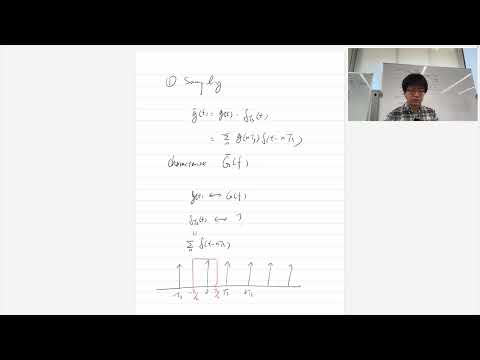
Mingyue Ji explains how impulse-train sampling creates periodic replicas of a signal's spectrum and derives the Nyquist condition: for a band-limited signal with bandwidth B, the sampling rate must exceed 2B for ideal low-pass recovery. The lecture then connects ideal reconstruction to sinc interpolation and practical aliasing, showing why a pre-sampling anti-aliasing low-pass filter limits bandwidth to at most half the sampling rate, at the cost of high-frequency detail.
Key takeaways
- Impulse-train sampling repeats the original spectrum at integer multiples of the sampling rate, with each copy scaled by fs = 1/Ts.
- For a signal with bandwidth B, sampling above 2B keeps spectral copies separate and permits ideal low-pass reconstruction.
- Ideal reconstruction uses sinc interpolation: each sample weights a shifted sinc whose zeros fall at the other sample times.
- Practical time-limited signals are not strictly band-limited, so aliasing cannot generally be eliminated without limiting input bandwidth.
- An anti-aliasing filter cuts frequencies above fs/2 before sampling, preventing spectral overlap while potentially discarding detail.
- In imaging, optical anti-aliasing filters trade fewer aliasing artifacts for a blurrier result and reduced high-frequency resolution.
Chapters
- Sampling represents an analog signal, such as audio or video, through values taken at fixed time intervals.
- The goal is to choose a sampling rate that allows reconstruction of the original continuous-time signal.
- A band-limited signal is zero outside a bounded frequency range, while a time-limited signal is zero outside a bounded time interval.
- The sampling interval is Ts seconds per sample, and the sampling rate is fs = 1/Ts samples per second.
- Impulse sampling multiplies the original signal by a periodic delta train, creating impulses weighted by the signal values at nTs.
- The weighted impulse train remains a continuous-time signal because it is defined at every time, with zero values between impulses.
- Multiplication by the delta train in time corresponds to convolution in the frequency domain.
- Using a Fourier series expansion, the periodic impulse train has equal coefficients of 1/Ts for every harmonic.
- Its Fourier transform is another impulse train with frequency spacing fs and scale factor 1/Ts.
- The sampled spectrum is a sum of shifted copies of the original spectrum, centered at integer multiples of fs.
- Each spectral copy is scaled by 1/Ts, equivalent to the sampling rate fs.
- A band-limited spectrum can be recovered by low-pass filtering when neighboring copies do not overlap.
- For a signal with bandwidth B, adjacent spectral copies remain separated when fs exceeds 2B.
- An ideal low-pass filter can then isolate the central copy and recover the original spectrum.
- The minimum theoretical sampling rate is twice the signal bandwidth, the Nyquist rate.
- An ideal reconstruction filter with a rectangular frequency response produces a sinc-shaped impulse response.
- Reconstruction sums shifted sinc functions weighted by the samples, with sinc zero crossings aligned to neighboring sample times.
- Unlike simply connecting sample points, sinc interpolation reconstructs the continuous signal exactly under the ideal band-limited sampling conditions.
- A signal cannot be both time-limited and band-limited, so practical finite-duration signals generally have frequency content extending indefinitely.
- When fs is below 2B, repeated spectral copies overlap and their components combine in the sampled spectrum.
- Once overlapping copies have combined, a low-pass filter cannot separate them to recover the original signal exactly.
- When the sampling rate is too low, shifted spectra overlap around the midpoint between copies.
- That midpoint is fs/2, known as the folding frequency.
- Reducing the signal bandwidth to fs/2 or less before sampling prevents overlap between adjacent spectral copies.
- An anti-aliasing filter is a low-pass filter placed before the sampler to restrict input bandwidth to at most fs/2.
- After filtering, sampling at fs avoids spectral overlap in the idealized model.
- The procedure addresses the unlimited bandwidth of practical time-limited signals by attenuating frequencies above the folding frequency.
- Removing high-frequency components can reduce image detail and make an image look blurrier.
- Without an optical anti-aliasing filter, fine image patterns may retain more apparent sharpness but can produce aliasing artifacts.
- Camera designers and cinematographers weigh the reduced artifacts from an optical anti-aliasing filter against the loss of high-frequency detail.
Transcript excerpt
0:03 Yeah, let's see what we covered in our last lecture. In our last lecture, we start talking about the sampling. So, yeah, which we say is a bridge between analog communication to digital communication. Okay, here. So, here are some motivation why we need a digital communication. Okay. So, uh yeah because normally uh at originally what we want to transmit our voice, video and music, right? So, they're all analog, right? So, why do we even bother to talk about digital communication, right? So, we say there are like list of advantages of digital communication, right? So, I will not repeat them, right? You can take a look at this and watch the videos in our last lecture if you don't remember.
0:51 Okay. [clears throat] Yeah. And uh so this is sampling right. So basically uh so what do we mean by sampling is that an analog signal can be represented by it samples. Okay. So uh normally what we do is that we take a value of the analog signal with within a fixed interval. Okay. So yeah if we do that so basically we need to understand uh you know what kind of the rate that we need to sample such that we can restruct the original analog signal right because our final goal is to re recover or we reconstruct our analog signal right so that's the information that we are transmitting right of course you know for some signals they are digital by nature for example like files right word files for example right so
1:40 there are digital by nature but you know many signal are not digital by nature right they're digital by analog like a video audio right okay so yeah here are some definition so uh we have two definition so those are
This is the start of the transcript. Save this video free for the whole transcript, searchable and time-coded.
In this course
Related notes
Summary, takeaways, and chapters were generated by AI from the video's transcript and may contain errors. The video belongs to its creator, Mingyue Ji.