EEL4514C Communication Systems and Components, Fall 2026, Lecture 30
Overview
Mingyue Ji reviews digital communication’s efficiency and design tradeoffs, then compares bipolar NRZ, Manchester, and RZ line codes in terms of synchronization, DC content, bandwidth, and implementation. The lecture develops a PSD analysis framework by modeling the transmitted signal as a pulse-shaped impulse train, with the derivation of the input sequence’s autocorrelation left for the next class.
Key takeaways
- Bipolar NRZ eliminates average DC when zeros and ones are equally likely, but long runs of the same bit still provide no transitions for timing recovery.
- Manchester coding guarantees a mid-bit transition and balanced positive and negative halves, but requires about twice the bandwidth of a full-bit pulse at the same data rate.
- RZ coding returns to zero within every bit and supports synchronization, while its duty cycle offers a design control between bandwidth and active transmission time.
- The PSD of a pulse-shaped line code factors into the pulse response and the symbol-sequence spectrum: Sᵧ(f) = |P(f)|²Sₓ(f).
- For an impulse train spaced by T_B, autocorrelation is zero at noninteger bit-period shifts and depends on discrete symbol autocorrelation at shifts nT_B.
Chapters
- Digital communication supports noise resilience, source compression, encryption, scrambling, storage, and regeneration.
- Digital systems can multiplex in time, frequency, and code domains, with OFDM cited as an efficient frequency-domain technique.
- Modulation design balances spectral efficiency, measured in information per second per hertz, against energy efficiency and error probability.
- Other desired properties include synchronization, favorable power spectral density, error correction, and transparency when noise is absent.
- Line coding represents binary 0 and 1 with selected baseband pulse shapes, denoted S0 and S1.
- The two main families are non-return-to-zero (NRZ) and return-to-zero (RZ) coding.
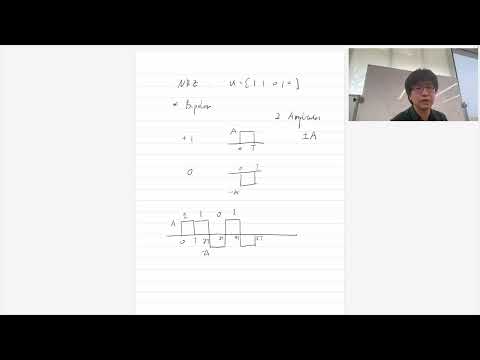
- Unipolar NRZ sends a square pulse for 1 and zero amplitude for 0, while bipolar NRZ uses positive and negative amplitudes.
- Bipolar NRZ maps the two bit values to +A and −A across the full bit interval T.
- For an example sequence 11010, each bit occupies a complete interval without returning to zero.
- With equally likely zeros and ones, the positive and negative pulse areas cancel on average, reducing the DC component.
- Long runs of identical bits still produce a flat waveform, making clock and bit-boundary synchronization difficult.
- Manchester coding uses a pulse that changes polarity at the midpoint T/2 of every bit interval; the opposite pulse represents the other bit value.
- The required mid-bit transition provides timing information even during long runs of identical bits.
- The positive and negative halves balance, so the code has no DC component.
- Its two half-bit waveform segments require about twice the bandwidth of a full-bit square pulse at the same data rate.
- Return-to-zero coding requires the signal to return to zero during each symbol interval, with the example pulse active for T/2.
- Unipolar RZ sends the pulse for 1 and zero amplitude for 0; bipolar RZ sends positive and negative pulses for the two bit values.
- Unipolar RZ has a DC component, while bipolar RZ cancels its average when positive and negative symbols are balanced.
- Both RZ forms create transitions within bit intervals, improving synchronization compared with flat NRZ runs.
- A shorter RZ pulse has a wider spectrum than a full-duration NRZ pulse, creating a bandwidth cost similar to Manchester coding.
- RZ can use less transmitted power because the signal is active for only part of each bit interval.
- Unlike Manchester coding, an RZ pulse’s duty cycle can be adjusted; increasing its active duration can reduce bandwidth.
- RZ may be easier to implement because it does not require a polarity reversal at every bit’s midpoint.
- A transmitted bit stream is treated as a random sequence, so its spectrum is described by power spectral density rather than a single deterministic Fourier transform.
- PSD provides a quantitative way to compare how NRZ and RZ pulse choices distribute signal power across frequency.
- The analysis separates effects of the pulse shape from effects of the symbol-amplitude sequence.
- The signal is modeled as y(t) = Σₖ aₖp(t − kT_B), where aₖ is a code amplitude and T_B is the bit duration.
- The same model covers unipolar amplitudes such as 0 and 1, as well as bipolar amplitudes such as −1 and 1.
- Equivalently, the signal is the convolution of pulse p(t) with a weighted impulse train; p(t) acts as a pulse-shaping filter.
- The output PSD follows Sᵧ(f) = |P(f)|²Sₓ(f), so the pulse spectrum shapes the input impulse-train PSD.
- The Fourier transform of the autocorrelation function is used to obtain the PSD of the random input impulse train x(t).
- For time shifts τ that are not integer multiples of T_B, shifted impulse trains do not overlap, giving zero autocorrelation in the ideal impulse-train model.
- At shifts τ = nT_B, overlapping impulses contribute products of symbol amplitudes, producing weighted delta functions.
- The weights reduce to the discrete sequence autocorrelation, formed from averages of aₖaₖ₊ₙ; its exact evaluation is deferred to the next lecture.
Transcript excerpt
0:03 Let's get started. Okay. So, yeah, let's recall what we cover in our last lecture. So, in our last lecture, we briefly talk about the advantage of digital communication and also we talk a little bit on the desirable property for digital modulation and then we start talking about the line coding. Okay? And yeah, for the advantage of digital communication, so the first we can see is robust to noise in compared to the analog communication. And also we can do source encoding or source compression so in that way. So though the higher bandwidth may not be a very big deal for digital communication. Okay? And we can guarantee security, right? So we can do encryption, so we can do scrambling,
0:49 right? And also it is easy for data transmission and for data storage. Okay? And it's also information agnostic, right? So it doesn't matter too much what kind of information that we're going to transmit. So we can we just transmit zeros and ones, right? On the physical layer, it is not very different from different sources. Okay? And it's also easy to do multiplexing and multiple access, right? Unlike analog communication, normally we can only do the multiplexing and the multiple access in the frequency domain, right? Like FDMA or FDD. But for digital communication, we can do this for other domains, right? For example, we can do that in the time domain, so we can we can still do that in the frequency domain and we can do that in the code domain, right? Even even if when we do that in the frequency domain,
1:36 so we can do that in a much more efficient way like OFDM that we're using today, right? And so for these digital sources, so it's very easy to to reproduce and
This is the start of the transcript. Save this video free for the whole transcript, searchable and time-coded.
In this course
Related notes
Summary, takeaways, and chapters were generated by AI from the video's transcript and may contain errors. The video belongs to its creator, Mingyue Ji.