EEL4514C Communication Systems and Components, Fall 2026, Lecture 26
Overview
Mingyue Ji reviews the Nyquist sampling theorem and aliasing, then compares practical reconstruction methods with ideal sinc interpolation. The lecture develops a narrow rectangular pulse approach using a low-pass filter and equalizer, and introduces how the Nyquist rate of 2B samples per second helps quantify information rate in a band-limited channel.
Key takeaways
- A band-limited signal with bandwidth B can be reconstructed from samples when the sampling frequency exceeds 2B, because its repeated spectra remain separated.
- Aliasing occurs when spectral copies overlap; an anti-aliasing filter prevents overlap by removing frequencies above the allowed band, at the cost of high-frequency detail.
- Ideal sinc interpolation is exact but impractical because sinc pulses have infinite duration and extend before the sample time.
- Triangular first-order hold and rectangular zero-order hold are implementable alternatives, but their corners or jumps introduce additional high-frequency content.
- Narrow rectangular pulses can be followed by low-pass filtering to remove spectral replicas and an equalizer to compensate for the pulse response.
- At the Nyquist rate, a channel with bandwidth B carries at least 2B samples per second, providing the basis for counting digital bits per second once bits per sample are specified.
Chapters
- Assume the transmitted signal is band-limited to bandwidth B, with spectral content outside that band equal to zero.
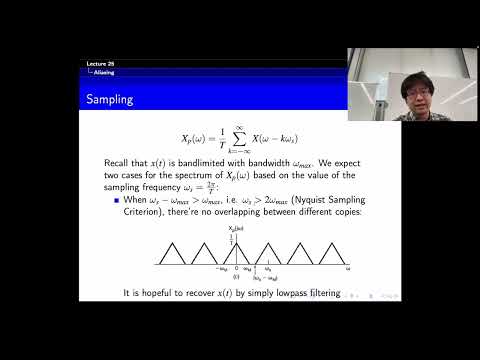
- Model sampling by multiplying the signal by an impulse train with sampling period Ts; its Fourier transform is another impulse train.
- Convolving the original spectrum with the impulse train creates repeated spectral copies spaced by the sampling frequency fs.
- A low-pass filter can recover the original spectrum only when adjacent copies do not overlap, requiring fs greater than 2B.
- If fs is below the Nyquist rate, spectral copies overlap and cause aliasing that cannot be undone by ordinary filtering.
- An anti-aliasing filter limits input bandwidth before sampling, but removes high-frequency detail; optical anti-aliasing can make camera images slightly blurry.
- Represent each sample as Gk = G(kTs); ideal reconstruction sums weighted sinc pulses centered at each sample time.
- Sinc interpolation gives exact recovery for a properly band-limited signal sampled above the Nyquist rate.
- The sinc pulse has infinite duration and extends into negative time, making it impossible to implement exactly and noncausal without delay.
- Replace each sample's ideal sinc pulse with a practical pulse shape p(t), producing a sum of shifted, sample-weighted pulses.
- A finite pulse can be implemented, while additional signal processing can compensate for its reconstruction distortion.
- Connecting neighboring sample points provides an intuitive approximation when ideal sinc reconstruction is unavailable.
- A triangular pulse with width Ts and unit peak connects adjacent samples, forming a linear interpolator or first-order hold.
- The triangular shape reproduces straight-line segments between sample values but does not recover the original signal exactly.
- Corners in the piecewise-linear output introduce abrupt slope changes and additional high-frequency components.
- A rectangular pulse held for one sampling period produces the familiar digital-to-analog zero-order hold output.
- The zero-order hold is causal and keeps each sample value constant until the next sample arrives.
- Its sudden jumps at sample boundaries generate high-frequency components, making its spectral behavior less smooth than triangular interpolation.
- Use a rectangular pulse of duration Tp much smaller than Ts, creating narrow pulses at the sample times.
- In frequency, the narrow time-domain pulse has a wide sinc-shaped response; sampling still creates spectral copies spaced by fs.
- A low-pass filter removes the extra copies, leaving the desired baseband spectrum multiplied by the pulse response and scaled by 1/Ts.
- Within the signal band, where |f| is less than B, choose the equalizer response to compensate for the pulse spectrum, with a factor Ts/P(f).
- Set the reconstruction filter to zero beyond the nearest replica, beginning at fs minus B, to reject unwanted copies.
- The region between B and fs minus B contains no signal energy, so its filter response can be chosen flexibly; a time delay can also help make the filter causal.
- For a band-limited channel of bandwidth B, Nyquist sampling requires at least 2B samples per second.
- Digital communication can express a transmission rate in bits per second by assigning a number of binary digits to each sample.
- The lecture introduces maximum information rate for band-limited channels and defers the detailed calculation to the next lecture.
Transcript excerpt
0:04 Okay, let's get started. Uh let's review what we covered in our last lecture. Uh in our last lecture, uh we start talking about uh the digital communication, right? And uh we focus on sampling and aliasing. So yeah when we talk about sampling here so we assume that the signal uh or our transmitted signal G of T uh that is a band limited signal. Okay so we have a fixed bandwidth of B right so basically it means that all the signal outside of this bandwidth is basically zero. Okay. And uh then uh what we want to analyze is uh this kind of signal, right? So we use a impulse train, right? And uh we
0:53 use our original signal, modify the impulse train and then to get our uh sample signal. Okay. So the reason that we do this is the ease for the mathematical analysis, right? And later on, so we're going to see that in practice. So there's no way to do the this kind of sampling, right? because there's no way that we can make this u infinitely infinitely narrow narrow right therefore you know we you know there will be we're going to analyze in a different way right so those this is just for the ease of analysis okay and um so basically after this modification so this this is just a time domain signal right and uh so we cannot see a match from the time domain so we're going to see the signal from the frequency domain right and in the frequency domain the signal look like
1:41 this right so basically we have our original signal convolutes with uh this guy right which is the for transform of the impulse train okay and uh so here is the analysis so basically what we do
This is the start of the transcript. Save this video free for the whole transcript, searchable and time-coded.
In this course
Related notes
Summary, takeaways, and chapters were generated by AI from the video's transcript and may contain errors. The video belongs to its creator, Mingyue Ji.