EEL4514C Communication Systems and Components, Fall 2026, Lecture 31
Overview
Mingyue Ji derives power spectral densities for line-coded digital signals by modeling the transmitted waveform as a symbol sequence convolved with a pulse shape, then using the symbol autocorrelation. For equiprobable independent bits, bipolar NRZ produces a sinc-squared spectrum without a DC impulse, while unipolar NRZ (OOK) adds a DC spectral line; the lecture closes by setting up, but not completing, the unipolar RZ calculation.
Key takeaways
- For independent, equiprobable bipolar NRZ symbols coded as +1 and −1, the mean is zero and all nonzero-lag autocorrelations vanish, yielding an A²Tᵦ sinc-squared PSD without a DC impulse.
- Unipolar NRZ OOK symbols coded as 1 and 0 have mean 1/2, so their nonzero-lag autocorrelation is 1/4 and their PSD includes a DC impulse in addition to its continuous sinc-squared component.
- A line-coded waveform's PSD separates into the symbol-sequence PSD and the pulse-shape factor: Sᵧ(f) = Sₓ(f)|P(f)|².
- The bit period Tᵦ sets the rectangular NRZ spectral nulls at f = n/Tᵦ for nonzero integers n.
- Manchester coding improves timing recovery by creating a mid-bit transition, but its narrower pulses require more bandwidth and more complex implementation than NRZ.
- For unipolar RZ, changing the pulse width from Tᵦ to Tᵦ/2 changes the pulse spectrum, while the OOK symbol statistics remain unchanged.
Chapters
- Line coding maps binary 0s and 1s to distinct pulse shapes, including unipolar and bipolar NRZ and RZ variants.
- Long runs of identical NRZ bits make timing synchronization difficult; Manchester coding adds a mid-bit transition to help recover timing.
- Manchester requires more bandwidth and more complex signaling than NRZ, while RZ uses a pulse shorter than the bit period and therefore has wider bandwidth than NRZ.
- With equally likely bits, bipolar coding can eliminate the average DC component, unlike unipolar coding.
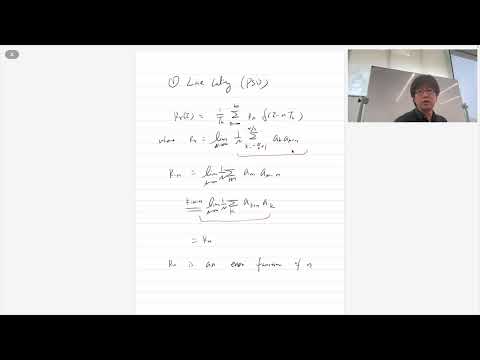
- The baseband waveform is modeled as a weighted pulse train, with symbols Aₖ spaced by the bit period Tᵦ and pulse shape p(t).
- Equivalently, the symbol sequence is filtered by the pulse shape; the output spectrum is Sᵧ(f) = Sₓ(f)|P(f)|².
- The pulse transform is straightforward for a rectangular pulse, but finding the symbol-sequence PSD Sₓ(f) requires its autocorrelation.
- The sequence autocorrelation Rₙ is the long-run average product of Aₖ and Aₖ₊ₙ.
- Changing the summation index shows R₋ₙ = Rₙ, so the autocorrelation is even in the lag.
- The continuous-time autocorrelation is a weighted impulse train, Rₓ(τ) = (1/Tᵦ)ΣₙRₙδ(τ − nTᵦ).
- Fourier transforming this impulse train gives Sₓ(f); calculating Rₙ from the symbol statistics is the key step.
- The derivation assumes information bits Uₖ are independent and identically distributed Bernoulli(1/2), so each bit value has probability 1/2.
- For bipolar NRZ, Uₖ = 1 maps to Aₖ = +1 and Uₖ = 0 maps to Aₖ = −1, with pulse amplitude carried by the pulse shape.
- The resulting bipolar symbols are independent, equally likely +1 and −1 values, which makes their mean zero.
- For equiprobable bipolar symbols, E[Aₖ] = 0 and E[Aₖ²] = 1.
- Independence makes cross-correlations zero for nonzero lag, so R₀ = 1 and Rₙ = 0 when n ≠ 0.
- The symbol-sequence PSD is therefore flat at 1/Tᵦ; filtering by a rectangular NRZ pulse gives an A²Tᵦ sinc²(πfTᵦ) spectrum.
- The sinc-squared spectrum has nulls at nonzero integer multiples of 1/Tᵦ and no DC impulse.
- Unipolar NRZ, also called on-off keying (OOK), maps Uₖ = 1 to Aₖ = 1 and Uₖ = 0 to Aₖ = 0.
- With equiprobable bits, E[Aₖ] = 1/2 and E[Aₖ²] = 1/2.
- For distinct symbol times, independence gives E[AₖAₗ] = E[Aₖ]E[Aₗ] = 1/4, unlike bipolar NRZ's zero cross-correlation.
- The OOK autocorrelation is R₀ = 1/2 at zero lag and Rₙ = 1/4 for every nonzero lag.
- Separating the zero-lag term rewrites the autocorrelation as a periodic impulse train plus an additional impulse at τ = 0.
- Fourier transformation produces a continuous component and spectral impulses at integer multiples of 1/Tᵦ.
- Multiplying the OOK sequence PSD by the rectangular-pulse spectrum gives a sinc-squared continuous component plus discrete spectral lines.
- The pulse spectrum is zero at nonzero integer multiples of 1/Tᵦ, so the nonzero-frequency impulses in the line train are suppressed.
- A DC impulse remains, with weight A²Tᵦ/4 in the lecture's normalization, reflecting OOK's nonzero mean.
- Compared with bipolar NRZ, OOK's extra DC component carries no changing information and represents a power cost.
- Unipolar RZ returns to zero within each bit period, using a rectangular pulse of duration Tᵦ/2 rather than Tᵦ.
- The shorter pulse changes the pulse-spectrum factor to one based on Tᵦ/2, while the symbol autocorrelation follows the same OOK statistics.
- Mingyue Ji leaves the unipolar RZ PSD calculation for the next lecture; digital-signal detection in noise is announced in the agenda but not covered here.
Transcript excerpt
0:03 Let's get started. So, let's review what we covered in our last lecture. Uh in the last lecture, we focused on the line coding, okay? And uh so here's a a review of what line coding is. So basically, uh we assume that we're transmitting a binary zero and one sequences. The idea is that we map zero to one waveform and uh one to another waveform or we call that um a pulse pulse shape. Okay? And we have two broad classes of this approach. So the first one is called narrow return to zero and the other one is called return to zero code, okay? And for narrow return to zero code and also for the return to zero code, we have two cases to consider. So one case is unipolar and the other one is bipolar. Right? For the unipolar one, basically we just have one amplitude and the other
0:50 one is zero, right? And for bipolar, so we have uh one negative and uh one positive and one negative, okay? And uh one disadvantage of the bipolar and unipolar NRZ is that so it it's difficult to deal with a long string of zero and ones, right? So if it's too long, then we may not be able to tell how many we're transmitting and it's also also difficult for the synchronization. Therefore, we introduced the Manchester code, right? So for Manchester code, so we give, you know, other than a square waveform, we give we give a different shape for the zero and ones, right? And then so uh it will be easier to distinguish how many ones and zeros are transmitting if we have a long string of ones and zeros, okay? and also it's also easier for synchronization. Okay.
1:37 And uh for the Manchester code compared
This is the start of the transcript. Save this video free for the whole transcript, searchable and time-coded.
In this course
Related notes
Summary, takeaways, and chapters were generated by AI from the video's transcript and may contain errors. The video belongs to its creator, Mingyue Ji.