EDF9850_Lecture3_Part2
Overview
Lesa Hoffman explains how multilevel models separate within-cluster, between-cluster, and contextual effects when person-level predictors also vary across clusters. She compares cluster mean centering, constant centering, and latent centering, showing how their coefficients and variance implications differ, with examples from 3,500-plus students in 191 schools and tools including R's lmerTest, glht, Mplus, and lavaan.
Key takeaways
- Cluster mean centering separates within-cluster deviations from cluster means, so the level-one coefficient estimates the within effect and the cluster-mean coefficient estimates the between effect.
- The contextual effect equals the between slope minus the within slope; including a constant-centered person predictor and its cluster mean estimates the within and contextual effects directly.
- In Hoffman's school example, the within verbal slope is about 2.423, the between slope is about 3.66, and the contextual effect is about 1.237.
- An uncentered or constant-centered level-one predictor alone can smoosh within and between relationships into one slope, often misrepresenting level-two effects even when its estimate resembles the within slope.
- Latent centering in multilevel SEM can account for unreliability in observed cluster means; Hoffman's Mplus example estimates a between effect of 4.2 compared with 3.66 using observed cluster means.
- Cluster-robust standard errors address dependence in uncertainty estimates but do not repair a misspecified, smooshed slope; centering and predictor specification still matter.
Chapters
- Subtracting each cluster's mean from a person-level predictor leaves only within-cluster relative information.
- The resulting level-one slope estimates whether people with higher X than their cluster peers also have higher Y.
- Adding the cluster mean as a level-two predictor estimates the between-cluster relationship and can explain random-intercept variance.
- The contextual effect is mathematically the between-cluster slope minus the within-cluster slope.
- It asks whether cluster composition adds an effect after controlling for a person's own predictor value, such as the effect of changing schools.
- With cluster mean centering, Hoffman says to estimate this effect indirectly as a linear combination; R's lmerTest contest1D and the glht function can test such combinations.
- When predictors are correlated, each regression coefficient represents that predictor's unique association with the outcome after accounting for the others.
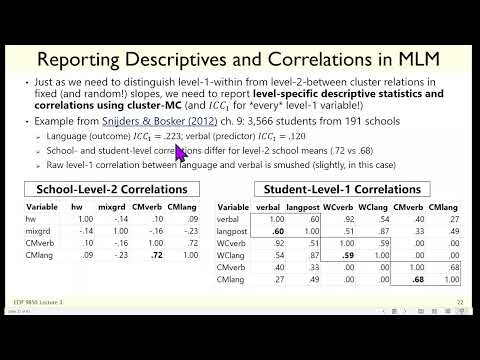
- Multilevel descriptives should distinguish within-cluster and between-cluster correlations and report an ICC for every level-one variable.
- In the school example, cluster-mean verbal and language scores correlate about .72, while their within-school versions correlate .59; the student-level correlation of .60 blends the two levels.
- For two clusters with scores 2 and 4 versus 6 and 8, the means are 3 and 7; subtracting each cluster mean yields within-cluster values of -1 and 1.
- Cluster mean centering makes the level-one predictor orthogonal to the cluster mean, so their slopes separately represent within and between effects.
- Centering each person's score at a constant such as 5 shifts values but preserves both within- and between-cluster variation, making the person-level predictor correlated with its cluster mean.
- With a constant-centered person-level predictor and its cluster mean both in the model, the person-level coefficient recovers the within effect.
- The cluster-mean coefficient becomes the contextual effect because it estimates the additional cluster association after controlling for the person's score.
- The contextual effect plus the within effect equals the between effect; in Hoffman's numerical example, 1.237 plus 2.423 is approximately 3.66.
- A model with only the constant-centered person-level predictor can smoosh within and between relationships into one slope, potentially misrepresenting the between effect.
- Hoffman's diagrams contrast a between slope of 1 and within slope of 0, producing a contextual effect of 1, with a case where between is 0 and within is 1, producing -1.
- In another example, a between effect of 2 and a within effect of 0.5 imply a contextual effect of 1.5.
- The algebraic equivalence shows that cluster mean centering directly estimates the between effect, while constant centering with the cluster mean directly estimates the contextual effect.
- A school-composition effect can differ sharply from a person-level effect, so reporting only the between slope may miss the incremental context association.
- Latent centering lets the model decompose predictor X into a level-two random intercept and a level-one residual, analogous to the outcome decomposition.
- Univariate mixed-model tools such as lme4 and SAS procedures require observed cluster means and deviations; multilevel structural equation modeling can estimate the decompositions jointly.
- In an Mplus example, the within slope is about 2.423, while the latent between effect is 4.2 rather than the observed-mean estimate of 3.66.
- The difference illustrates Lüdtke bias: treating observed cluster means as perfectly reliable ignores sampling error and shrinkage; latent approaches need adequate cluster counts and ICC signal.
- Cluster mean centering makes the level-one and level-two predictors represent distinct within and between information, so their coefficients remain interpretable when included separately or together.
- With constant centering, a level-one predictor alone assumes equal within and between effects; adding its cluster mean changes the level-two coefficient to the contextual effect.
- Within-cluster predictors can reduce level-one residual variance, and the multilevel adjustment can make estimated level-two random-intercept variance rise.
- Level-one interactions may retain between-cluster variation even when their inputs are centered; multiplying first and then centering is a proposed solution, but Hoffman notes evidence is not uniform.
- Constant centering is useful when the research question targets contextual effects, such as whether school composition matters after controlling for student characteristics.
- For binary predictors such as free-lunch status, cluster mean centering can replace 0 and 1 with less intuitive values such as plus or minus 0.5.
- If sampled students do not provide a reliable cluster mean, a more comprehensive external school or country measure may be preferable at level two.
- For random slopes, Hoffman recommends cluster mean or latent centering; constant centering can smoosh slope variation in a way that adding the cluster mean cannot readily fix.
- Fixed cluster effects add dummy variables, such as nine indicators for ten clusters, and suit small cluster counts or research focused on specific cluster differences.
- Random intercepts are useful when the goal is to explain why clusters differ; fixed effects are suited to estimating what those differences are.
- If only within-cluster relationships matter, centering both X and Y by cluster allows a single-level model of within-cluster variation.
- Cluster-robust standard errors adjust uncertainty for dependence but do not fix a smooshed slope estimate, so correct standard errors can still accompany the wrong effect.
- A person-level predictor with ICC below 1 can vary within clusters, and an ICC above 0 means it also contains between-cluster information.
- Hoffman summarizes three approaches: observed cluster mean centering, constant centering plus the cluster mean, and latent centering in multilevel SEM.
- The next topic is random slopes, where level-one effects vary across clusters and cross-level interactions can explain that variation.
- The course example includes more than 3,500 students across 191 schools, illustrating why level-specific effects and predictor variation must be modeled explicitly.
Transcript excerpt
0:01 Hello folks and welcome back to my home office where I'm very happy to be inside with air conditioning. I am here today to finish lecture three. I am approximately where the first part left off on slide 18 of lecture 3 in which we're reviewing what happens when we use cluster mean centering to set up the effects of level one predictors in our model. So the two kinds of slopes that cluster mean centering provides directly correspond to the kinds of variance that each predictor has. In cluster mean centering. Recall that we first subtract each individual clusters mean of the person level predictor. That way what is left at level one is only within cluster relative information. So once we put that new within cluster
0:49 predictor into the model, it answers the question, if I have a higher X relative to others in my cluster, do I also have a higher Y? If so, then to some extent, the level one person residual variance would be reduced. This is what the within cluster slope has to be for that level one predictor because that's the only information it contains only relative information relative to the cluster mean. So that means that the slope of this new variable is going to be the same regardless of whether the cluster mean of that corresponding variable is also included. And a note relative that's the key phrase here heading into the next portion of the lecture. The other piece of it then once we put in this cluster mean predictor centered
1:37 around a constant so that zero is meaningful. That answers the question as to whether if my cluster has a higher average value of this person predictor than other clusters. Does my cluster also have a higher outcome? If so, then
This is the start of the transcript. Save this video free for the whole transcript, searchable and time-coded.
In this course
Related notes
Summary, takeaways, and chapters were generated by AI from the video's transcript and may contain errors. The video belongs to its creator, Lesa Hoffman.