EAS4200 Aerospace Structures, Lecture 31, 2026 Fall
Overview
Ting Dong extends thin-walled closed-section torsion analysis to multi-cell structures, where each cell has its own shear flow but connected cells must share the same twist. The lecture sets up torque equilibrium and twist compatibility for a two-cell section, explains signed shear flow on the shared wall, and begins a rectangular-section calculation using centerline dimensions, varying wall thicknesses, and a specified unit twist.
Key takeaways
- A two-cell thin-walled section requires two unknown cell shear flows, so torque equilibrium must be supplemented by a compatibility equation.
- Connected cells must have equal twist, θ1 = θ2, just as bonded components in a composite shaft must rotate together.
- With counterclockwise flow positive in each cell, the shared-wall flow is q1 - q2 for cell 1 and q2 - q1 for cell 2.
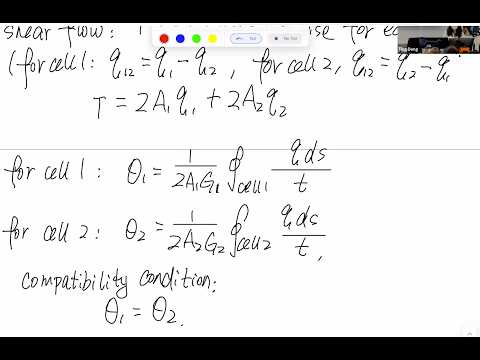
- The multi-cell torque relation is T = 2A1q1 + 2A2q2, where each area is enclosed by its cell's centerline.
- Variable wall thickness is handled segment by segment in the twist integral, using each segment's shear flow, length, and thickness.
- For the example, the centerline dimensions are 40 and 50, the right-side thickness is twice the left-side thickness, and the shared-wall thickness is 3; the calculation is started but not completed.
Chapters
- The prior lecture derived the closed-section relation between torque, enclosed centerline area, and constant shear flow: T = 2Aq.
- Shear modulus, twist, and the line integral of shear flow over wall thickness are used to calculate torsional deformation.
- The closed-section formulas accommodate variable wall thickness, unlike simplified constant-thickness examples.
- A wing airfoil may form multiple enclosed cells rather than one closed section.
- Metallic wings can use separate structural components, while composite layups may form an integrated multi-cell structure.
- The focus shifts to whether thin-walled multi-cell structures can withstand torsion-induced shear stress.
- A two-cell section has separate unknown constant shear flows, q1 and q2, so one torque-equilibrium equation is insufficient.
- Torque equilibrium is expressed as T = 2A1q1 + 2A2q2, with each cell's area measured along its centerline.
- The extra compatibility condition is equal rotation or twist for both cells, θ1 = θ2, because the joined structure cannot separate.
- Each cell's twist relation uses its area, shear modulus, and the integral of shear flow divided by local wall thickness.
- Counterclockwise shear flow is defined as positive for each cell.
- For cell 1, shared-wall flow is q1 - q2; for cell 2, the same wall contributes q2 - q1.
- The shared wall must be included in each cell's closed contour and twist integral, with the sign reversed according to contour direction.
- The example uses a two-cell rectangular cross-section with centerline dimensions of 40 and 50, avoiding thickness offsets in the area calculation.
- Wall thicknesses are labeled t1, t2, and t12; the right-side wall is specified as twice the left-side thickness, and the shared wall has thickness 3.
- Given material shear modulus and unit angle of twist, the tasks are to determine the applied torque and the section's torsional constant.
- Because the example supplies a unit twist rate, the two cell equations can be used to solve for q1 and q2 before calculating total torque.
- For cell 1, three outer wall segments with thickness t1 are grouped into one integral term.
- The shared-wall contribution uses q1 - q2 and its separate thickness t12, illustrating how direction and thickness enter the calculation.
- The worked calculation begins converting dimensions to meters and shear modulus to pascals, but no numerical torque or torsional constant is completed in the lecture.
Transcript excerpt
0:00 How was the quiz? >> It's great, right? Okay. Um, glad to hear that. So, let's continue for students in the back. Can you hear me? Okay, great. So, if anytime you cannot hear, um, just raise your hand. Um, I try to maximize the volume. Um so in the last class we talked about the close section and we derived the equation to how to uh calculate toal constant J for a closed section and what is a deformation. So this is equation for rotation and of
0:49 course if you have the uh gj theta and torque you can use that one to calculate the deformation also and this is for tsha constant j and all this equation you can use directly um including this equation from the mass materials it's basic equation and this is the equation we derived in the last class um she flow equal to torque Two area is area enclosed by the sheer flow or center line and uh we did the example that with uh circular cross-section uh open and close did a comparison of the toional constant or its rigidity um to rigidity and we also did example problem um with different thickness
1:40 of the same wall because our derivation at the beginning start um uh the t could change this t the thickness could change. So our uh all the equation we derived can be used for different thickness and actually in real life a lot of time the thickness they are different for optimization for minimum weight uh it's not necessarily always constant thickness like what you did in mcast material circuit crossction always the constant thickness so now uh we today I want to expand this one a little bit more because let's say um for f we consider is a uh single
This is the start of the transcript. Save this video free for the whole transcript, searchable and time-coded.
In this course
Related notes
Summary, takeaways, and chapters were generated by AI from the video's transcript and may contain errors. The video belongs to its creator, Ting Dong.