EAS4200 Aerospace Structures, Lecture 33, 2026 Fall
Overview
Ting Dong reviews shear flow in a thin-walled channel section, showing how flange and web shear-flow distributions follow from the first-moment equation and how signed coordinates preserve direction. The lecture then defines the shear center and derives its offset by balancing shear-flow torque, before outlining fatigue-quiz methods using Goodman correction and cycle-to-failure calculations.
Key takeaways
- For the channel example, shear flow starts at zero at a free flange edge, increases linearly along the flange, and enters the web at that flange's terminal value.
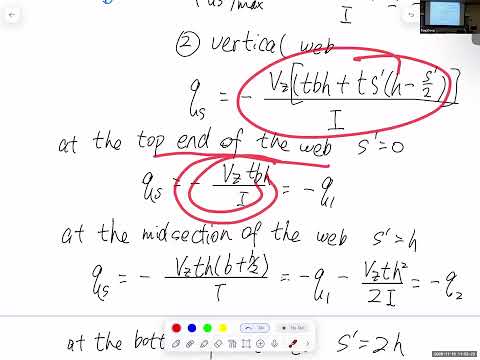
- The web shear-flow distribution is quadratic, and differentiating it locates the maximum magnitude at the web midpoint, s′ = h.
- Use signed centroid coordinates, not unsigned distances, in the shear-flow equation; the sign carries the physical flow direction.
- Changing the direction or origin of the wall coordinate changes the algebraic expression but not the shear-flow values at corresponding physical points.
- The shear center is the load application point for which transverse loading produces bending without twist; for a symmetric channel, it lies on the symmetry axis and may be outside the section.
- Fatigue calculations with tensile mean stress require Goodman correction before using the S-N curve, while fully reversed loading can be evaluated directly from that curve.
Chapters
- Ting Dong says final grades cannot be predicted while an exam worth 25%, a quiz, attendance, and homework remain ungraded.
- Students should confirm required passing grades with undergraduate advising because requirements can differ between aerospace and mechanical engineering majors.
- The possible grading-scale adjustment aims for 40% of students to earn an A if the unadjusted share is below that threshold; the current estimate is about 34% to 35%.
- For a top flange measured from its free edge, the cut area grows as thickness t times distance s, so shear flow starts at zero and increases linearly toward the web.
- At the web, the flange's terminal shear flow becomes the web's starting value rather than resetting to zero.
- Along the vertical web, the centroid coordinate varies as h minus half of s′, making the shear-flow expression quadratic in s′.
- Differentiating the web's quadratic shear-flow expression gives an extremum at s′ = h, the web midpoint.
- For the bottom flange, the centroid's z-coordinate is negative h; keeping that sign produces the correct shear-flow direction.
- A positive internal shear force makes the bottom-flange shear flow oppose the defined s-direction in the example, while reversing the force reverses the flow.
- Defining the bottom-flange coordinate from the opposite edge gives a different-looking linear expression, but its endpoint values still run from the web value to zero.
- The channel's shear-flow magnitude is linear on each flange and quadratic on the web, with the web maximum at its midpoint.
- Ting Dong recommends solving the full example without looking at the worked solution as preparation for Exam 3.
- For thin-walled calculations, the dimensions refer to wall centerlines, including flange width b and web height h.
- A transverse load away from the shear center causes both bending and twist; a load through the shear center bends the beam without twisting.
- For a cross-section symmetric about the stated axis, the shear center lies on that symmetry axis, though not necessarily within the material.
- A free-body diagram of the cantilever separates the applied transverse force from the wall's opposing reaction force and reaction shear flow.
- Taking moments about a convenient point on the web or flange makes the shear flows whose lines pass through that point have zero moment arm.
- Integrating the top-flange shear flow times its 2h moment arm gives the torque used to balance the force times its offset from the shear center.
- The resulting offset depends on cross-section geometry and inertia, not on the magnitude of the applied force.
- After calculating the offset magnitude, the direction is determined from the sense of the reaction shear-flow torque.
- For the downward-load example, the balancing force must be shifted to the left; shifting it right would add to the twist.
- The shear center can lie outside the channel section, so its position must be inferred from torque balance rather than assumed to be on the material.
- The quiz covers fully reversed loading and two nonzero-mean-stress cases, distinguishing compressive mean stress from tensile mean stress.
- For tensile mean stress, apply the Goodman equation to obtain an equivalent stress amplitude before reading cycles to failure from the S-N diagram.
- The rubric awards points for finding mean stress and amplitude, applying Goodman correction, calculating cycles for loading cases, and converting stress to force with F = σA.
Transcript excerpt
0:00 Post students in the back, can you hear me? Students in, okay, great. Thank you. Uh if anytime you cannot hear me, just raise your hand so I can see if there's anything I can adjust here. So I received some emails saying that today's the withdraw deadline. Um uh and ask me like what grade you can get from my class. Um I don't know [gasps] because we still have one exam which is 25 percent. Uh we have a quiz that not graded. We have some attendance grade that not in on campus yet. We have some homework that is not graded yet. So I cannot guarantee anyone that oh you will get a C in my class or you will get a D in my class. Uh I don't really know. So please do not ask me like oh um what grade I can get
0:49 so I can make a decision if I want to withdraw or not. I don't know. Uh we'll calculate we'll grade everything very strictly based on our grading rubric which is very reasonable. I um well based on the one we we have showed and the one we discussed with our TAs. Um and all your grade will be calculated based on our syllabus. So let's say homework 10 percent, exam 20 uh 75 percent, uh quiz 15 percent, attendance extra 3 percent. Um everything is based on the calculation. So I don't really know. And also some students ask like do do we really need a C or D to pass this class? Again, please please confirm with undergrad advising team. I don't really know.
1:35 Um because from what I I don't know the policy in our department but I from what I heard from students um is that it depend on which major you're
This is the start of the transcript. Save this video free for the whole transcript, searchable and time-coded.
In this course
Related notes
Summary, takeaways, and chapters were generated by AI from the video's transcript and may contain errors. The video belongs to its creator, Ting Dong.