EAS4200 Aerospace Structures, Lecture 3, 2026 Fall
Overview
Ting Dong introduces surface traction as force per unit area at a point on a plane, emphasizing that its value depends on the plane's unit normal even when the cut preserves the same external forces. The lecture develops vector notation, separates traction into normal and shear stress, and works through a 3D example yielding normal stress 5, shear stress 5, and a 45-degree angle; it also explains how to construct plane normals using direction cosines.
Key takeaways
- Surface traction at a point is still specific to a plane: changing the plane normal changes the traction even when the same external forces remain on the retained side of the cut.
- For a plane with unit normal n, normal stress is the projection t⁽ⁿ⁾ · n, while shear stress is the magnitude of the component perpendicular to n.
- For traction (3, 4, 5) on a plane with normal (0, 0, 1), the normal stress is 5, shear magnitude is 5, and the traction-to-normal angle is 45 degrees.
- A 3D unit normal can be built from its direction cosines, with components (cos α, cos β, cos γ) satisfying nx² + ny² + nz² = 1.
- For a unit vector equally angled to the X, Y, and Z axes, all three components are 1/√3, not 1/2.
Chapters
- Ting Dong directs students to the Canvas homepage playlist for recorded lectures, but says lecture notes are not normally posted.
- The stated goal of attending class is to distribute study effort across the semester rather than concentrating it before an exam.
- More than half the class reportedly had a conflict with the scheduled December 2 Exam 3; proposed alternatives were November 18, 19, and 17, pending department confirmation.
- The lecture shifts to structural failure topics, including static loading, fatigue, and shear flow, beginning with stress fundamentals.
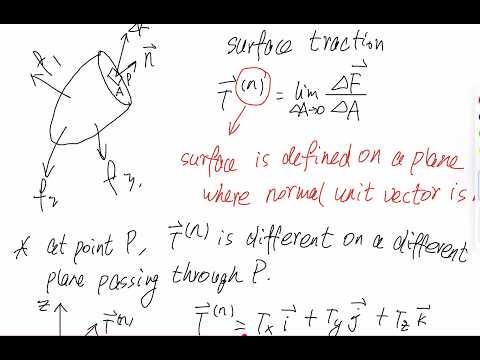
- For a general 3D structure, Dong considers a cut through the body and the forces acting on one side.
- A unit normal vector n identifies the orientation of the cutting plane: it has magnitude 1 and is perpendicular to the plane.
- At a small area around point P, surface traction is defined as force divided by area; taking the area toward zero gives traction at a point.
- Traction has stress units, such as newtons per square metre, or pascals.
- Rotating a cut through P changes its normal n and the area over which the same resultant force is distributed, so traction is plane-dependent.
- In XYZ coordinates, surface traction has components Tx, Ty, and Tz and can be written using the i, j, and k unit vectors.
- Its magnitude is √(Tx² + Ty² + Tz²), distinct from the direction of the plane normal.
- The traction vector is determined by force equilibrium and generally does not point along the plane's unit normal.
- The component of traction parallel to n is normal stress, calculated as σₙ = t⁽ⁿ⁾ · n.
- The component perpendicular to n lies in the plane and is the shear stress.
- The shear-stress magnitude follows from the right-triangle relation τ = √(|t⁽ⁿ⁾|² − σₙ²).
- For traction vector (3, 4, 5) and a plane parallel to the Z-axis, the example takes the plane normal as (0, 0, 1).
- The dot product gives normal stress σₙ = 5; the traction magnitude is √50.
- Subtracting the squared normal component gives shear-stress magnitude √(50 − 25) = 5.
- Since the normal component and shear magnitude are both 5, the angle between traction and the plane normal is 45 degrees.
- A 3D unit vector can be expressed through its direction cosines: n = (cos α, cos β, cos γ), for angles with the X, Y, and Z axes.
- The unit-length constraint is nx² + ny² + nz² = 1.
- A unit vector equally angled to all three axes has components (1/√3, 1/√3, 1/√3); a vector along Z is (0, 0, 1).
- Dong recaps the lecture's sequence: identify the plane normal, calculate surface traction components, then resolve them into normal and shear stress.
- Choosing the wrong unit normal can invalidate every later calculation, so the plane geometry must be established carefully.
- The class ends with a plan to continue on Friday; the recording includes brief conversation after the formal wrap-up.
Transcript excerpt
0:00 time class um time class. Uh so something asked me like after lecture notes so I don't upload lecture notes but I do post a recorded video. So if you check the canvas homepage and there is a playlist and I post all the recorded video there. So if somehow let's say you miss some part or anything like you don't have time to take the notes you can go back and check that one uh to complete your notes. But I normally don't post the um action now. Yeah. Oh, thank you for reminding me. Um is better now?
0:47 No. How about now? It's still now it's on. I don't know that How about now? Are you guys okay? Okay.
1:34 How about student in the back? Can you hear me? >> Yes or no? >> Okay. Okay. Great. So, if anytime you cannot hear me, just just raise your hand and let me know. Um stay quiet stay quiet. Um so so as I said uh I I don't uh post election note because uh based on observation whenever I post election note the attendance just like um um I'm not like criticizing anyone. It's just human nature posted and student feel like oh I don't really need to go to class anymore and then I can just read a lecture note right before the exam. Um, and I'll be great. Um, that's a common assumption. Um, and again, I'm not saying that you
2:22 have to come to the class to learn content. I'm just just want to distribute stress to each 50 minutes instead of studying right before the exam, the night before the exam. It's not good for your mental health and physical health. So, um, this is one of the strategy that you try to attend
This is the start of the transcript. Save this video free for the whole transcript, searchable and time-coded.
In this course
Related notes
Summary, takeaways, and chapters were generated by AI from the video's transcript and may contain errors. The video belongs to its creator, Ting Dong.